The Complete Guide to Modern Home Office Design

By Tereza Hower | Published May 6, 2026 | Updated October 13, 2026
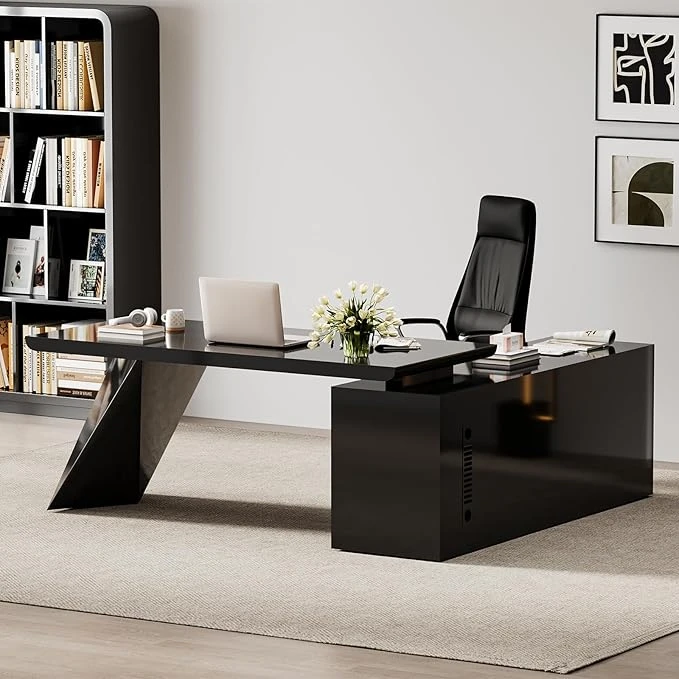
Most modern home office ideas stop at the desk and the chair, which is exactly where the real decisions begin. A room that works for nine hours a day is built from the things around those two pieces: where the desk faces, how many lamps are on, what the floor and the windows are made of, and whether the cables have somewhere to go. Get those right and almost any decent desk looks intentional. Get them wrong and the most beautiful desk in the catalog reads as a workstation parked in a spare room.
Start with orientation, because it is the one decision that cannot be fixed with a purchase later. Desk facing the window is the layout I use and the one I recommend to anyone who spends more than two hours a day on screen. Everything else in this guide, from the depth of the desktop to the color temperature of the bulbs, follows from that first call.
This guide covers what a modern home office means as a room rather than a desk, the order to plan it in, the three layouts that hold up after a year of use, how to choose a desk and a chair without compromising either, the lighting that quietly lifts everything else, what each tier of the room costs, and the five style directions worth knowing if you want a workspace that reads as part of the house rather than an outpost of an old corporate office.
Key Takeaways
- Build the room in three layers: bones (desk, chair, storage), atmosphere (lighting, rug, curtains), and personality (art and a few real objects).
- Plan the desk first because it fixes the layout, but spend the larger share of the budget on the chair.
- Use three light sources at one color temperature, never a single overhead fixture.
- Solve acoustics with soft layered material: a natural fiber rug, lined curtains, and an upholstered chair remove most of the echo on calls.
- Choose the style direction that already lives in the rest of the house so the office reads as a continuation, not a separate world.
Table of Contents
- What Modern Home Office Ideas Actually Mean
- How Do You Plan a Modern Home Office in the Right Order?
- Which Layout Works Best for Most People?
- How to Choose the Right Desk
- Why the Chair Is Where Most People Compromise Too Much
- Why Lighting Is the Single Biggest Upgrade
- Storage: Hide What You Use, Show What You Love
- Color, Texture, and the Acoustics Nobody Mentions
- Which Style Fits Your Home?
- What Does a Modern Home Office Cost?
- What Are the Most Common Modern Home Office Mistakes?
- Tradeoffs Worth Thinking Through
What Modern Home Office Ideas Actually Mean
A modern home office is a room or zone designed for focused daily work that reads as part of the rest of the home and is built to last as long as any other room in the house. Modern, or contemporary, is not a style label here; it describes how the room is conceived, as a long term piece of the home rather than a stopgap. A Japandi office and an industrial office are both modern home offices in this sense.
Most underwhelming offices skip from the desk straight to decor and never address the connective tissue in between, so the useful way to think about the room is in three layers. The bones are the desk, the chair, and the storage. The atmosphere is the lighting, the rug, the curtains, and the color on the walls. The personality is the art, the objects on open shelves, and the few things on the desk worth looking at.
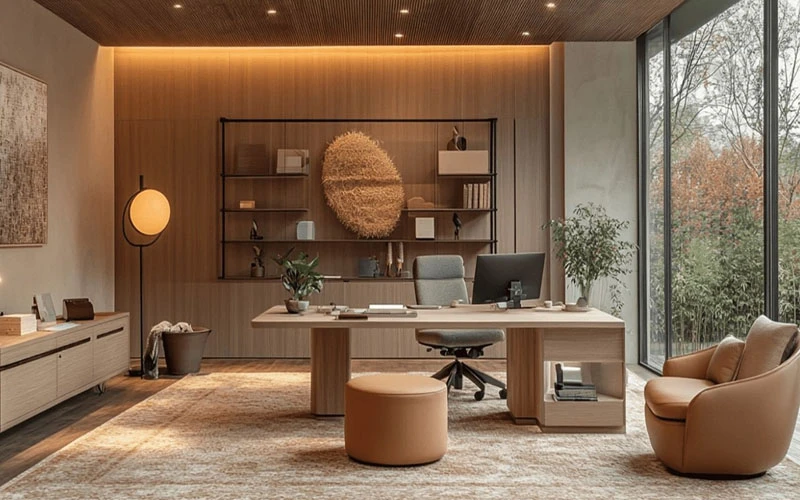
When all three layers are present, the room reads as designed. When any one is missing, it reads as a workstation. Modern home office ideas worth keeping work on all three layers in parallel rather than treating decor as a finishing coat applied after the furniture arrives.
How Do You Plan a Modern Home Office in the Right Order?
Sequence matters here: desk first, chair second, credenza third, lighting fourth, rug fifth, and everything else after. The sequence matters because each piece constrains the next. The desk fixes the layout and the visual mass of the room, the chair has to fit under and beside it, the credenza has to fit the wall that is left, and the lighting has to reach all three.
Planning the desk first is not the same as spending on it first. Decide its position, depth, and footprint before anything else, then put the larger share of the money into the chair, which is the piece the body touches for the whole working day. Rooms planned the other way around, chair bought on a whim and desk squeezed in afterward, end up with a desk that is too shallow for the monitor and a chair that does not slide under it. Deciding which wall you face at the start is also central to modern minimalist office design, where it determines the desk’s location and the room’s proportions.
Rug and art come last on purpose. Both are cheap to change and both look wrong when chosen before the furniture footprint is known. A rug sized for an empty room is almost always too small once the desk and chair sit on it; the front legs of the chair should stay on the rug when pushed back. The modern home office furniture essentials guide walks through the desk, chair, and storage decisions piece by piece.
Which Layout Works Best for Most People?
There are more layout options than the standard advice suggests, but in practice three of them work consistently across small rooms, shared rooms, and dedicated spaces. The right one depends less on square footage than on what happens behind that desk for most of the day.
1. Desk facing the window
The layout recommended at the top of this guide, and the default for anyone on screen most of the day. The eyes get natural reference light, the room feels larger because the depth of the view extends past the desk, and there is no glare fight on the monitor the way there is with a window at your back. Lined linen curtains cut harsh midday sun without losing the ambient daylight that keeps the room from feeling like a basement at four in the afternoon.
2. Desk against a wall, monitor at eye level
The classic, and the right answer if the room has no good window orientation or if the window faces a wall close enough that direct sun is constant. The wall behind the desk becomes the visual anchor of the room, so treat it as one. A single piece of art the width of the desk, or a low run of floating shelves, reads better than a scatter of small frames.
3. Desk floating in the room
Used well, this is the most generous layout because it lets the room breathe on all four sides. Used badly, it leaves the desk adrift with no anchor and a tangle of cables visible from every angle. It works with at least 11 by 11 feet of floor, a desk with a finished back panel, and a plan for the cables before the desk is bought.
If the room has a strong architectural feature such as a fireplace, a bay window, or a vaulted ceiling, that feature should set the orientation of the desk before any of these layouts do. The room tells you what it wants if you let it.
How to Choose the Right Desk
The desk is the single largest visual mass in the room, which means the wrong one fights the rest of the house for years. Three decisions matter more than the rest: depth, material, and base.
Depth is where most people get it wrong. A 24 inch deep top feels cramped the moment a laptop, a monitor, and a coffee cup share it. Twenty eight to thirty inches is the range to buy in, and a second monitor or longhand writing pushes it to thirty two. Width matters less than depth because people spread sideways long before they run out of room front to back.
For material, solid wood ages well, looks correct in almost every style direction, and forgives the inevitable scratches better than veneer or laminate. White oak reads light and Scandinavian, walnut reads warmer and more mid century, and ash sits between the two. For an industrial direction, a solid wood top on a powder coated black steel base is the cleanest version of that look without tipping into barn wood. The Scandinavian furniture guide covers how the light wood species set the tone of a room.
The base decides the visual weight of the room. A trestle base or thin tapered legs keep the floor visible underneath, which makes the room feel larger and lighter. A solid panel base, drawers to the floor, or a heavy plinth grounds the room but eats visual space. In a room under 120 square feet, choose the lighter base; the minimalist desks roundup sorts the seven types worth buying by exactly this trade.
One contrarian note on finishes: an oiled wood top looks better after a year than a lacquered one. Oil shows age as patina; lacquer shows age as scratches. Anyone who cannot stand a single mark on the surface should choose a stone or linoleum top instead and skip the gloss lacquered wood that looks immaculate on day one and tired by month nine.
Why the Chair Is Where Most People Compromise Too Much
If the budget is split between desk and chair, put more of it into the chair. This is rarely the advice people want, because the desk is the piece they see. But the chair is the piece the body touches for six to nine hours a day, and a desk bought to look beautiful loses its shine the week the lower back starts to hurt.
The trade here is between a true ergonomic task chair and a chair that looks like part of the home. For years those two categories did not overlap; they do now. Herman Miller, Steelcase, and Humanscale all make ergonomic chairs in soft neutral colorways that read more residential than corporate. Below that price, look for a fully adjustable chair with a real lumbar mechanism, breathable upholstery, and arms that move in three directions, and skip anything that calls itself ergonomic but only adjusts height.
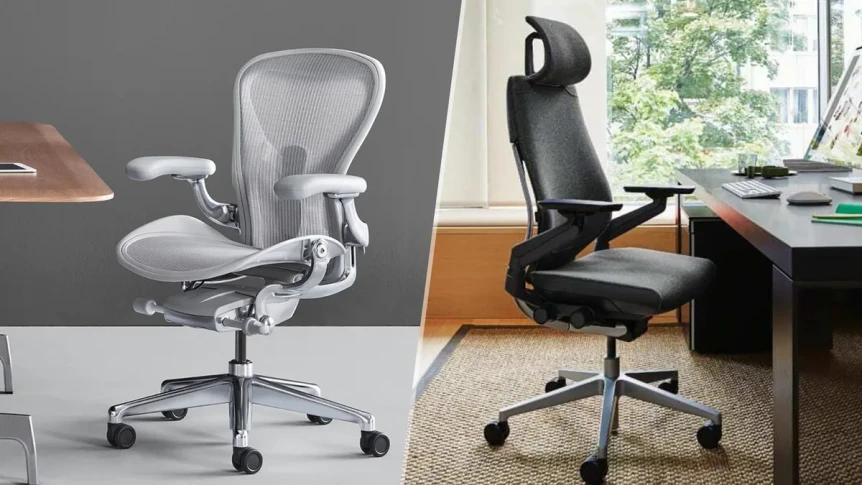
One contrarian note: a beautiful wooden chair, the kind that photographs well on a mood board, is a poor primary chair for full time work. Keep it nearby as a reading chair or for the occasional short session, and use a real task chair for the bulk of the day. The difference shows up in the back within five years.
The other compromise is upholstery. Mesh chairs cool well but tend to read as office equipment in a home setting. Fabric upholstery in a warm neutral, with a real lumbar mechanism underneath, splits the difference: it looks like part of the room and still adjusts the way a back needs it to.
Why Lighting Is the Single Biggest Upgrade
Most home offices have one overhead fixture and a desk lamp. That is not enough. The room needs three layers of light to look correct at every hour of the working day: ambient overhead, task light at the desk, and a third source somewhere else in the room to balance the shadows.
The third layer is the one people skip and the one that gives a home office away as unfinished the moment you walk in. A small table lamp on a credenza, a floor lamp behind the chair, or a wall sconce above a shelf will all do the job. The point is to break the single overhead source and give the room dimension.
For desk lamps, look for an adjustable arm, a warm bulb in the 2700 to 3000 Kelvin range, and a shade that directs light onto the work surface rather than into the eyes. A single overhead fixture, however warm its bulb, makes faces look tired on camera by three in the afternoon, and two lamps at desk height fix it. The modern home office lighting guide goes deeper on fixtures, placement, and bulbs for a workspace.
One overlooked detail: color temperature consistency across all three sources matters more than the individual fixtures. A 2700 Kelvin desk lamp paired with a 4000 Kelvin overhead reads as two separate rooms colliding. Match the bulbs across fixtures and the room feels coherent before anyone notices why.
Storage: Hide What You Use, Show What You Love
The rule is simple. Hide the things used daily, because their daily appearance becomes visual clutter. Show the things loved and rarely touched, because they earn their place by adding personality without adding noise.
Translated into furniture, that means a closed credenza or a low cabinet for cables, chargers, printer, files, and the snacks nobody wants on camera. Then open shelving above or beside it for books, ceramics, framed art, and a few objects with a story. The proportions matter: aim for roughly two thirds closed storage to one third open display in any room under 150 square feet. In larger rooms the ratio can flip.
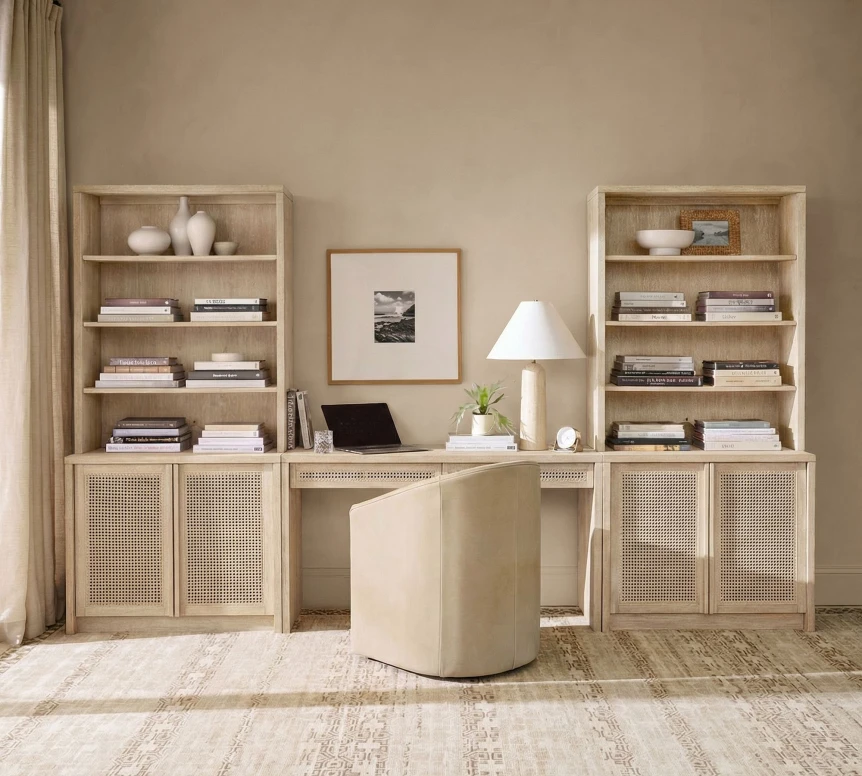
With wall space for only one piece of storage furniture, choose a low credenza over a tall bookcase. The lower piece keeps the room feeling open, gives a surface to style with a lamp and a few objects, and provides the closed storage the room actually needs. The sideboard buying guide is the closest cousin for judging the construction.
What to keep off the open shelves: anything plastic with a logo on it, anything replaced more than once a year, and any stack of three or more identical items. Shelves earn their visual weight by holding objects with edges, materials, and stories. Loose office supplies belong behind a door.
Color, Texture, and the Acoustics Nobody Mentions
Wall color in a home office should support focus, not perform for a camera. The cleanest direction is a warm white or a soft greige that reflects daylight without going cold. Benjamin Moore’s White Dove, Farrow and Ball’s Strong White, and Sherwin Williams’s Accessible Beige all work as foundational walls, and the modern paint colors guide covers how to test them in the room’s actual light. For more depth, a muted sage, a clay pink, or a warm bone reads sophisticated and easy on the eye over long sessions.
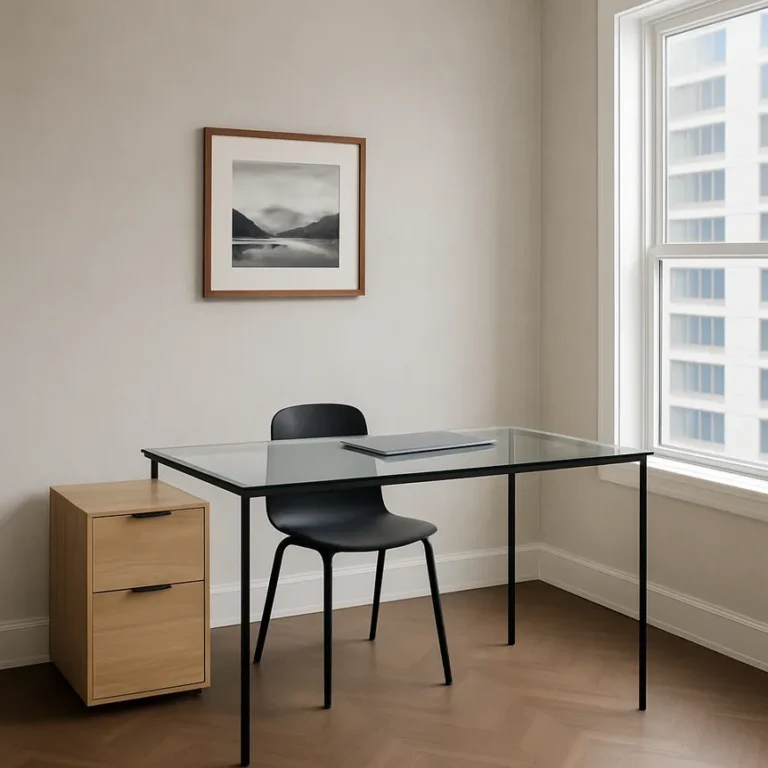
Color and texture together solve a problem most people do not know they have: acoustics. Hard surfaces bounce sound, so a small room with bare floors, a glass desk, and uncurtained windows makes a voice sound tinny on every call and feeds the microphone every echo. The fix is layered, soft material.
A natural fiber rug, lined curtains in linen or wool, a fabric upholstered chair, and a wool throw across the back of it together kill most of the echo. Each piece on its own is a modest improvement; all four together change how the room sounds to everyone on the other end of the call.
The warm neutral palettes that the broader design world has moved toward translate cleanly to a workspace because they were built for rooms people spend hours in. The minimalist color palettes overview covers the underlying logic and the specific combinations that hold up.
Which Style Fits Your Home?
A home office should read like a continuation of the house, not a different building. If the living room is warm minimalist and the office is moody industrial, every walk between the two rooms carries a rupture. Pick the direction that lets the office feel like one more room rather than a separate world.
Five style directions are worth knowing. The table summarizes how they differ at a glance; the sections beneath go into the detail and point to the dedicated guide where one exists.
| Direction | Best for | Materials | Palette | Lighting feel |
|---|---|---|---|---|
| Japandi | Calm, focused daily work | Warm oak or ash, ceramic, linen, paper | Off white, soft greige, charcoal accent | Soft, layered, low glare |
| Minimalist | Discipline and restraint | Painted wood, lacquer, stone, mesh | White or near white with one accent | Sharp, sculptural, one statement fixture |
| Scandinavian | Small rooms and light starved spaces | Light oak, ash, wool, cotton | White, pale grey, soft tan | Bright ambient with one warm task lamp |
| Mid century modern | Personality with restraint | Walnut, brass, leather, bouclé | Warm neutrals with mustard, olive, or rust accent | Warm, directional, sculptural shades |
| Industrial | Lofts and exposed structure | Steel, reclaimed wood, leather, concrete | Concrete grey, black, oxidized brass | Bold statement fixture, bare bulb tolerated |
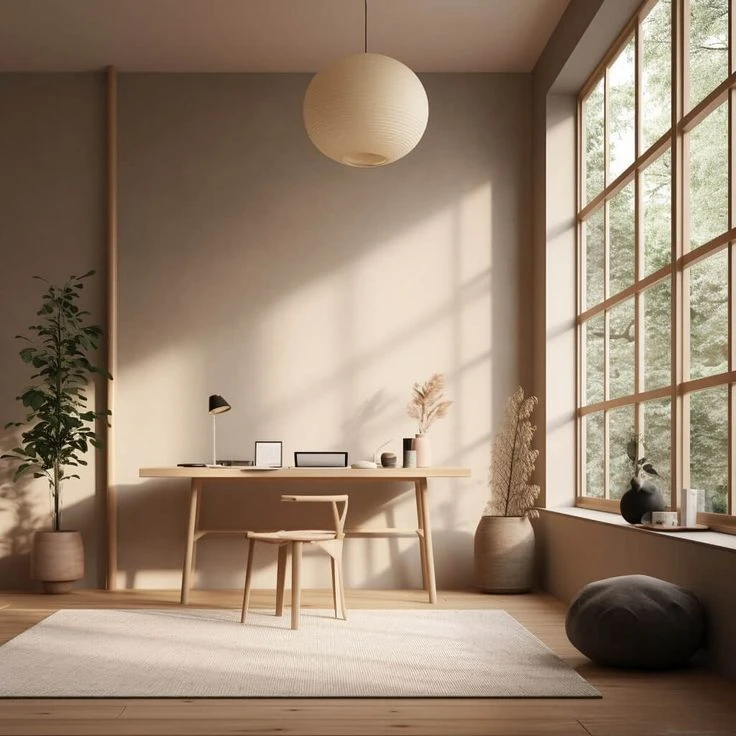
Japandi home office: quiet, warm, focused
The most popular direction for a reason. Natural light, warm wood, a restrained palette, and almost nothing on the desk that is not in use. It reads beautifully on camera and feels calm to sit in. The full breakdown is in Japandi home office ideas for focused, calm work, and Japandi office furniture covers what to buy piece by piece.
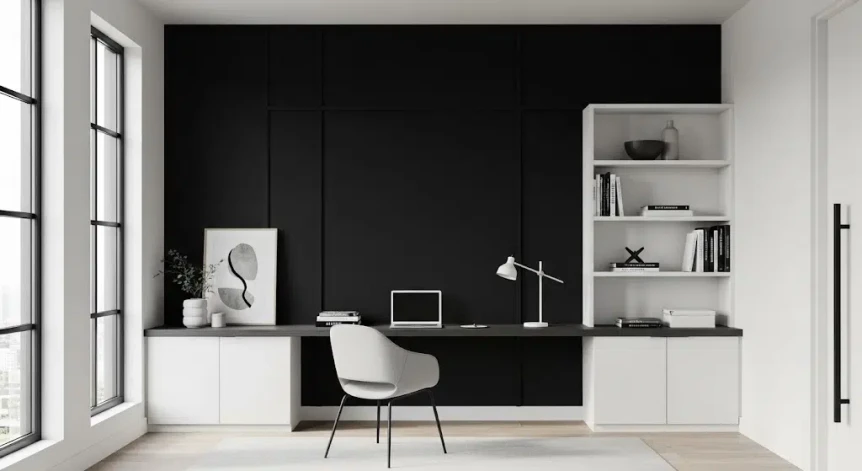
Minimalist home office: intentional, almost monastic
Pares the room down to the essentials and gives each piece room to breathe. It demands real discipline because every visible object becomes a statement. See minimalist home office ideas for the rules that keep it from feeling sterile.
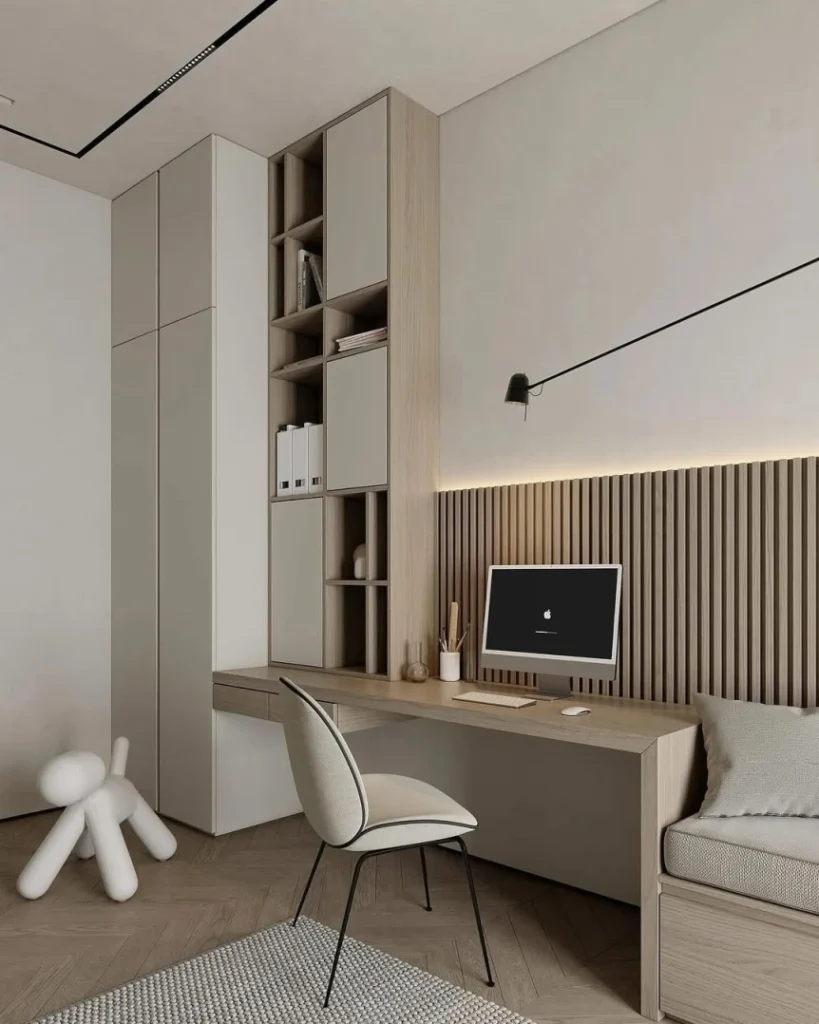
Scandinavian home office: light, practical, made for small spaces
The most forgiving direction for a small room. Light wood, white walls, a single piece of statement lighting, and enough texture to keep it from going cold. The complete guide to Scandinavian interior design covers the palette and material rules that carry into a workspace.
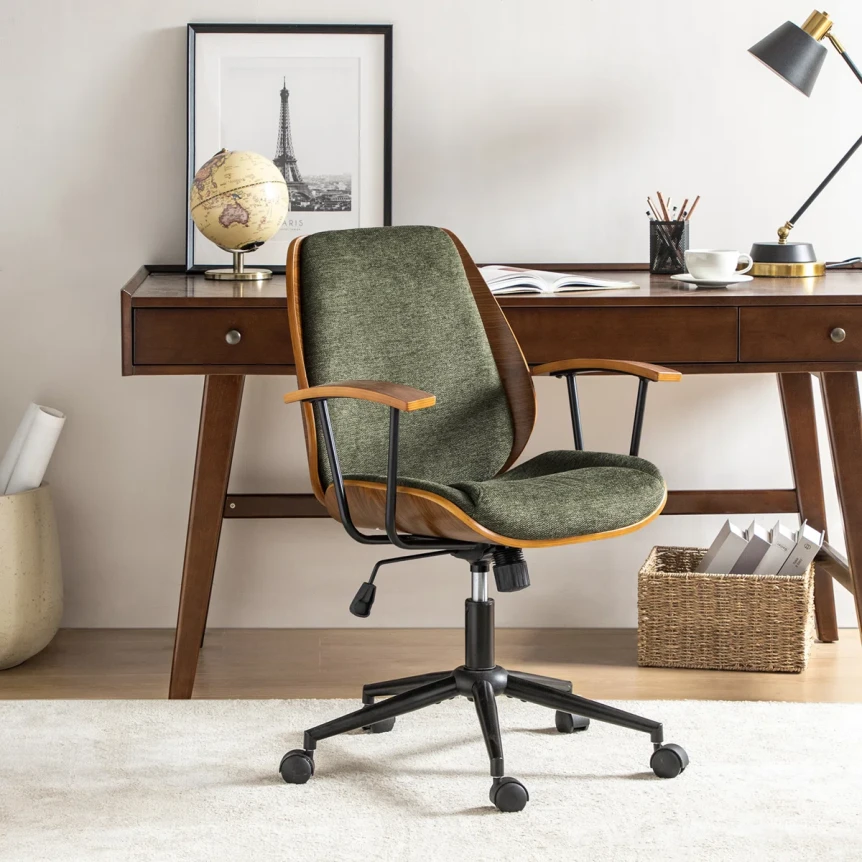
Mid century modern home office: warm wood and clean lines
If the house leans toward walnut, brass, and tapered legs, this is the direction to follow. Less austere than Japandi, more personality than minimalist. See the mid century modern home office guide for the specifics on chairs, lighting, and desk silhouettes.
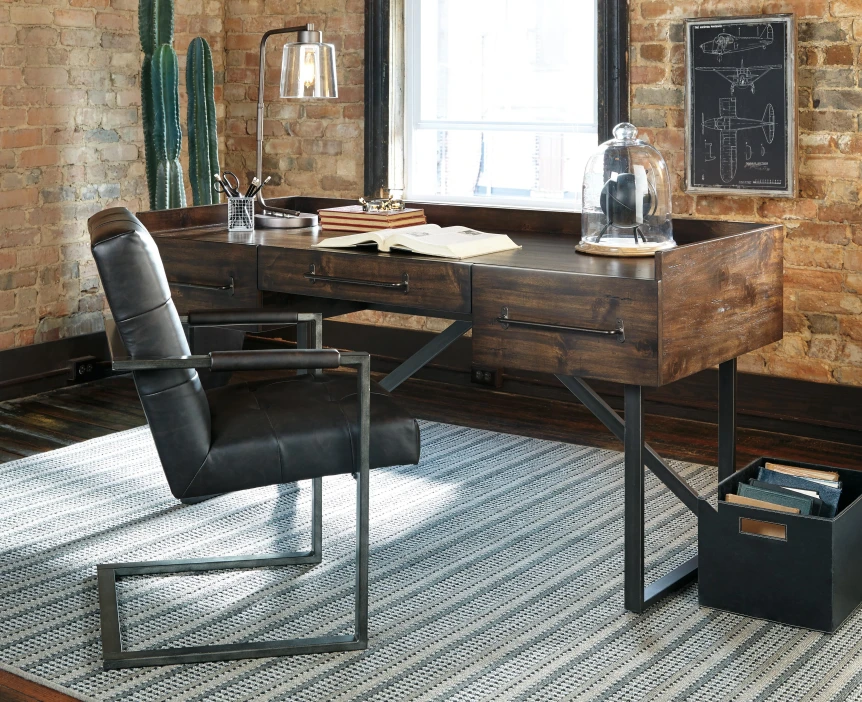
Industrial home office: raw materials, bold lighting
For lofts, exposed brick, and homes with a stronger industrial backbone. Steel and wood, leather, and a real piece of statement lighting. The complete guide to industrial interior design sets out the material rules that keep the look from tipping into theme.
What Does a Modern Home Office Cost?
A workable split is roughly half the budget on the chair, a third on the desk, and the rest across lighting, rug, and storage. The table sets out what each piece costs at the tier that lasts a year or two against the tier that lasts a decade, and what the extra money actually buys.
| Piece | Starter tier | Lasting tier | What the extra buys |
|---|---|---|---|
| Task chair | $150 to $300 | $600 to $800 used, $1,200 and up new | A real lumbar mechanism, arms that adjust three ways, upholstery that survives daily use |
| Desk | $150 to $400 | $800 to $2,000 | Solid wood top at 28 to 32 inches deep, a base that does not wobble, a finish that can be repaired |
| Credenza or closed storage | $150 to $300 | $500 to $1,200 | Plywood or solid construction, metal drawer slides, adjustable hinges |
| Lighting (three sources) | $80 to $150 | $250 to $500 | Adjustable task arm, matched bulbs, a third fixture that reads as furniture |
| Rug | $80 to $150 | $200 to $400 | Natural fiber, a size the chair can roll on, real acoustic damping |
Everything in the starter column will work for a while. The difference is what happens in year two: a starter chair loses its lumbar support, a laminate desktop chips at the edge where the wrists rest, and a thin rug curls where the chair rolls. The lasting tier costs three to four times as much and is the point at which the pieces stop being replacement candidates.
Where to save: the rug and the third lamp can come from the starter column with no real penalty, and a used ergonomic chair from a reputable maker is often the best value in the whole room. Where not to save: the chair mechanism and the desk depth. Both are the errors that cost the most to undo.
What Are the Most Common Modern Home Office Mistakes?
After more than ten years of curating home furniture, the same handful of mistakes turn up in workspaces again and again. None are catastrophic. All are fixable, and most cost less to avoid than to remedy.
- Spending the budget on the desk before the chair. Plan the desk first, but fund the chair first. The chair sets the price floor of the room.
- Skipping the third lamp. Two sources are not enough. Three is the threshold where the room starts to look like a designed space rather than a workstation.
- Placing the desk in the darkest corner. Even with task lighting, the lack of ambient daylight quietly wears people down. Move the desk if the room allows it.
- Treating cable management as an afterthought. A cable tray under the desk, a grommet hole in the top, and a power strip mounted to the underside solve most of the problem.
- Choosing a desk too narrow for the room. A 48 inch desk on a 12 foot wall looks lost. Aim for at least sixty percent of the wall width.
- Hanging art too high. The center of any piece above a desk should sit roughly 58 inches from the floor, not above standing eye level.
- Mixing color temperatures across bulbs. One warm desk lamp and one cool overhead make the room read as unfinished. Pick one temperature in the 2700 to 3000 Kelvin range and use it in every fixture.
Tradeoffs Worth Thinking Through
Every home office is a series of trades. Naming them in advance keeps a buyer from accidentally choosing the option that looks great in photos and feels wrong by month three.
Standing desk versus fixed height
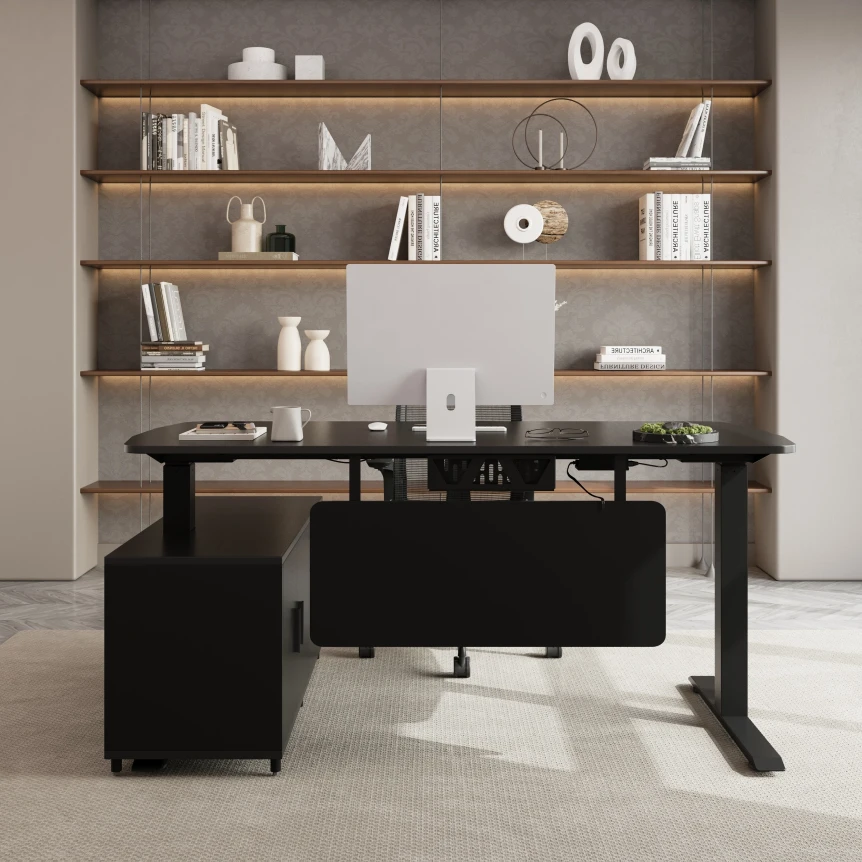
A height adjustable desk is the right answer for most people who work full time at a screen, and the wrong answer for anyone who values the look of a beautifully built fixed desk above the flexibility. The mechanical bases are functional but rarely beautiful. For a height adjustable desk, choose a base with thin profile motors and a solid wood top to hide the engineering; for a fixed desk, choose a chair that allows posture to shift across the day.
Closed door office versus open zone
A door is worth more than a beautiful office without one. Given the choice between a small dedicated room with a door and a larger zone carved out of an open plan, choose the door every time. Calls, focus, and the simple act of closing work for the day all benefit.
Performance versus aesthetics for the chair
No chair is both a perfect ergonomic match and a perfect aesthetic match. Pick performance first, then the closest aesthetic match within that. The reverse choice ends in a beautiful chair replaced within eighteen months.
Built in versus freestanding
Built in cabinetry looks intentional and uses every inch of the room, but it ties the house to that exact configuration for good. Freestanding furniture is less efficient on square footage but moves with you and adapts as the work itself changes. Renters and anyone expecting to move within five years should default to freestanding; owners with a room genuinely fixed in purpose can justify the built in commitment.
Where to Go From Here
If the room does not yet have a direction, start with the style guide closest to the rest of the house. Japandi is the most forgiving direction and the one most homes can absorb without a rupture; a house that is already mid century or industrial should follow that thread instead. The cluster guides go deeper than this pillar can on the specifics, and each stands on its own.
The most important thing is to make the decisions in the order that matters: desk position, then chair, then storage, then lighting, then everything else. Do that and the room stops being a workstation parked in a spare bedroom and starts reading as one more well made room in the house.
Frequently Asked Questions
How much should I budget for a modern home office setup?
A workable budget is roughly half on the chair, a third on the desk, and the rest split across lighting, rug, and storage. A good ergonomic chair from a reputable maker starts around $600 to $800 used, or $1,200 and up new. A solid wood desk in white oak or walnut runs $800 to $2,000 depending on size and base, and lighting plus a natural fiber rug together add another $400 to $700. It can be done for less, but those are the price points where the pieces start to last a decade rather than a year.
What size room do I actually need for a real home office?
A dedicated office can work in as little as 80 square feet with thin legged furniture, one wall kept fully open, and the window used as the visual anchor. The comfortable minimum is closer to 100 square feet, which leaves room for a real chair, a desk, a credenza, and a path to the door. Anything under 80 square feet is functional but feels tight by the end of a working day.
Is a standing desk worth it for full time screen work?
For most people who work at a screen full time, yes. The benefit is not the standing itself but the option to change posture across the day, which keeps the body from locking into one position for nine hours. The downside is aesthetic: most height adjustable bases are visually busy. Look for a base with thin motors and pair it with a solid wood top to soften the mechanical look.
Can a home office work in a shared room?
Yes, with two rules. First, mark the workspace visually with a rug or a single piece of furniture that signals the zone, so it reads as a designed space rather than a corner. Second, treat closed storage as non negotiable, because a shared room cannot afford visible cables, paper, and chargers after hours. A low credenza beside the desk does the heavy lifting.
What is the single most overlooked element in a modern home office?
Acoustics. A small room with bare floors, a glass desk, and uncurtained windows sounds tinny on every call, no matter how good the microphone is. A natural fiber rug under the desk, lined linen or wool curtains, an upholstered chair, and a wool throw together remove most of the echo. It costs almost nothing and changes how you sound to everyone else on the call.