Japandi Office Furniture: What to Buy, Piece by Piece

By Tereza Hower | Published September 4, 2026 | Updated October 12, 2026
Most Japandi office furniture fails at the checkout, not in the room. The desk that photographed so well turns out to be oak veneer over particleboard, the sculpted wooden chair cannot be sat in past lunch, and the tall bookcase that was meant to hold everything ends up holding the visual weight of the whole room. None of that is a styling problem. It is a buying problem, and buying problems are cheaper to fix before the boxes arrive.
This guide is the buying list, organized by piece: desk, chair, storage, lighting, and rug. Each section names the forms and materials worth paying for, the size ranges that work, and the price band where quality actually changes. For the palette and styling side, the Japandi home office ideas guide is the companion read. This one is about what to pull the card out for.
The Quick Take
- Buy the desk first and spend on a solid wood top in white oak, ash, or walnut; veneer is the false economy in this style.
- Use a real task chair as the work seat and keep the wooden chair as the secondary seat.
- One low credenza in matching wood does more than a tall bookcase and keeps the eye line low.
- A paper shade pendant or lamp is the one decorative spend that earns its place.
- Buy in this order: desk, chair, credenza, lighting, rug, then nothing for a month.
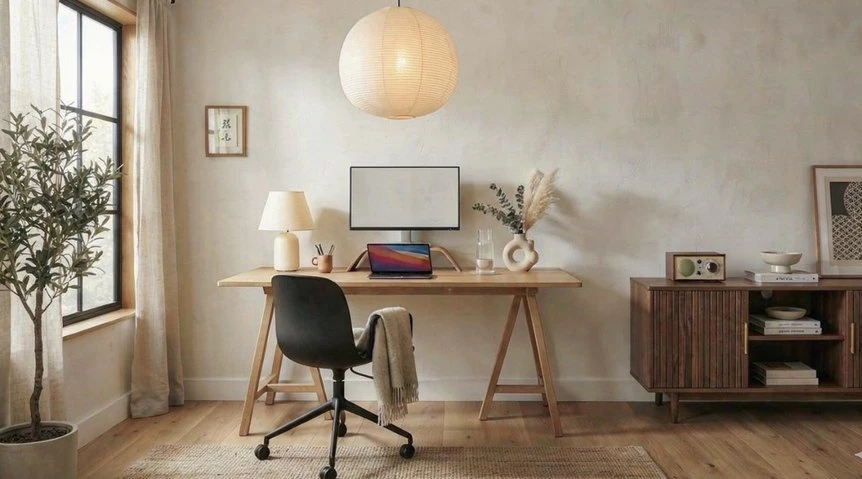
Japandi Office Furniture at a Glance
The table is the short version. Every row below gets a full section, but if the decision has to be made this week, this is enough to shop from. Prices are typical ranges for pieces built to last, not the floor of the market.
| Piece | What to look for | Material to favor | Typical spend | Buy priority |
|---|---|---|---|---|
| Desk | Solid top at least 1 inch thick, slim trestle or thin steel base, 28 to 30 inch depth | White oak, ash, or walnut | $600 to $2,500 | First |
| Task chair | Adjustable seat height, lumbar support, warm neutral colorway | Mesh or wool blend in ecru, clay, or charcoal | $400 to $1,500 | Second |
| Credenza | Low profile, 28 to 32 inches high, closed doors, minimal hardware | Same wood family as the desk | $500 to $2,000 | Third |
| Lighting | Paper or linen shade, warm bulb between 2700 and 3000 Kelvin | Washi paper, linen, matte black or brass stem | $150 to $700 | Fourth |
| Rug | Flat weave, low pile, sized to sit under the desk and chair | Jute, sisal, or undyed wool | $200 to $900 | Fifth |
| Secondary chair | Solid wood frame, woven or paper cord seat | Oak or ash | $250 to $900 | Last |
Which Desk Should You Buy First?
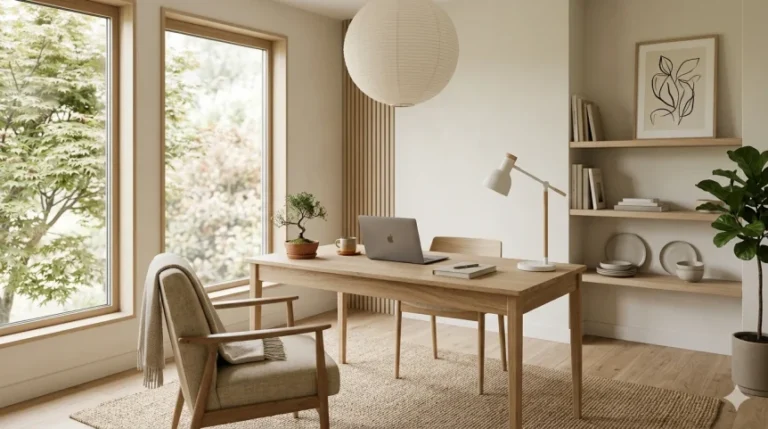
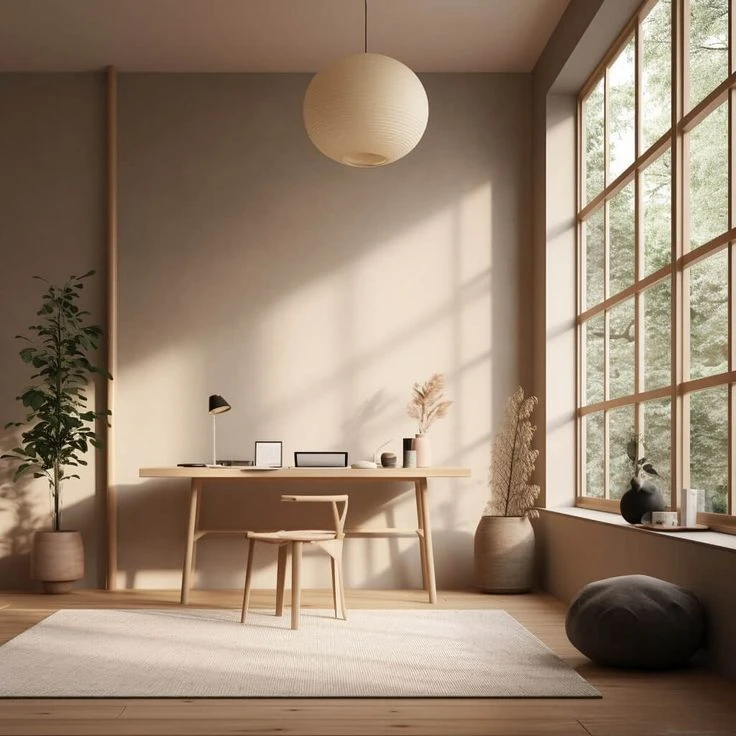
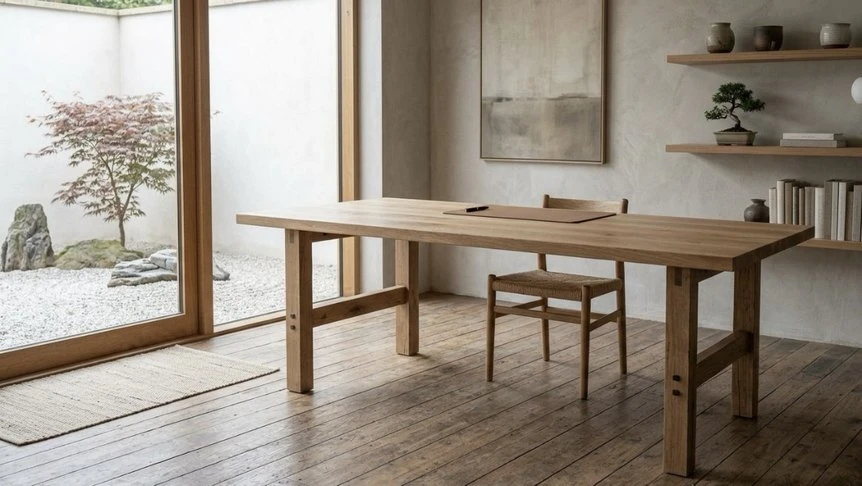
The desk is the largest piece of Japandi office furniture and the one that sets the wood tone for the whole room. Two forms carry the style best. A solid wood slab on a thin trestle base is the more Japanese reading, with the weight of the top and the lightness of the legs doing the work. A solid top on a slim matte black steel frame is the more Scandinavian reading, and the easier one to pair with an existing chair.
Size matters more than most buyers expect. A depth of 28 to 30 inches leaves room for a monitor at a sane distance without pushing the keyboard to the edge. Widths of 55 to 63 inches suit a single monitor setup; go to 70 inches only if the room can take a long horizontal line. Standard desk height is 29 to 30 inches, and the Japandi preference for slightly lower proportions is better met with a low credenza than with a desk that ruins your wrists.
The desk is where solid wood pays off over veneer. On a coffee table, veneer edge wear is cosmetic. On a desk, the edge is where forearms rest eight hours a day, and a veneer edge shows through within two years in exactly the place you look at most.
A solid white oak or ash top at an inch thick starts around $600 for a modest size and runs to $2,500 from a small workshop. The quality jump is real between $400 and $900. Above $1,500 you are paying for a maker’s name and a wider slab, not a better desk.
Walnut is the right choice only in a room with strong daylight. In a north facing room it reads gloomy, and the whole point of Japandi is warmth without weight. White oak and ash suit most rooms. Place the desk facing the window where the layout allows it, which is the arrangement that holds up for anyone spending more than two hours a day on screen.
What Chair Actually Works in a Japandi Office?
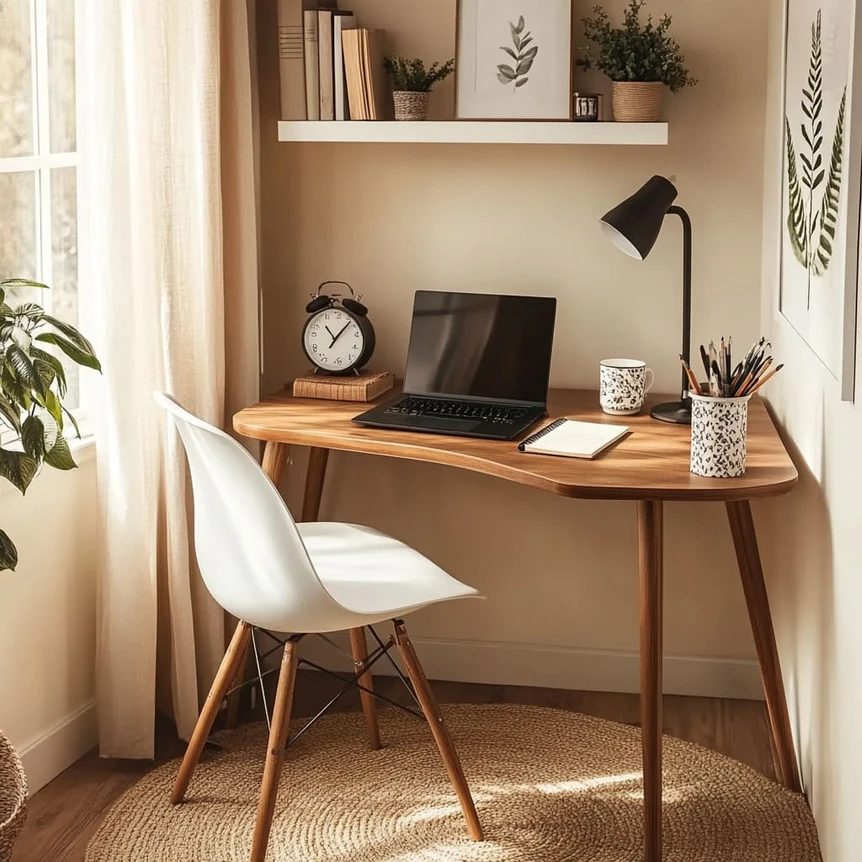
A proper task chair, brought into the palette. The wishbone silhouettes and paper cord seats that define the look are beautiful and cannot support a full day at a screen. The ideas guide makes this argument at length, so the short version here is that the work chair is a functional purchase and the wooden chair is a furniture purchase, and the two should not be confused.
What to look for in the task chair: adjustable seat height across at least 16 to 21 inches, adjustable lumbar support, and a fabric or mesh in a warm neutral. Several of the established ergonomic makers now offer their chairs in ecru, clay, and charcoal colorways, which sit inside a Japandi room without argument. A matte black frame is the safest base color. Avoid chrome, which fights every other material in the room.
Comfort is the one thing an online listing cannot show, so try the chair in person if at all possible. Sit in the chair for ten minutes, not ten seconds. A chair that feels firm at first and neutral after ten minutes is the right one; a chair that feels plush at first is usually the one that hurts by three in the afternoon. Expect to spend $400 to $1,500, with the meaningful jump in mechanism quality happening around $600.
The wooden chair still belongs in the room, as the secondary seat by a side table or under the window. A solid oak or ash frame with a woven or paper cord seat runs $250 to $900. Buy it last, after the room has been lived in for a month, when it is clear where a second seat would actually get used.
Storage: The Low Credenza Over the Tall Bookcase
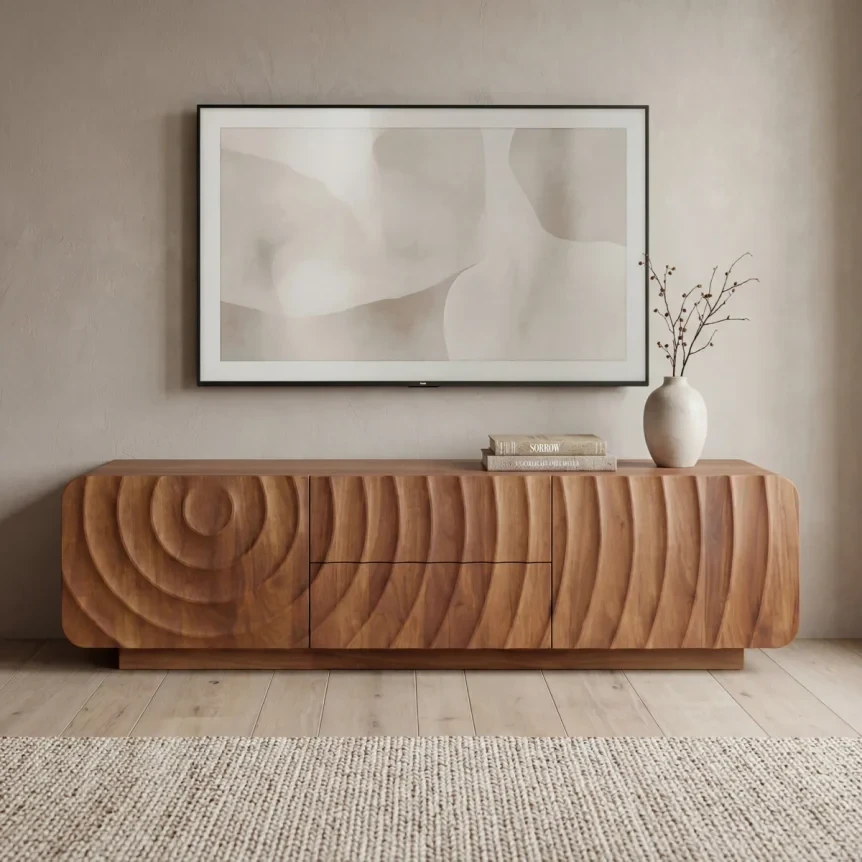
A tall bookcase is the most common storage mistake in a Japandi office. It pulls the eye up, invites clutter, and turns the calmest wall in the room into a display problem. A low credenza between 28 and 32 inches high does the opposite: it hides the printer, the files, and the cable mess behind closed doors, and gives you one surface to style with a lamp and a single object.
Look for a credenza in the same wood family as the desk. It does not need to match exactly, but a walnut credenza beside a pale ash desk reads as two separate purchases. Widths of 47 to 71 inches cover most rooms.
Doors should be flat panel or slatted, with routed pulls or push latches rather than visible hardware. Sliding doors are the more Japanese detail and work well where a chair sits close to the cabinet.
Expect $500 to $2,000. Below $500 the carcass is almost always particleboard with a foil finish that will chip at the door edges; between $700 and $1,200 you get solid wood fronts on a plywood carcass, which is the sensible middle. The sideboard buying guide covers the construction checks in detail, and every one of them applies here.
Ask two questions before buying a credenza: where will it live, and what will it do? A credenza that has a clear answer (printer and paper inside, lamp on top, under the window) earns its footprint. A credenza bought because the wall looked empty becomes a surface for things that do not have homes.
Lighting and Rug: The Two Pieces That Add the Warmth
Once the three working pieces are in, the room will feel correct and slightly cold. Lighting and the rug are what fix that, and both are cheaper than they look.
Lighting
Three sources is the minimum: overhead, a desk lamp, and a third somewhere across the room. The desk lamp is the functional buy, and it should have an adjustable arm and a warm bulb between 2700 and 3000 Kelvin. Matte black or brushed brass stems both work; avoid polished chrome for the same reason as the chair.
The third source is where the style shows. A washi paper pendant or a paper shade floor lamp gives a softer light than any fabric or metal shade and carries the Japanese half of the room visibly. Paper shade pendants run $150 to $400; a sculptural paper floor lamp from a design maker can reach $700. This is the one decorative spend in the room worth making, and the home office lighting guide covers how the three layers should relate.
Rug
A flat weave jute, sisal, or undyed wool rug in a low pile so the chair can roll. Size it so the front legs of the desk and the full travel of the chair sit on it; for a 60 inch desk that usually means a 6 by 9 foot rug placed with its long side parallel to the desk. Jute runs $200 to $500 at that size, wool $400 to $900.
Skip anything with a printed pattern. Texture is the point here, not the design, and a patterned rug is the fastest way to make a restrained room look busy.
How to Tell Quality Japandi Furniture from Cheap
Japandi is a style built on material honesty, which makes cheap versions easier to spot than in most styles. The tells are consistent across every piece in this guide.
- Solid versus veneer. Look at the edge of the desk top or the door of the credenza. Solid wood shows end grain that continues the face grain; veneer shows a thin line where the sheet stops. A product listing that says “oak finish” or “oak effect” is not oak.
- Joinery. Trestle desks and wooden chairs should show pegged, doweled, or mortise and tenon joints. Visible screws and metal brackets at the joints mean the piece will loosen within a year.
- Finish. Hard wax oil or a matte lacquer lets the grain show and can be repaired locally. A thick glossy polyurethane is hiding something and cannot be spot repaired.
- Chair mechanism. Tilt the chair back and let go. A quality mechanism returns smoothly with no clunk; a cheap one bounces. Check that the gas lift holds height under your weight for a full minute.
- Weight. A solid oak desk top at 60 by 30 inches and an inch thick weighs 45 to 60 pounds on its own. If the shipping weight for the whole desk is under 40 pounds, the top is not solid.
Common Mistakes When Buying Japandi Office Furniture
- Buying the set. Matching desk, chair, and bookcase from one range reads as a catalog page, not a room. Buy in the same wood family from different sources.
- Choosing walnut for a dark room. Walnut needs daylight. In a north facing office it turns the calm into gloom. Choose white oak or ash unless the room is bright.
- Skipping the task chair to save the look. The wooden chair is a secondary seat. Using it as the primary chair costs more in the long run than any task chair does.
- Overbuying storage. One credenza. If it is full within a month, the problem is what is being kept, not the cabinet.
- Spending on the decor first. The ceramics and the plant come last. A room bought in the wrong order ends up with beautiful objects on a bad desk.
What Order Should You Buy Japandi Office Furniture In?
Desk first, because it sets the wood tone and the proportions everything else answers to. Chair second, because it is the piece you will feel every day and its color needs to be chosen against the desk. Credenza third, once it is clear what needs to be hidden.
Lighting fourth, when the shadows in the room are known. Rug fifth, sized to the desk and chair that are now in place.
Then stop for a month. The secondary wooden chair, the ceramics, and the single plant are decisions that get better with time in the room. Japandi rewards patience more than any other style covered on this site, and the rooms that look most settled are almost always the ones that were bought slowly.
Where This Fits in the Wider Style
Office furniture is the most functional corner of the style, and the principles here carry into the rest of the home. The Japandi furniture guide covers the living room and bedroom pieces with the same material logic. For the wall and textile colors that the wood tones above should sit against, the Japandi color palettes guide gives the specific combinations.
If you are still deciding between this direction and a stricter or lighter one, the Japandi versus minimalist versus Scandinavian comparison is worth reading before the desk is ordered, since the wood tone decision differs across the three. For the full philosophy behind the pieces, the complete guide to Japandi interior design is the place to start. And for the same three working pieces chosen without a style filter, the modern home office furniture essentials guide covers the ergonomics in more depth.
Frequently Asked Questions
What wood is best for a Japandi desk?
White oak and ash suit most rooms because they stay warm without going dark. Walnut is the richer choice but needs a bright, south or west facing room to avoid reading gloomy. Whichever species, buy a solid top at least an inch thick rather than veneer, since the desk edge takes daily forearm wear and veneer shows through there first.
Can a wooden chair be the main chair in a Japandi office?
Not for full workdays. A paper cord or sculpted wood chair has no seat height adjustment or lumbar support and becomes uncomfortable within a couple of hours. Use a proper task chair in a warm neutral colorway as the work seat and place the wooden chair as a secondary seat by a window or side table.
How much should Japandi office furniture cost?
A full room built to last usually runs $2,000 to $6,000: roughly $600 to $2,500 for a solid wood desk, $400 to $1,500 for a task chair, $500 to $2,000 for a credenza, $150 to $700 for lighting, and $200 to $900 for a rug. The quality jump is biggest in the middle of each range; the top of each range mostly buys a maker’s name.
Should Japandi office storage be open or closed?
Mostly closed. A low credenza with flat or slatted doors hides files, cables, and the printer and leaves one surface to style. Open shelving should be limited to two or three objects per shelf; a full row of books fights the restraint the style depends on.
What size rug works under a Japandi desk?
Size the rug so the desk’s front legs and the full travel of the chair sit on it. For a 55 to 63 inch desk that usually means a 6 by 9 foot flat weave rug placed with the long side parallel to the desk. Choose jute, sisal, or undyed wool in a low pile so the chair rolls freely.