Mid Century Modern Home Office Ideas: Warm Wood, Clean Lines

By Tereza Hower | Published May 8, 2026 | Updated October 13, 2026
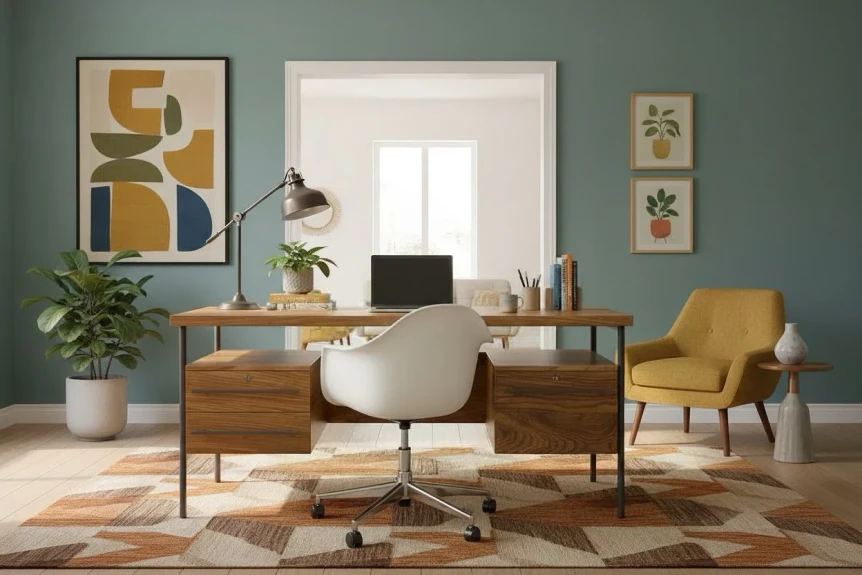
A well done mid century modern home office looks like part of the house rather than a workstation that wandered in. The reason is material: walnut, brass, leather, and one saturated color carry a warmth the corporate office never had. That same warmth is the trap, because the style tips into theme park territory the moment every piece is too on the nose.
Below are the palette, the pieces, and the proportions that make the style work for a real working day, plus the choices that separate a considered office from a period costume.

Key Takeaways
- Build the room around one walnut or teak desk with tapered legs, then extend the wood tone with a low credenza.
- Use a warm neutral base and exactly one saturated accent, such as mustard, forest green, teal, or burnt orange.
- Keep the period chair for reading and work in a modern ergonomic chair in tan leather or a warm neutral.
- Light the room in three layers with warm bulbs; brass and walnut both look wrong under cool light.
- Mix in quieter contemporary pieces so the room reads as lived in rather than staged.
What Defines a Mid Century Modern Home Office?
A mid century modern home office is a workspace built on postwar design: warm woods such as walnut and teak, tapered legs, leather and wool, brass or matte black hardware, and one or two saturated colors. Lines are clean and low, and the materials are meant to show.
The common mistake is treating it as a costume. A walnut desk, walnut bookcase, and walnut chair with a starburst clock and a sunburst mirror is an exhibit, not an office. The convincing version mixes two or three strong period pieces with quieter contemporary ones and lets those few pieces lead. For the wider principles of the style, see the complete guide to mid century modern design.
Which Colors Suit a Mid Century Office?
The palette runs on warm earth tones with one saturated accent. The base is cream, warm white, soft beige, or a warm gray. The accent gives the room its personality: deep mustard, forest green, burnt orange, teal, or burgundy.
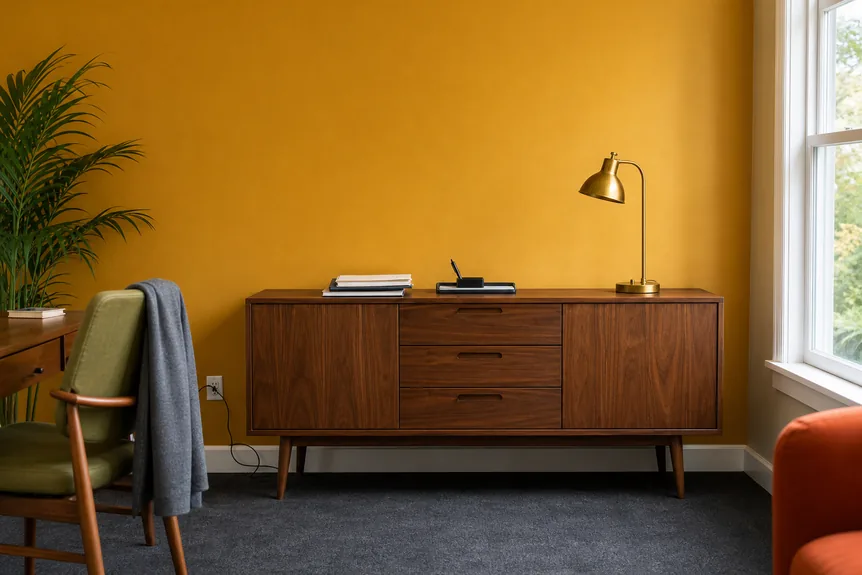
For walls, warm neutrals such as Accessible Beige (Sherwin-Williams SW 7036), Manchester Tan (Benjamin Moore HC-81), or Setting Plaster (Farrow and Ball No. 231) sit well under walnut and brass. For a saturated accent wall or a painted bookcase back, Studio Green (Farrow and Ball No. 93) or Rookwood Dark Green (SW 2816) stay in the right tonal family.
Choose one accent and stop. Two saturated colors plus walnut and brass starts to feel busy, and the office loses the calm it needs for work.
How to Choose a Mid Century Desk
The desk is the room’s most important piece. Walnut is the classic wood, teak works equally well, and ash gives a lighter take on the look. The legs should taper, the base should be slim, and the proportions should feel deliberate: period desks sit lower and narrower than most contemporary ones.
Check depth before anything else. Many vintage desks are only 22 to 24 inches deep, which suits a laptop but feels tight with a monitor; 28 to 30 inches leaves room for a screen at arm’s length. Desk height should be 28 to 30 inches, and a width of 48 to 60 inches fits most rooms.
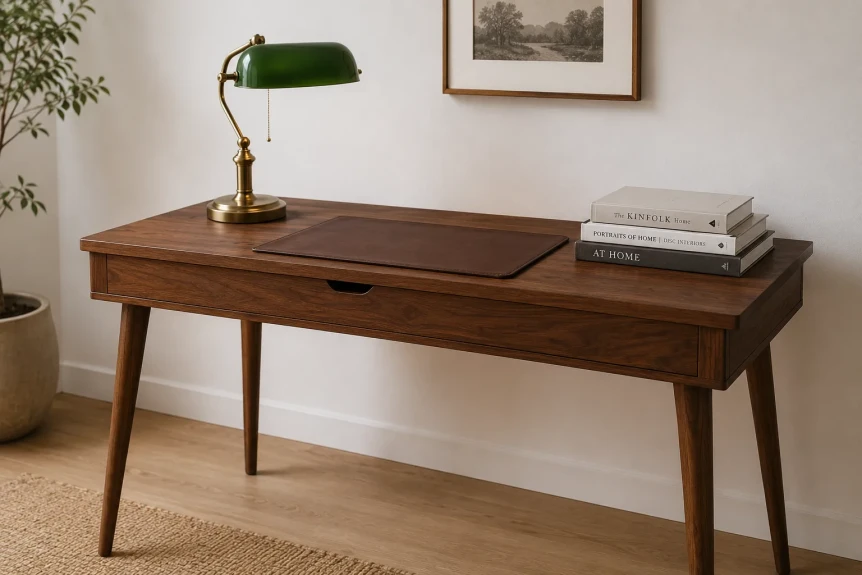
A vintage desk in sound condition is usually a better buy than a reproduction: older timber, real patina, and joinery made to be repaired. For a new desk, look for solid walnut or a thick walnut veneer on plywood, tapered or hairpin legs rather than panel sides, and no heavy chrome or thick steel framing. The modern home office furniture essentials guide covers sizing for desks, chairs, and storage together.
Which Chair Works for a Full Workday?
The classic mid century desk chair, with a sculpted wooden back and a leather or upholstered seat, is one of the most beautiful office chairs ever designed and one of the hardest to sit in for eight hours. Lumbar support is minimal, height adjustment is limited, and the arms are more decorative than useful.
The practical answer is a modern ergonomic chair in tan leather or a warm neutral fabric, with the rest of the room carrying the period weight. Keep the wooden chair for a reading corner or short sessions. A soft pad executive chair in the Eames aluminum group style is the closest thing to period character with real adjustability; it is expensive, but it suits the room and the spine.
Lighting: Brass, Sculptural, Warm
Lighting is the easiest part of the style to get right. Brass, sculptural forms, and warm bulbs around 2700K all read correctly. The three layer rule applies: an overhead source, a task lamp at the desk, and a third light elsewhere in the room.
Overhead, a Sputnik style chandelier, a globe pendant, or a multi arm fixture works. At the desk, a brass articulating lamp with a small shade, or a task lamp in a saturated color, does the job without trying too hard; place it on the side opposite the writing hand to avoid shadows. For the third layer, a brass arc floor lamp behind the reading chair or a wall sconce above the credenza closes the loop.
The mid century modern lighting ideas guide covers the classic fixtures, and the modern home office lighting guide covers glare and screen placement in a working room.
Storage: Credenza First, Bookcase Second
The credenza is the most useful storage piece the period produced, and a home office is where it earns its keep. Closed cabinets below hide files and cables, sliding doors save swing space, and the top takes a lamp, a printer, or a few objects.
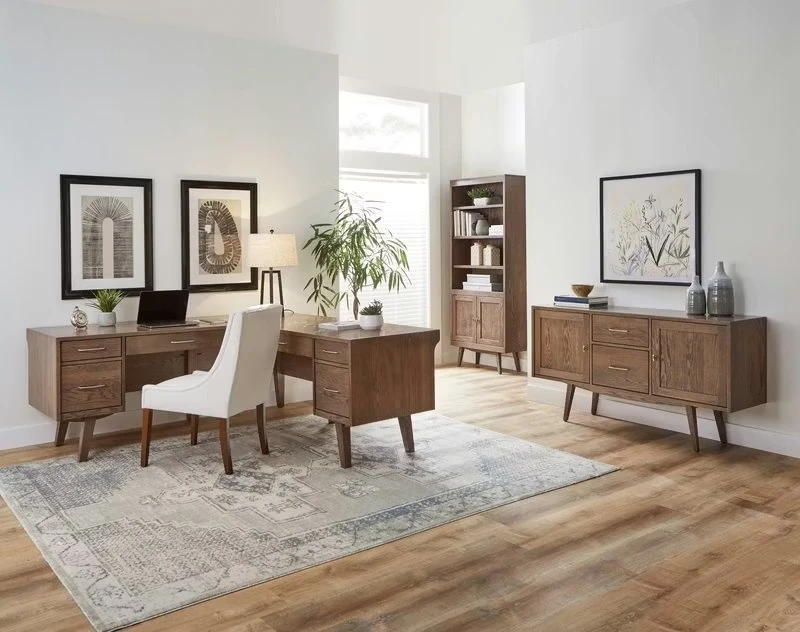
Plan cables with the storage. A credenza with a cutout in the back panel can hold a router, a printer, and a power strip out of sight, and a grommet or a slim tray under the desk keeps cords off the tapered legs, where they spoil the clean lines the style depends on.
With room for one storage piece, choose a credenza around 16 to 18 inches deep, low enough to sit under a window. With room for two, add a low bookcase in the same wood tone. Avoid tall, narrow bookcases: the style leans horizontal, and tall pieces fight it. The sideboard buying guide applies almost directly to choosing a credenza.
Mid Century Office Pieces at a Glance
| Piece | Look for | Size to check | Avoid |
|---|---|---|---|
| Desk | Walnut or teak, tapered legs, slim apron | 28 to 30 inches deep for a monitor, 28 to 30 inches high | Heavy chrome, thick steel frames |
| Task chair | Tan leather or warm fabric, full adjustment | Seat height that suits the desk, about 10 to 12 inches below the top | A period wooden chair as the main seat |
| Credenza | Sliding or slatted doors, simple pulls, same wood as the desk | 16 to 18 inches deep, low enough for a window | Tall, narrow cabinets |
| Lighting | Brass, globe, or sculptural shades, warm bulbs | Three sources in the room | Cool white bulbs |
| Rug | Wool, geometric or solid | Large enough for all four chair casters | Shiny synthetics |
How to Tell a Good Mid Century Piece from a Costume
Period furniture often used walnut or teak veneer on plywood, so veneer alone is not a warning sign. Quality shows elsewhere. Pull out a drawer: dovetail joints and a solid wood drawer box mean the maker cared, while stapled particleboard means they did not.
Look at the veneer edges and corners for lifting or chips, run a hand along the legs to feel whether the taper is smooth, and check that sliding doors run without sticking. On reproductions, a printed wood grain that repeats across the top, legs screwed straight into a thin top, and an orange toned finish are the giveaways.
Textiles, Rugs, and Art
The room needs textile warmth. A wool rug in a geometric pattern or a soft solid, a leather desk pad, a wool throw, and a cushion or two on a secondary seat all add it. Wool, leather, linen, and cotton read correctly; shiny synthetics do not.
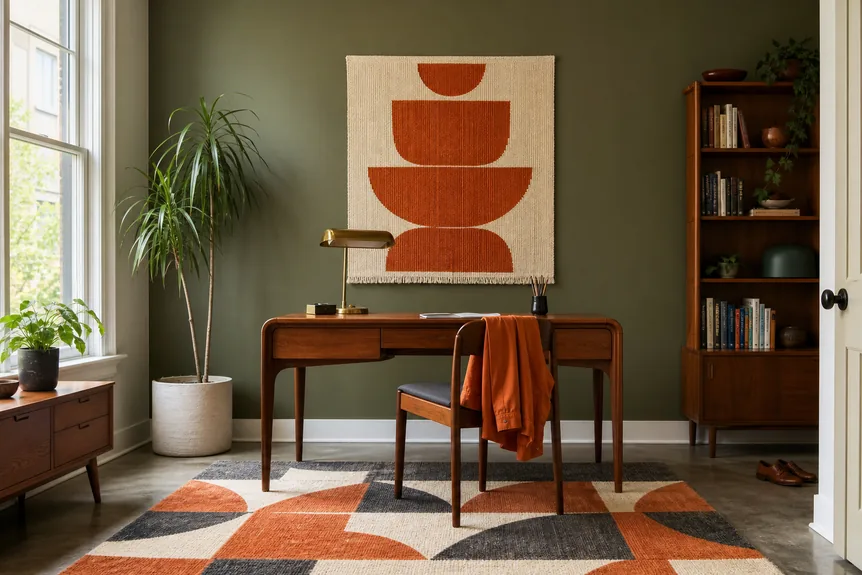
For art, the period is generous: abstract paintings, botanical prints, travel posters, woven hangings, and ceramic wall pieces all suit it. Commit to scale. A small piece on a large wall looks undersized, while one large work or a tight group of three to five looks deliberate. Wide or square pieces suit the horizontal lines better than tall narrow ones.
Can a Mid Century Office Work in a Small Room?
It suits small rooms well, because the furniture is low and leggy and lets the floor show. A 48 inch desk, a credenza that doubles as printer stand and file storage, and a wall mounted shelf above the desk cover most needs in a spare bedroom or a corner.
Keep the accent color to one wall or one piece, and choose a globe pendant over a floor lamp to save floor space. For more ideas on compact workspaces, compare the minimalist home office and Japandi home office approaches.
Common Mistakes in Mid Century Home Offices
Committing too hard to the period. Three walnut pieces, a starburst clock, and a sunburst mirror together is a costume. Mix in quieter contemporary pieces.
Working all day in the wooden chair. It is a reading chair, not a task chair. Back pain arrives within weeks.
Skipping the saturated accent. Without one strong color, the room reads as beige minimalism. Choose mustard, green, teal, or burnt orange and use it once.
Cool white bulbs. Brass turns gray and walnut turns flat under cool light. Stay at 2700K or warmer.
Mid Century Versus Industrial
Both styles use leather, warm metal, and plenty of character, so they are easy to confuse. Mid century leans on walnut, brass, and tan leather, with curved and tapered lines and one saturated color. Industrial leans on steel, blackened metal, darker leather, and rougher wood, with straight lines and a tighter palette of black, gray, and warm wood.
For the industrial direction, see the complete guide to industrial interior design.
Putting It Together
Build the room in this order: the walnut desk first, then the credenza, then lighting, then the chair, and textiles, art, and accessories last. The desk is the spine of the room, the credenza extends its wood tone and hides the clutter, and the right brass light pulls the room together early. The task chair comes late because a modern chair in a warm neutral will suit whatever wood and wall color came before it.
For the wider workspace picture, return to the complete guide to modern home office design.
Frequently Asked Questions
Should I buy a vintage mid century desk or a reproduction?
A vintage desk in sound condition usually wins on timber, patina, and joinery, but many are only 22 to 24 inches deep. Choose a reproduction or a new desk if you need 28 to 30 inches of depth for a monitor.
How do I keep a mid century office from looking like a costume?
Limit the strong period pieces to two or three, such as the desk, a credenza, and one light, and pair them with quieter contemporary pieces. Skip the starburst clock and sunburst mirror combination.
Walnut or teak for a mid century desk?
Both are true to the period. Walnut is darker and cooler brown; teak is warmer and more golden. Match the desk to the credenza so the room reads as one wood tone.
What is the best accent color for a mid century modern office?
Mustard, forest green, teal, and burnt orange all suit walnut and brass. Use one of them, on a single wall, a bookcase back, or a chair, against a warm neutral base.
What chair works in a mid century modern home office?
A modern ergonomic chair in tan leather or a warm neutral fabric for daily work, with a period wooden chair kept for reading or short sessions.