Sofa Buying Guide: How to Choose the Right Couch

By Tereza Hower | Published February 24, 2026 | Updated September 7, 2026
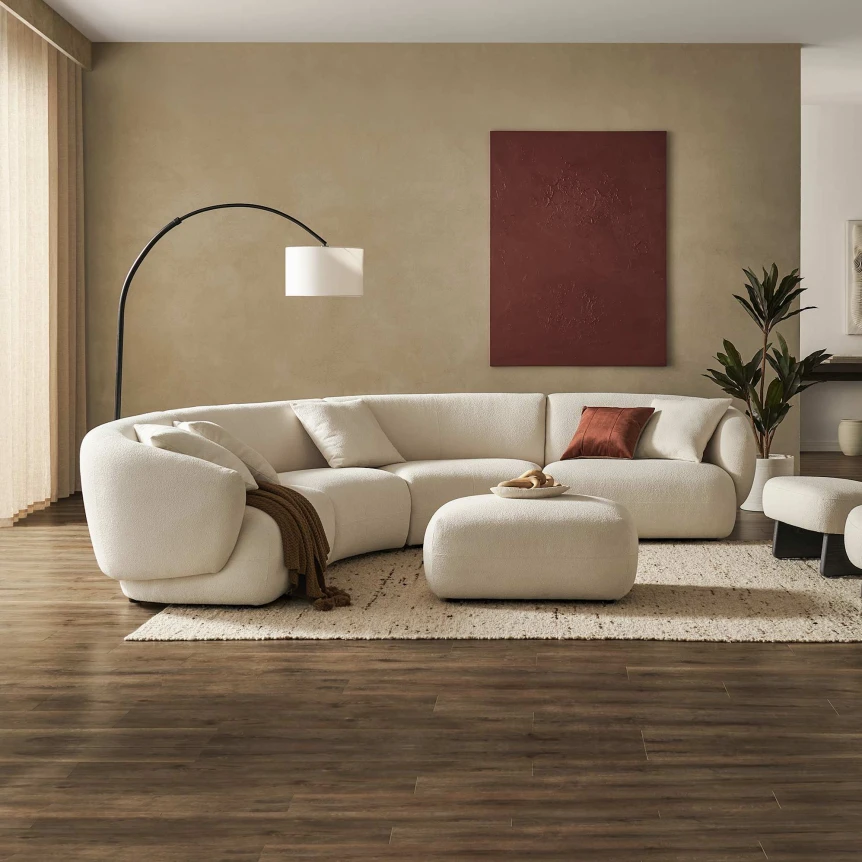
The sofa is the highest stakes purchase in most living rooms. It is the largest piece of furniture in the room, the most expensive single item, and the one that gets used for hours every day. Get it right and the rest of the room comes together easily; get it wrong and an $1,800 mistake takes up the entire wall for the next five years. Most advice on how to choose a sofa starts with style, which is exactly the wrong end.
The buyers who end up happy make the decisions in a particular order: frame first, size second, fabric third, style last. The ones who end up unhappy reverse it, falling for a fabric color and rationalizing everything else. This guide follows the first order, because it is the one that determines whether the sofa is still comfortable in year five.
Key Takeaways
- Decide in this order: frame, size, fabric, style; a sofa bought the other way around is the one that gets replaced.
- A kiln dried hardwood frame, sinuous or eight way hand tied springs, and foam of 1.8 pound density or higher are the three specs that predict a ten year sofa.
- The sofa should be at least 18 inches shorter than its wall, leave 36 inches of walkway, and fit through every door and stair turn on the way in.
- Performance fabric for households with children or pets; top grain leather for longevity; neutral upholstery for a piece this large.
- The $1,500 to $2,500 tier is where real construction lives; above it the money buys brand and customization rather than a better frame.
How to Choose a Sofa: The Order That Works
Four decisions, made in sequence, cover almost everything. The frame and suspension decide how long the sofa lasts, so they come first and rule out most of the market before anything else is considered. Size comes second, because a sofa that does not fit the wall or the doorway is not a sofa but a return.
Fabric comes third, chosen for how the household actually lives rather than for a swatch. Style comes last, and by that point the field is small enough that it becomes an easy choice rather than a seductive one. A buyer who reaches the style decision with three candidates left has done the work; one who reaches it with thirty has not started.
The sequence matters because each decision constrains the next. A solid frame is available in every style; a particular shade of velvet is not available on every frame. Anyone who starts with the color ends up accepting whatever construction happens to come underneath it, and that is how a beautiful sofa sags in eighteen months.
After more than ten years curating home furniture, the order above is the single piece of advice that would have prevented the most returns. Everything that follows is that sequence in detail.
Which Sofa Type Fits Your Room?
The type of sofa is partly decided by the room and partly by how the household uses it. The table gives the dimensions and the room each type needs; the sections beneath cover what each does well and where it falls short.
| Type | Typical width | Room it needs | Best for | Watch for |
|---|---|---|---|---|
| Three seater | 84 to 90 inches | A wall of 102 inches or more | Most living rooms; the default | Seat depth decides whether it sits or lounges |
| Loveseat | 60 to 72 inches | Studios, narrow rooms, bedrooms, or a second piece | Couples; secondary seating | Two adults sit close; awkward for roommates |
| Sectional | 100 to 130 inches on the long side | 14 feet of wall on the long side; 10 by 12 feet minimum | Households of three or more; movie watching | Dominates any room under 12 by 14 feet |
| Modular | Configurable; 30 to 40 inches per unit | Any; reconfigures with the room | Renters and frequent movers | Visible seams between units collect crumbs |
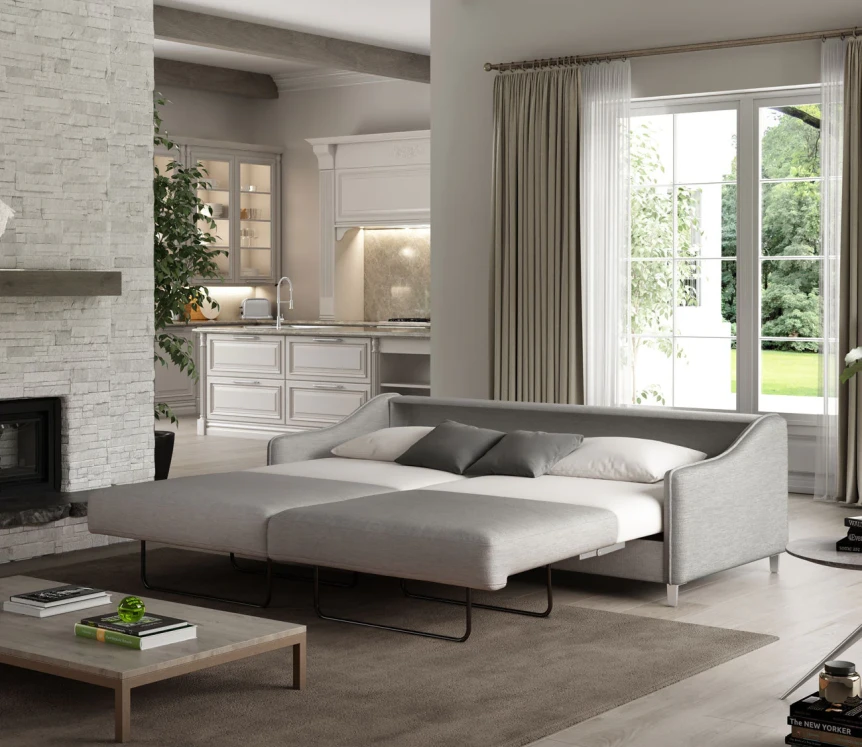
| Sleeper | 72 to 90 inches | Clear floor of 90 inches in front when open | Guest rooms and studios | Shallower seat, stiffer cushions, thin mattress |
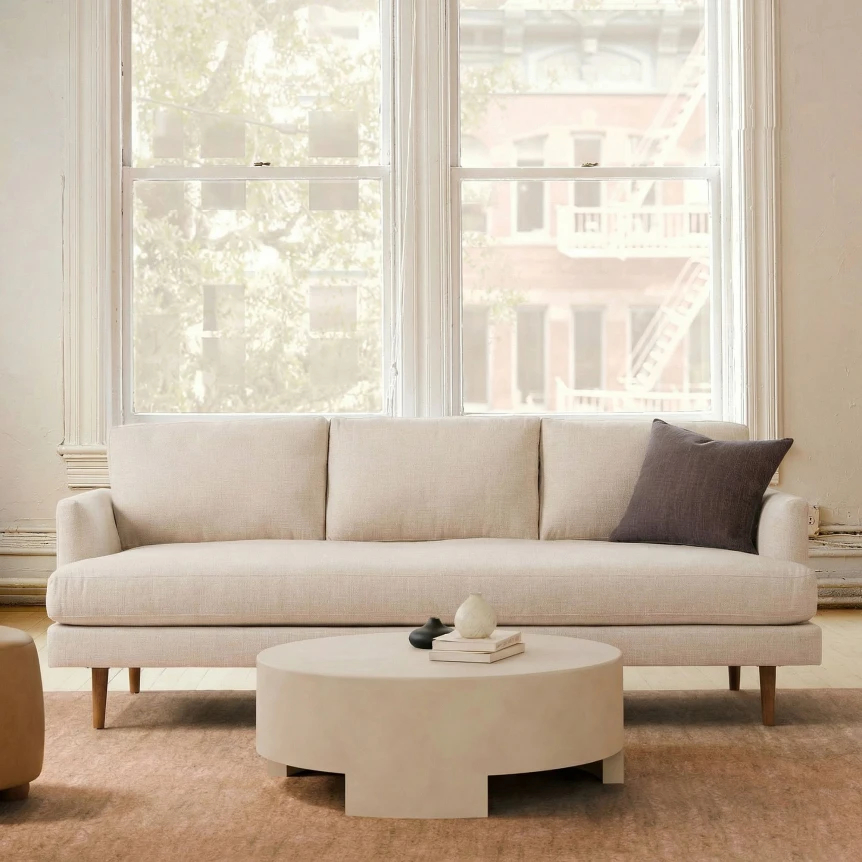
Three seater sofa
The default for most living rooms. It seats three, fits the typical 84 to 90 inch sofa wall, and works in nearly any style; when in doubt, it is almost always the right answer. The variation that matters most within the category is seat depth: a 21 inch seat reads formal and supports upright posture, while a 24 to 26 inch seat is built for lounging and napping.
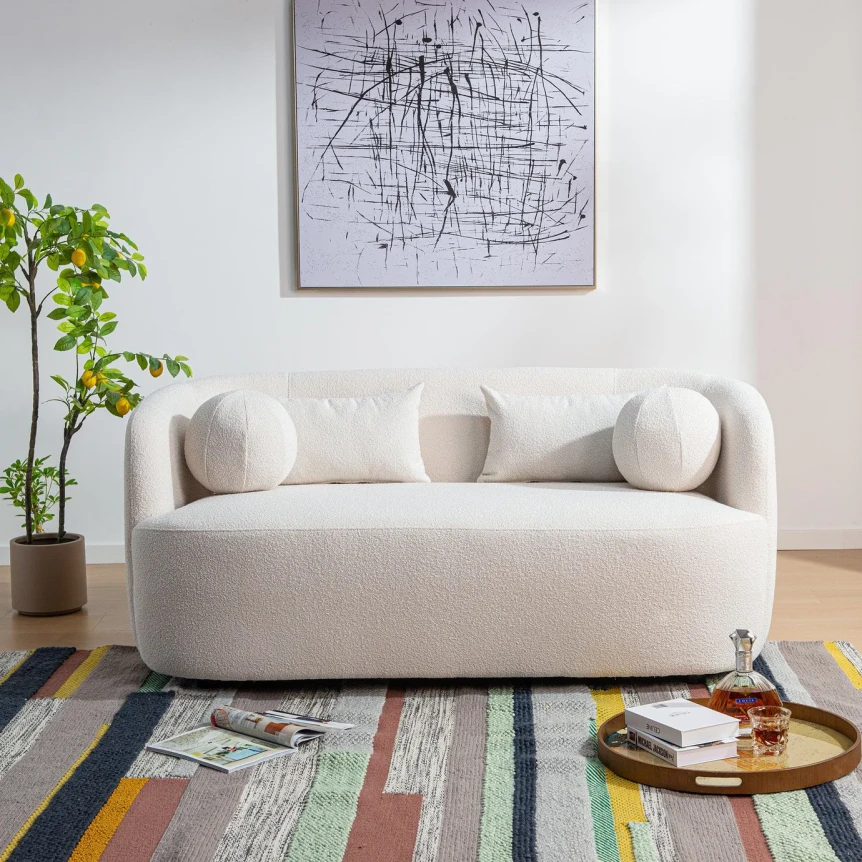
Loveseat
A 60 to 72 inch sofa for two, right for studio apartments, narrow rooms, bedrooms, or as the second piece in a larger room with a three seater. The trade most buyers underestimate is proximity: two adults on a loveseat sit noticeably closer than on a three seater, which is fine for a couple and awkward for roommates or guests.
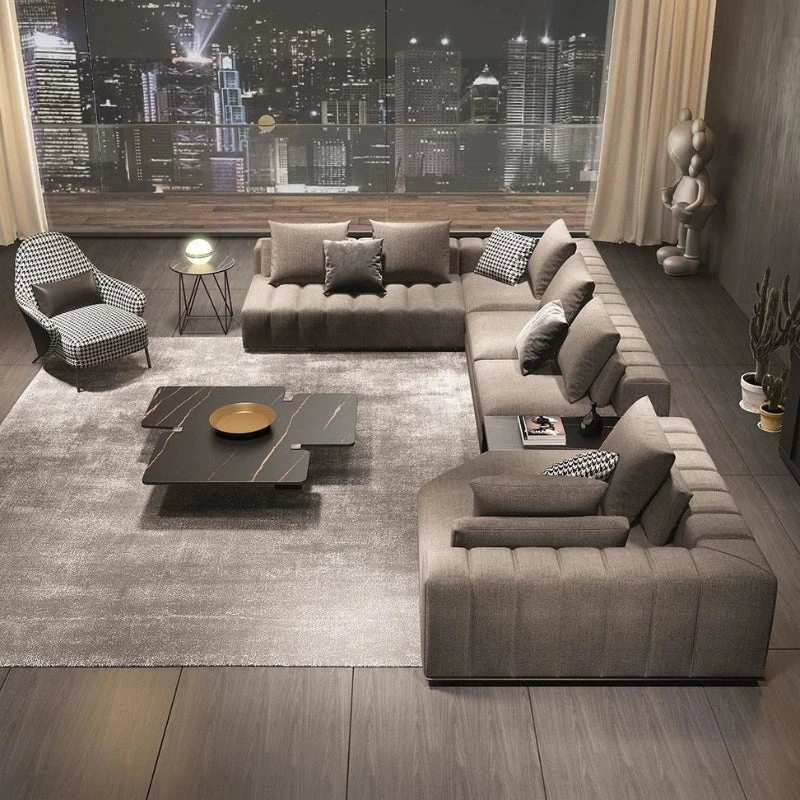
Sectional
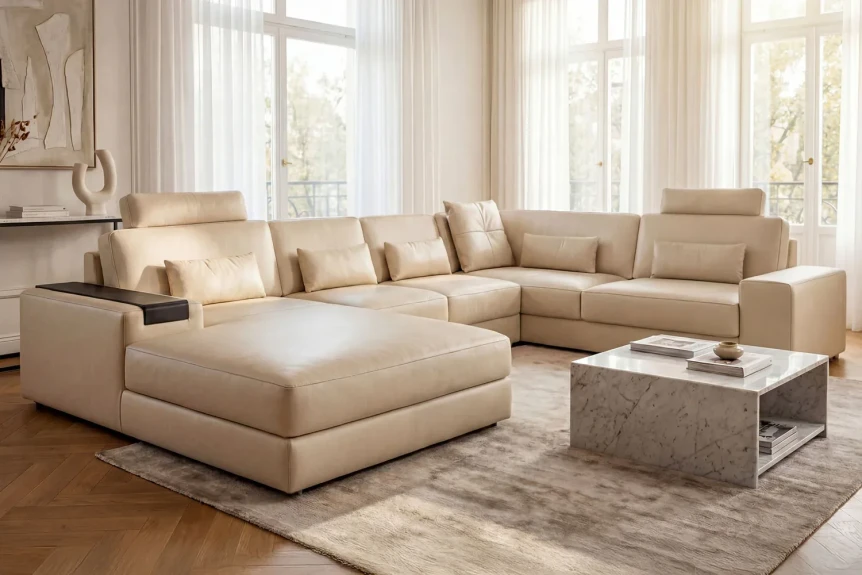
L shaped or U shaped, built for larger rooms and bigger households. The math is unforgiving: a sectional needs at least 14 feet of wall on the longer side and a room of at least 10 by 12 feet. In anything smaller it consumes the whole space and forces every other piece to work around it.
Match the chaise side, the longer leg of the L, to the household’s habits. Anyone who naps, reads, or watches films on the sofa wants the chaise; a household that mostly entertains is better served by two equal sides.
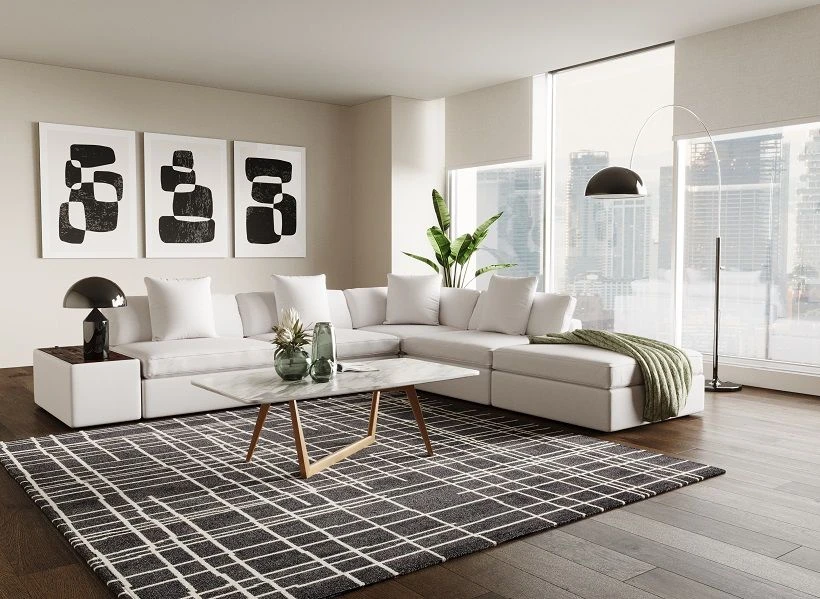
Modular sofa
Individual units that connect with hooks or brackets so the layout can be rebuilt. Excellent for renters who move often and for anyone unsure of a long term layout. The trade is that the seams between units are visible and collect crumbs, and modular pieces are harder to upholster cleanly than a single frame, so they tend to look slightly less finished than a one piece sofa.
Sleeper sofa
A sofa with a pull out bed, usually a full or queen mattress folded inside the frame, and the right answer where one piece has to do double duty in a guest room or studio. The mechanism takes internal space, so sleepers have shallower seats and stiffer cushions than a comparable sofa, and the mattress is thinner than a bed’s. Buy one for occasional guests, never as a primary bed.
How to Tell a Quality Sofa From a Cheap One
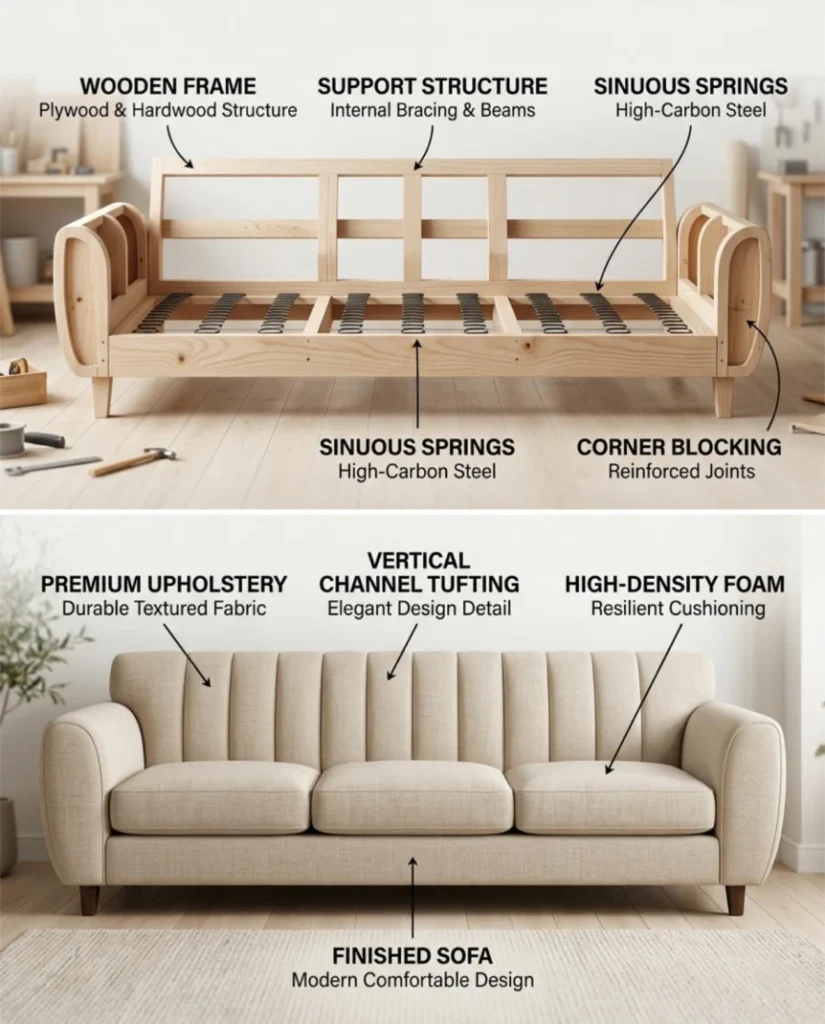
A quality sofa is one built on a kiln dried hardwood frame with eight way hand tied or heavy gauge sinuous springs and high resilience foam, and those three things can be checked in a showroom in ten minutes. The price tag is a poor substitute for checking. A $2,500 sofa from a fashionable direct to consumer brand can hide a particleboard frame under low density foam, while a $1,400 sofa from a maker that has built upholstery for fifty years can carry every one of the specs that matter.
Lift one corner, hard. A sofa with a kiln dried hardwood frame and eight way hand tied springs is heavy; an 84 inch three seater should weigh 150 to 220 pounds. If two people lift it easily, the frame is engineered wood, often listed as “hardwood solids” on a spec sheet, which is not the same thing. Engineered frames warp, split, and loosen within five to seven years.
Push down on the seat, in the middle and at the corners. A quality seat has high resilience foam of 1.8 to 2.5 pound density over hand tied or sinuous springs, and it gives and comes back with no sense of bottoming out. Feeling the frame through the cushion means the foam is too thin; a seat that sags under a hand is on light gauge wire springs and will sag under a person within two years.
Sit for fifteen minutes, not thirty seconds. Comfort matters, and this is the part most people skip when shopping online, and the part I always made customers do in person. Sit, lean back, lean forward, move to the edge, lie down with feet up. A sofa that feels wonderful for thirty seconds and slightly off at fifteen minutes is the wrong sofa, and the back support that disappears at minute twenty is the most common reason a sofa gets replaced.
Check the seams and the piping. Quality upholstery shows straight, evenly spaced stitching with no loose threads, and on a striped or patterned fabric the pattern matches across the seams, which is the clearest sign a maker cares about detail. Cheap sofas show wavy stitching, mismatched pattern, and visible staples underneath.
Look at the legs and how they attach. Solid wood legs bolted into a hardwood frame hold up for decades. Plastic legs, hollow metal legs, or legs threaded into particleboard loosen, wobble, and eventually break.
What Cushion Fill Should a Sofa Have?
The fill decides how the sofa feels in year three, and it is the spec most buyers never ask about. Four constructions cover the market, and each trades comfort against maintenance in a different place. The right one depends less on budget than on whether the household will flip and plump a cushion once a week, because two of the four need exactly that.
High resilience foam at 1.8 pound density or above is the workhorse: firm, supportive, holds its shape for a decade, and needs no fluffing. Below 1.8 pounds, foam crushes visibly within two years and the seat develops a permanent dent where the household sits most. The density is on the spec sheet or available from the maker; a seller who cannot supply it is selling the low number.
Feather wrapped foam, a foam core inside a channeled jacket of feather and down, is the compromise most premium sofas use. It sits softer and looks more relaxed than plain foam, holds its structure because the core does the work, and needs a weekly flip and plump to stay even. It is the fill to choose for a deep, lounging seat.
All down or feather is the softest and the most demanding. The cushions look sumptuous when freshly plumped and slump within a day of use, so they suit a formal room sat in occasionally rather than a family room sat in nightly. They also cost the most and shed through anything but a tightly woven ticking.
Polyester fiber is the budget fill, used in back cushions on decent sofas and in seats on cheap ones. It feels soft on the showroom floor and flattens within months in a seat; in a back cushion it is acceptable. A sofa with fiber seat cushions is a two year sofa regardless of the frame.
How Big Should a Sofa Be?
Do the math before falling for anything online. Five numbers prevent most returns.
- Wall length: the sofa should be at least 18 inches shorter than the wall it sits against. An 84 inch sofa wants a 102 inch wall; anything tighter looks crowded.
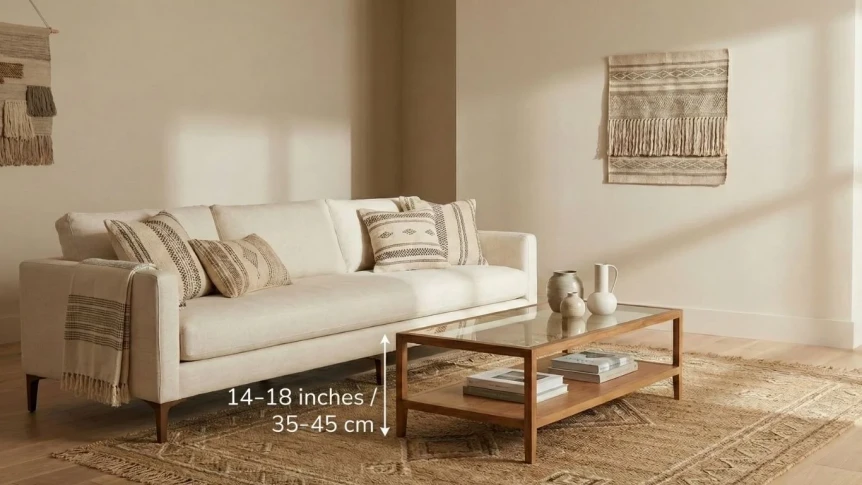
- Walkways: 36 inches of clear floor on the main path, 24 inches minimum on secondary paths, and 14 to 18 inches between the sofa and the coffee table.
- Doorways and stairs: measure every doorway, hallway turn, and staircase between the front door and the room. A sofa 38 inches deep will not make a 90 degree turn in a 36 inch hallway, and a sofa that fits the room but not the route in is the most expensive return there is.
- Seat height: 17 to 19 inches is standard. Shorter people are more comfortable lower, taller people higher; anyone under five foot four or over six foot should note it while shopping.
- Seat depth: 21 to 22 inches sits upright, 24 to 26 inches lounges, and 28 inches and beyond needs a back pillow for anyone of average height. Choose deep seats only for a household that actually puts its feet up.
The painters tape trick: mark the sofa’s exact footprint on the floor with tape before buying, walk around it, and sit at one end with the tape standing in for the back. It catches the sizing problems that the listed dimensions hide, and it costs nothing. The modern coffee tables guide covers the table that has to fit in front of it.
Fabric vs. Leather: What Each Actually Lives Like
Catalog descriptions flatter both. The table gives what each upholstery is like to own, and the sections beneath cover the labels that mislead.
| Upholstery | Feel | Lifespan | Children and pets | Price premium |
|---|---|---|---|---|
| Performance fabric | Soft, warm, close to natural fibers now | 10 to 15 years | Best choice; spills wipe, claws slide | 10 to 20 percent over standard fabric |
| Linen or cotton | Softest and coolest | 7 to 10 years | Poor; stains set, linen wrinkles | None to modest |
| Velvet | Warm, plush | 8 to 12 years | Crushes and holds hair | Modest |
| Bouclé | Textured, cozy | 5 to 8 years | Poor; loops catch and pill on claws | Modest to high |
| Top grain leather | Cool in winter, warm in summer, softens with age | 20 to 30 years | Durable but shows claw scratches | Sofas start around $2,000 |
| Bonded or faux leather | Leather like for a year | 2 to 5 years | Peels and cracks | Cheapest, and worth avoiding |
Fabric
Fabric is warmer to the touch, softer on day one, and more forgiving of body heat, with no sticking in summer and no cold shock in winter, which also makes it the better upholstery for napping. The trade is staining: untreated fabric absorbs spills for good. Performance fabrics such as Crypton, Sunbrella, and Revolution solve that almost entirely, and their texture has closed most of the gap with natural fibers, so for a household with children or pets the upcharge is the best money in the whole purchase.
Leather
Real leather, meaning top grain or full grain rather than bonded or faux, is the most durable upholstery available and develops a patina that improves for decades; a quality top grain sofa lasts 20 to 30 years. The costs are the price, with leather sofas starting around $2,000 and climbing quickly, the temperature, cool in winter and sticky in summer, and the way it shows every claw mark.
The labels are where buyers get caught. Top grain is the highest practical grade and the one to buy; full grain is finer still and rarely used in furniture because of cost. Bonded leather is shredded scrap glued to a fabric backing, looks like leather for a year, and peels visibly within three. Faux leather is polyurethane or PVC: good polyurethane lasts five to ten years and feels reasonably close, PVC cracks within two, and since labels rarely say which, a faux leather sofa priced well below its peers is PVC.
Should You Buy a Sectional or a Regular Sofa?
The decision is mostly about room size and how the room is actually used. A regular sofa is right where the room is under 12 by 14 feet, where the room is mostly for conversation rather than television, where the furniture gets rearranged, or where a chair or loveseat alongside the sofa is preferable to one connected piece.
A sectional is right where the room runs over 14 feet on the long side, where the household naps or watches films on the sofa most days, where three or more people use the room together, or where an open plan needs the sectional to define a seating zone. In that last case the sectional is doing the work of a wall, and it is the one situation where its size is the point.
The common mistake is buying a sectional for a room that cannot hold it and then living with the domination because the money is spent. Measure first, and if the sectional does not fit with 36 inches of walkway around it, buy a regular sofa plus a chaise or an accent chair instead. That combination delivers most of the function at less than half the spatial cost, and the best modern sofas roundup sorts the regular sofas worth that role.
What Should You Look for When Buying a Sofa Online?
Buying online trades the fifteen minute sit for wider selection and better prices, so the checks have to move from the showroom to the spec sheet. Five things separate a listing worth trusting from one worth skipping, and a maker that publishes all five is telling the buyer something before a single word of marketing copy is read.
The frame material, in plain words. “Kiln dried hardwood” is the phrase to find. “Hardwood solids,” “engineered hardwood,” and “solid wood and plywood” are the phrases that mean particleboard is doing part of the work. A listing that says only “wood frame” is hiding something.
The foam density and the spring type. Good makers publish both; 1.8 pound foam or higher and sinuous or hand tied springs are the numbers to see. A listing that gives seat depth to the half inch but no foam density has chosen what to disclose.
The return window and who pays freight. Ninety days is the floor for a piece that cannot be tested first, and the return should not cost several hundred dollars in shipping. A thirty day window with buyer paid freight on a 200 pound item is a return that will never happen.
Swatches, in the room, for a week. Order the fabric samples, put them on the wall the sofa will face, and look at them in morning and lamp light. Screen color is not fabric color, and a warm gray on a monitor is often a cool gray in a north facing room.
Reviews written after a year, not a week. Sort by date and read the ones posted twelve months after delivery. Every sofa is comfortable on the day it arrives; the reviews that mention sag, pilling, or a cushion that never recovered are the ones that describe the sofa being bought.
What Most People Get Wrong
Three patterns repeat often enough to count as rules.
Style over construction. The sofa that looks beautiful in a rendering and arrives with low density foam on an engineered frame is uncomfortable within six months and ready for replacement within four years. The one with kiln dried hardwood, hand tied springs, and high resilience foam outlives two or three trend cycles, and construction is what keeps a sofa looking good in year five.
Underestimating seat depth. A 21 inch seat feels formal and supports posture; a 26 inch seat feels luxurious in the showroom and leaves anyone under five foot six choosing between feet off the floor and a perch on the front edge. Be honest about height and habit, and for reading with feet up, 24 inches is easier to live with than 26.
Bold color on the biggest piece. Deep teal velvet and bright mustard linen look spectacular in a catalog and become impossible to coordinate within a year as everything around them changes. For a piece this large and this expensive, a foundation neutral such as oatmeal, cream, charcoal, or warm gray is the safer call, with color carried by pillows, rugs, and art that are cheap to swap. The modern color schemes for living rooms guide covers how the sofa’s undertone has to agree with the walls.

What Does a Good Sofa Cost?
Under $800: engineered wood frame, light gauge wire springs, low density foam, polyester upholstery. Comfortable for the first year, visibly sagging within two, replaced within four. Acceptable for a first apartment; not worth moving.
$800 to $1,500: mixed construction and the widest variation in quality. The frame may be part hardwood, the springs sinuous or basic hand tied, the foam mid density, and performance fabrics start to appear. The showroom checks matter most here: a good $1,200 sofa exists in this range, and so does a $1,500 sofa worse than a $700 one.
$1,500 to $2,500: the range for a sofa that lasts ten years or more. Kiln dried hardwood, eight way hand tied springs, high resilience foam, and quality fabric or top grain leather are standard, and most established mid market upholstery makers sit here. The construction jump above the $1,500 line is real and visible.
$2,500 and above: custom upholstery, premium leather, designer names, and specialty construction such as down filled cushions, slipcovers, or custom dimensions. The jump from $2,500 to $5,000 buys brand and customization rather than a dramatically better frame. Worth it for exact specifications; not required for a sofa that lasts.
The Bottom Line
The right sofa is the one that stops being noticed after a week. It fits the room and the route into it, supports the back at minute fifteen as well as minute one, and sits alongside the rest of the room rather than fighting it for attention. Spend on the construction, choose neutral upholstery for a piece this large, and let the styling around it carry the personality.
For the room around it, the complete guide to modern living room design covers how the sofa sits with the other anchor pieces, the timeless living room staples guide covers the pieces that pair with it, the side tables and accent furniture guide covers the supporting cast, and how to style a cozy living room covers layering the rest once the sofa is in place.
Frequently Asked Questions
How do I know if a sofa will fit in my room?
Measure the wall, then every doorway, hallway turn, and staircase between the front door and the room. The sofa should be at least 18 inches shorter than its wall, with 36 inches of walkway in front and 14 to 18 inches to the coffee table. Mark the exact footprint on the floor with painters tape before buying. The most expensive returns are sofas that fit the room but cannot make a 90 degree turn in a tight hallway.
What is the most durable sofa fabric for homes with pets?
Performance fabrics such as Crypton, Sunbrella, and Revolution. They resist stains, repel liquid, clean with water, and stand up to claws far better than untreated natural fibers; microfiber and chenille are the strong choices at lower prices. Avoid linen, velvet, and bouclé in a pet household: linen shows wear, velvet crushes and holds hair, and bouclé pills when caught on a claw. Top grain leather lasts but shows scratches.
How long should a quality sofa last?
Ten to fifteen years with daily use for a sofa with a kiln dried hardwood frame, eight way hand tied or heavy gauge sinuous springs, and foam of 1.8 pound density or higher. Top grain leather on that construction can last 20 years or more. Sofas with engineered wood frames and low density foam begin to sag within two to four years and need replacing within five to seven.
Is a sectional or a regular sofa better?
It depends on the room and its use. A sectional suits a room over 14 feet on its long side, a household of three or more, and daily napping or film watching. A regular sofa suits a room under 12 by 14 feet, a household that rearranges, or anyone who prefers adding a chair or loveseat to committing to one connected piece. A sectional in a room too small for it dominates everything else.
What seat depth should I look for in a sofa?
21 to 22 inches is the standard upright depth for conversation and formal rooms. 24 to 26 inches is lounge depth for napping and reading with feet up. Beyond 26 inches, anyone of average height needs a back pillow. For someone under five foot six who wants to lounge, 24 inches is easier to live with than 26.