Modern Bookshelf Ideas for the Way You Actually Live

By Tereza Hower | Published May 27, 2026 | Updated October 12, 2026
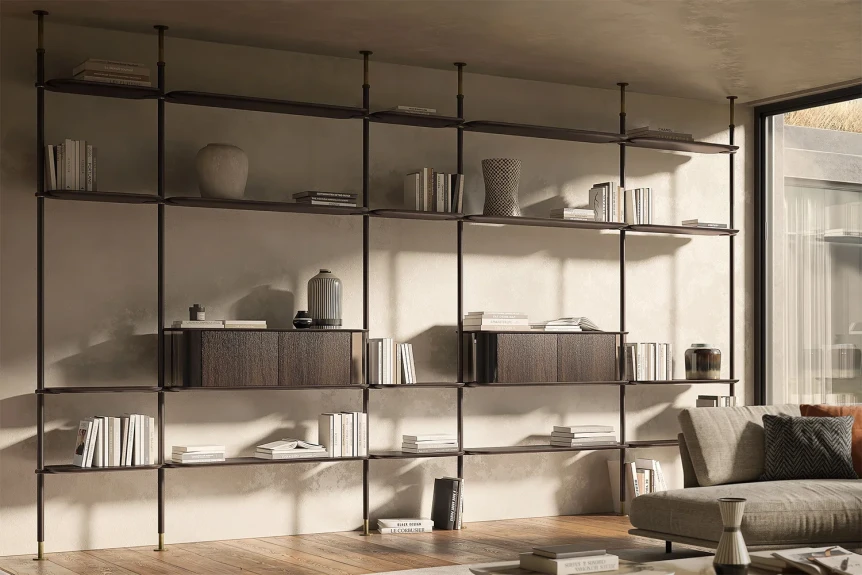
There are two kinds of bookshelf in any modern home. The aspiration shelf is the one you imagine when you save photos: floor to ceiling oak, ladder included, perfectly styled, full of books in cloth bindings. The working shelf is the one you actually use. It holds the books you reach for, the paperwork you have not filed, the small object your kid handed you in October. The two rarely live in the same piece of furniture, and most modern bookshelf ideas fail because they pretend they should.
Good modern bookshelf ideas account for this split honestly. Some shelving is for display, with looser editing and more breathing room. Some shelving is for function, with denser fill and fewer styling demands. The interesting homes usually have both, and they are clear about which is which. The ones that try to make one bookshelf do everything tend to end up with a unit that looks half-styled and half-overflowing.
Key Takeaways
- Most homes need both an aspiration shelf and a working shelf, not one piece doing both jobs.
- Ladder shelves and modular cube systems work best when they match the way you actually live, not how you imagine you will.
- Material and finish matter more than silhouette for a bookshelf that lasts a decade.
- Floor to ceiling shelving is rarely the right call in homes under nine foot ceilings.
- Modern bookshelf ideas should serve the room first and the photograph second.
What makes a bookshelf “modern” rather than traditional?
Modern bookshelves share a few traits regardless of style label. Clean joinery without applied moldings. Visible structure rather than concealed construction. Thinner shelf depths than traditional library bookcases, usually around 10 to 12 inches rather than 14 or more. A preference for natural materials in their honest form: solid wood with a clear finish, powder-coated steel, leather strapping rather than ornament.
Traditional bookcases lean toward symmetry, ornamental crowns, and built-in scale. Modern bookcases lean toward proportion, asymmetry of styling, and a lighter visual footprint even when the unit is large. The most modern bookshelves read as furniture first and storage second. They have presence on their own, before any books or objects go on them. For the same approach in another style, see color coded bookshelf.
The full styling principles for this kind of shelving sit in the complete guide to bookshelf styling. This post focuses on the unit itself, the form factor, and the trade-offs between common modern shapes.
The Aspiration Shelf vs the Working Shelf
The aspiration shelf is the unit you photograph. It earns its visual real estate in the room. It is styled with patience, holds books you actually want visible, and is typically smaller than people expect. Three to five shelves of carefully chosen material, hung floating or sitting on a clean base. This is the shelf that does the work in the living room or whichever room hosts the most.
The working shelf is the one in the office, the hallway, or behind a closet door. It is denser. It has reference books, kid art, taxes, and a small box of cables you have not parted with. The working shelf does not need to look like a magazine. It needs to keep your stuff organized and out of sight from the main room. The mistake is trying to host both jobs in one unit positioned in the living room.
If you live in a smaller space and cannot dedicate two separate units, the answer is closed storage doing the working-shelf job and a smaller open piece doing the aspiration job. A sideboard with closed doors plus a slim wall-mounted shelf gets you both functions in roughly the same footprint as one larger bookcase. The sideboard buying guide covers the closed half of this equation.
Which modern bookshelf shape works in your home?
The right modern bookshelf shape depends on three factors: how much you actually want to store, the ceiling height of the room, and whether you rent or own. The most photographed shapes (the floor to ceiling oak wall, the ladder shelf) are not always the right call in real living rooms.
| Shape | Best For | Typical Footprint | Watch Out For |
|---|---|---|---|
| Floor to ceiling built in | Homeowners with 9 foot plus ceilings and large book collections | Full wall length, deep visual commitment | Reads heavy in lower ceiling rooms; cannot move with you |
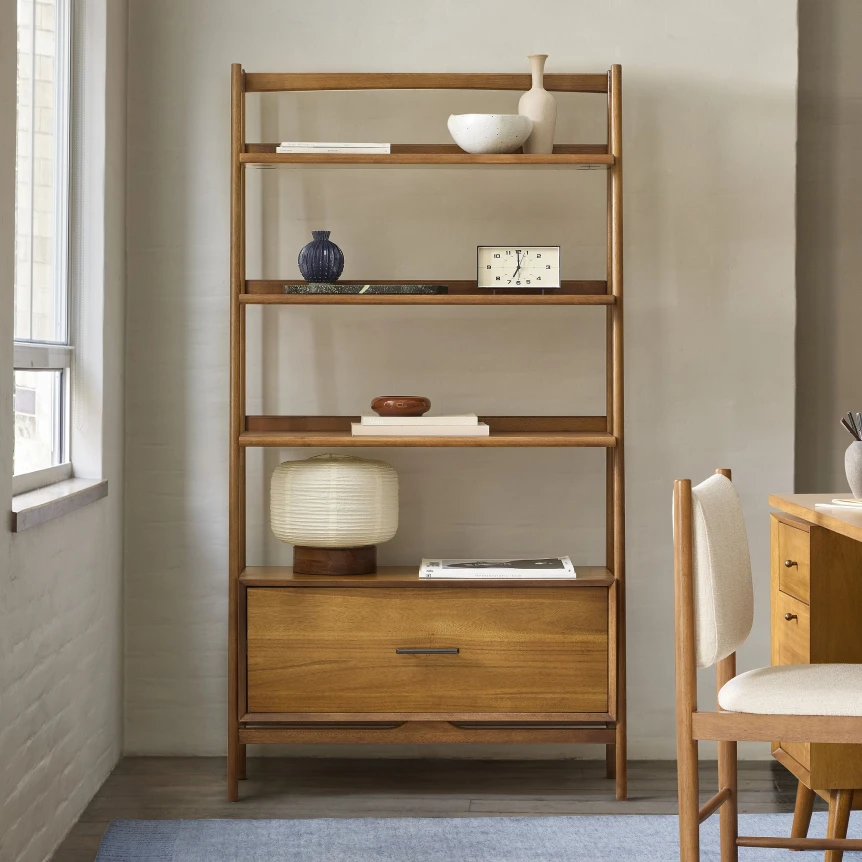
| Ladder shelf (leaning) | Small spaces, renters, lighter book collections | About 24 inches wide, 70 inches tall | Limited storage; can feel flimsy at upper shelves |
| Modular cube system | Growing collections, flexible rooms, renters who relocate often | Scales as needed | Every cube needs styling attention; can read as flat-pack |
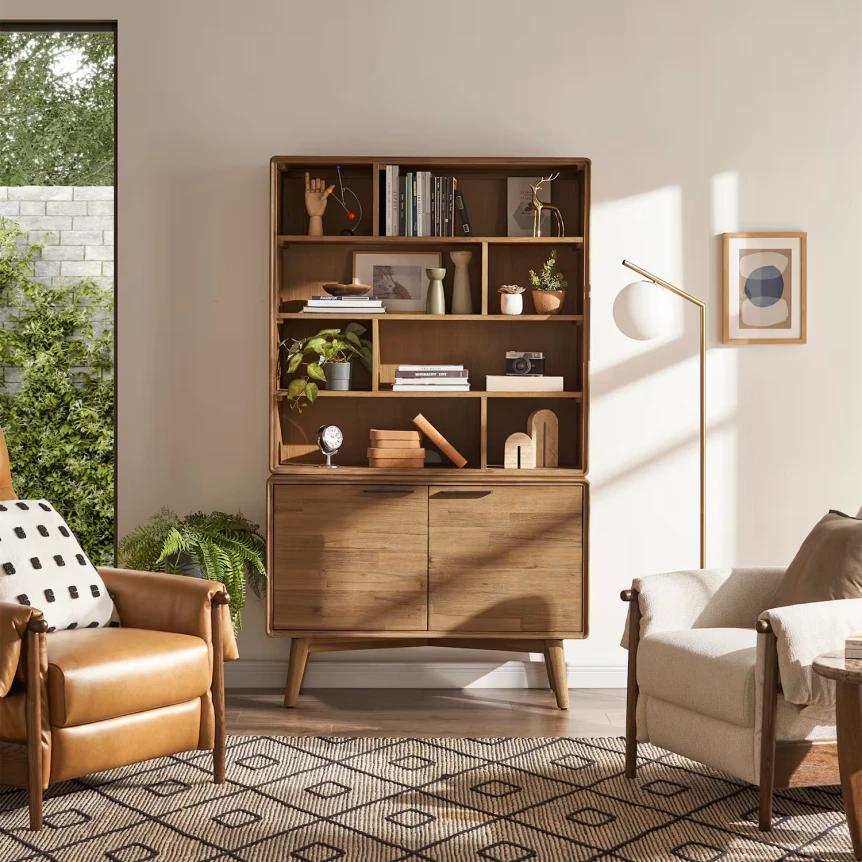
| Mid century low credenza with hutch | Mid century modern interiors, mixed book and object display | Roughly 60 to 72 inches wide | Higher price point for solid wood versions |
| Floating wall shelves | Minimalist rooms, focused display rather than storage | Adjustable, low visual weight | Limited capacity; depth tends to be shallow |
| Standalone bookcase (closed back) | Most living rooms, balanced display and storage | Roughly 36 inches wide, 72 inches tall | Make sure the back panel quality matches the rest |
If you are renting, the decision tilts strongly toward freestanding rather than built in. The reasoning, including the financial math, is laid out in built in vs freestanding bookshelves. A good freestanding piece that travels with you is a better investment than a custom install you walk away from in three years.
Material choices that earn the price
Solid wood is the material that ages well and resells well. Oak, walnut, and ash are the species that turn up in well-made modern bookcases most often, and they patina rather than wear. Veneered MDF is the dominant alternative at lower price points. A good veneer can look excellent for several years, but it does not survive moves and chips at the edges the way solid wood does not.
Powder-coated steel works beautifully for ladder shelves and industrial-leaning units. Matte black is the cleanest finish; brushed steel reads cooler and slightly dated; bronze and oil-rubbed finishes can work but tilt the unit toward traditional. Steel frame plus oak shelves is a combination that holds up across multiple style languages.
Avoid: glossy lacquered finishes (they show every fingerprint and chip the moment you scratch them), exotic veneers that go out of fashion (zebrawood, rosewood patterns), and any unit where the back panel is thin pressed cardboard. The back panel is one of the easiest places to spot a bookcase that will not last.
How does ceiling height change the right shelving choice?
Ceiling height changes the conversation entirely. In a room with eight foot ceilings, a floor to ceiling shelving wall closes the room rather than opening it. The mass overwhelms the visual rhythm. In a room with 10 foot or higher ceilings, the same install reads as architectural and impressive.
For standard ceilings (eight to nine feet), keep the bookshelf shorter than the ceiling by at least a foot. The negative space above the unit gives the eye somewhere to go and prevents the unit from competing with the architecture. A 72 inch tall bookcase in a room with 96 inch ceilings reads as furniture. The same bookcase pushed to 90 inches starts reading as built in, but without the conviction.
In rooms with very high ceilings, the rules invert. A six foot bookshelf can read as small and dwarfed by the volume of the room. Vertical shelving units, stacked floating shelves at different heights, or full wall installs all become viable in a way they are not in a typical eight foot space.
Why mid century modern shelving keeps showing up
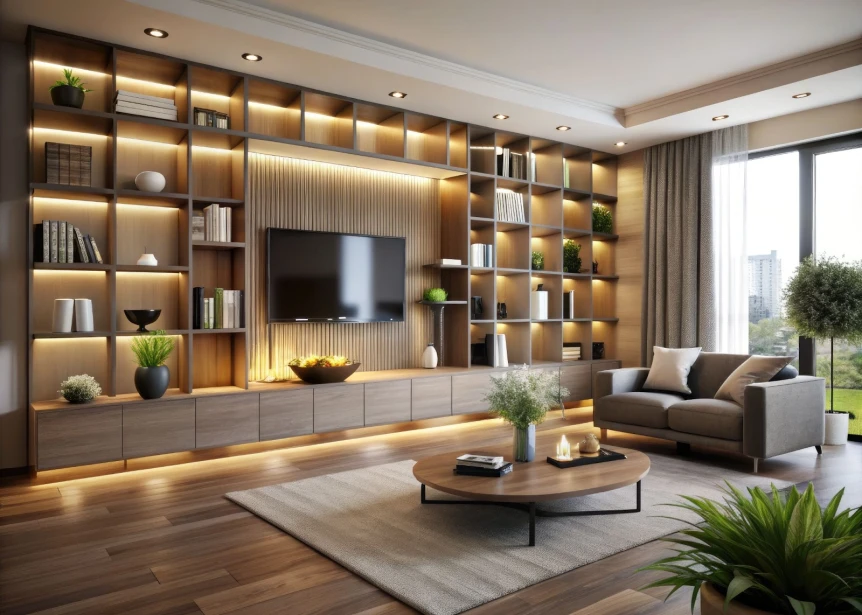
Modular cube-and-shelf wall units from the mid century are still the most enduring solution to the modern bookshelf problem. The proportions tend to be human-scaled. The mix of open shelves and closed cabinets matches the aspiration-versus-working-shelf split this whole post is built around. And the design language reads as both confident and adaptable.
Solid walnut versions are expensive but tend to be the pieces people keep. Lower-priced reproductions in veneered finishes can be a good starter, with the understanding that you may upgrade in a decade. The classic furniture pieces in the genre are covered in the mid century modern furniture guide, and the shelving units are usually the second or third piece people add after a sofa and a coffee table.
What about minimalist bookshelf ideas?
Minimalist bookshelves run smaller and more selective. Floating wall shelves or a single slim freestanding unit with three to five shelves of carefully edited books and one or two objects. The minimalist approach is not about owning fewer books. It is about being clear which ones earn open display, and storing the rest behind doors or in another room.
A floating shelf installation in a minimalist living room often looks like three shelves of varied length, mounted at offset heights against a quiet wall. The asymmetry breaks the architectural rigidity, the floating mount creates a lightness that grounded shelving cannot, and the limited capacity forces the editing that defines the style. For broader context, the minimalist furniture guide covers the larger language.
Scandinavian bookshelf ideas
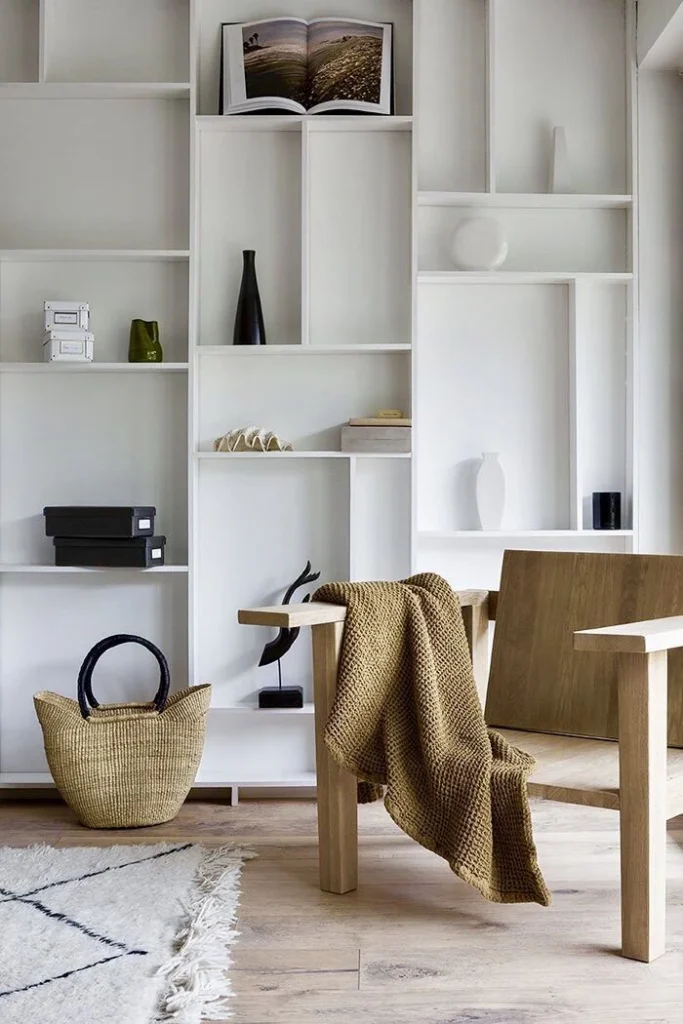
Scandinavian shelving tends to use lighter woods (white oak, ash, sometimes painted versions in soft whites), open structures with visible joinery, and proportions that lean tall and slim rather than wide and deep. The shelves themselves are often thinner than American counterparts, which gives the whole unit a delicate, almost airy presence.
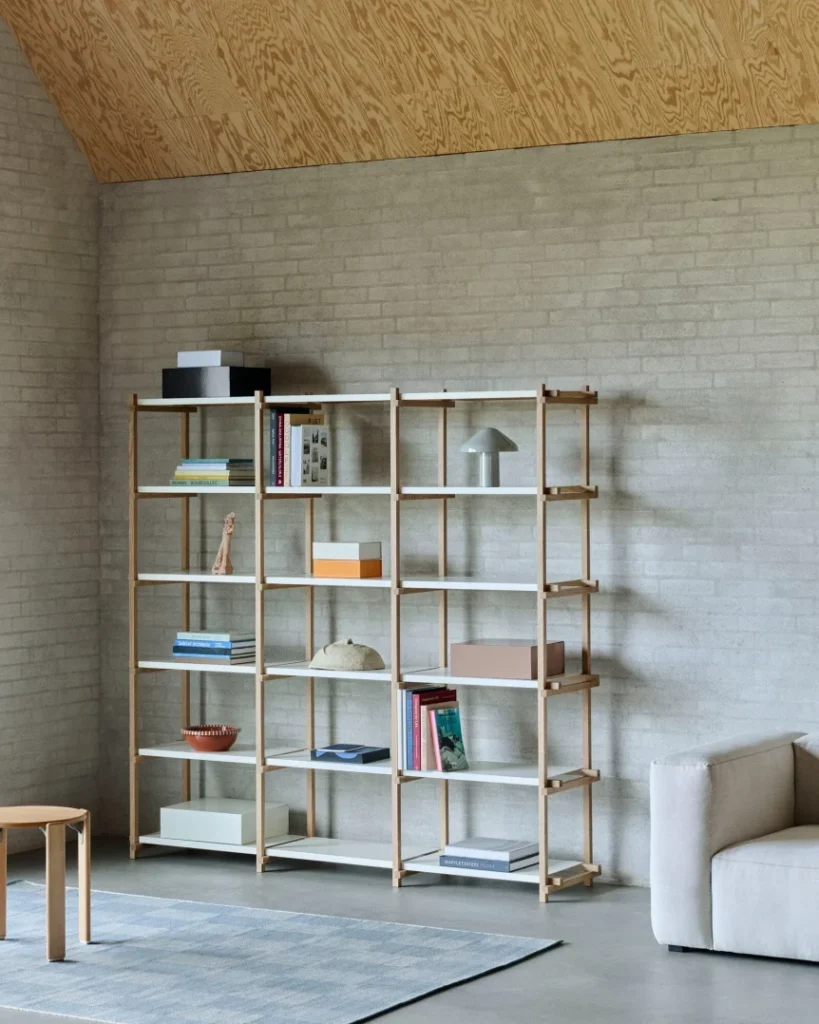
The styling for Scandinavian bookcases stays light. Fewer objects, more space between groupings, and a strong preference for objects in soft natural materials (linen, undyed wood, matte ceramic, raw stoneware). The Scandinavian furniture guide goes deeper on the material language, and the bookshelf is one of the easiest places to introduce a Scandinavian sensibility without committing the whole room.
Mistakes that make modern bookshelf ideas fall apart
Buying for the photograph rather than the room. A ladder shelf in a small bedroom is photogenic and impractical for a serious book collection. A floor to ceiling install is dramatic in marketing photography and overwhelming in eight foot ceilings.
Underestimating capacity. Modern bookshelves are typically shallower than traditional library bookcases. A 10 inch deep shelf holds standard hardcovers and most paperbacks, but it cannot accommodate large format coffee table books standing upright. If you own a lot of art and design books, factor in either deeper shelves or horizontal stacks as the default for those titles.
Choosing the wrong finish for the room. A red-toned wood bookshelf in a cool-palette room fights the rest of the space. The bookshelf is large enough to push the room’s color temperature one direction or the other, so pick the finish in context, not in isolation.
Filling it on day one. A new bookshelf that is fully styled within a week of arriving usually reads as bought, not curated. Let the unit live underfilled for a few weeks while you observe what wants to be on it. The result is more personal and less catalog.
Where to go from here
Once you have chosen the right shelving form, the next question is what goes on it. The pillar guide to bookshelf styling covers the thirds rule, the empty shelf principle, and the leaning technique that does most of the visual work. For style-specific styling approaches, bookshelf styling by style walks through how the same unit reads in Japandi, mid century modern, minimalist, and industrial homes.
If you are buying new and trying to decide between custom built in and freestanding, that is its own decision, and built in vs freestanding bookshelves walks through the tradeoffs that matter.
Frequently Asked Questions
What makes a bookshelf modern rather than traditional?
Modern bookshelves use clean joinery without applied moldings, visible structure rather than concealed construction, thinner shelf depths around 10 to 12 inches, and natural materials shown honestly. Traditional bookcases use symmetry, decorative crowns, and built-in scale. The cleanest signal of a modern bookshelf is that it reads as furniture first and storage second, with presence even before books and objects go on it.
Is a floor to ceiling bookshelf right for a living room with eight foot ceilings?
Usually no. In rooms with eight foot ceilings, floor to ceiling shelving closes the space rather than opening it, and the mass tends to overwhelm the visual rhythm of the room. A shelving unit at 72 inches tall in a 96 inch ceiling room leaves enough negative space above the shelf to keep the room feeling balanced. Save the floor to ceiling install for rooms with at least nine foot ceilings.
What is the difference between a ladder shelf and a regular bookshelf?
A ladder shelf leans against the wall and tapers from a wider base to a narrower top. A regular bookshelf stands vertical with uniform width. Ladder shelves are lighter visually, easier to move, and work well in smaller spaces or as accent pieces. They hold less than equivalent footprint bookcases and tend to feel less sturdy at the upper shelves, which matters if you own heavy books.
How deep should a modern bookshelf be?
Around 10 to 12 inches works for most book collections, including standard hardcovers and paperbacks. If you own a lot of large format art and design books, look for at least 13 inches of usable depth, or plan to store those titles in horizontal stacks. Shallower shelves around 8 to 9 inches read as more delicate but limit what fits upright.
Should I match the bookshelf wood to my other furniture?
Match within a tonal family rather than identical species. A walnut bookshelf does not need to match a walnut coffee table exactly. Mixing woods within the same warm or cool tone works well and adds depth. The combination to avoid is a clearly warm wood (red oak, walnut) with a clearly cool wood (ash, white oak with cool stain) in the same room. The temperature mismatch reads as accidental.