Built In vs Freestanding Bookshelves: How to Choose

By Tereza Hower | Published May 21, 2026 | Updated October 13, 2026
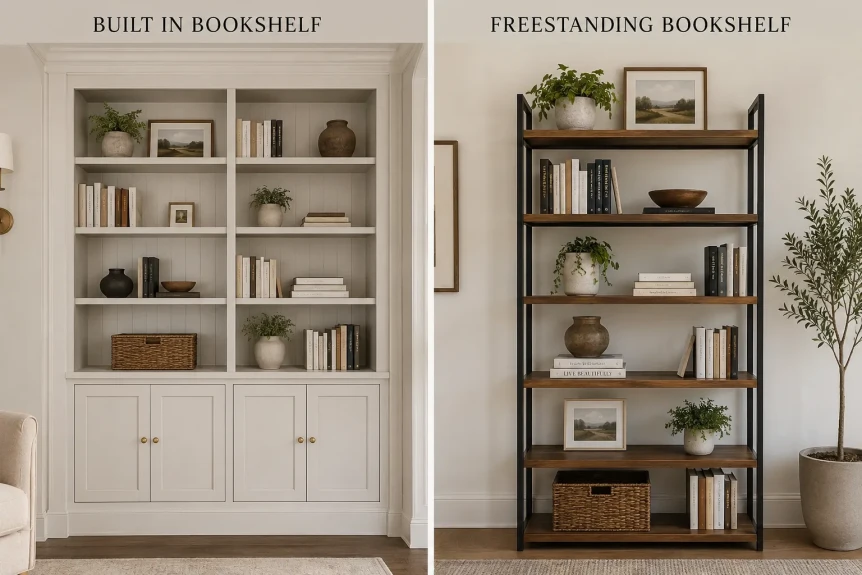
Is it actually worth building bookshelves into the wall, or is freestanding the smarter call? The answer depends on how long you plan to stay in the home, what your wall conditions allow, and whether you value the architectural look enough to forfeit the unit if you ever move. The conversation gets framed as a design preference, but the real decision is mostly financial and practical. The aesthetic difference between a good built in and a good freestanding piece is smaller than it looks online.
Over a decade of renting, most people move four or five times, and every shelving unit that survives the moves is freestanding. Partly that is circumstance, and partly it is the better decision. Freestanding pieces travel. A good one will outlast three couches and two coffee tables, while a built in stays behind in an apartment whose walls were never yours. Built in vs freestanding bookshelves is mostly a question about how long the room you are styling will stay yours, and what you want to walk away with when it changes.
Key Takeaways
- Built ins add value only when you stay in the home long enough to recoup the cost.
- Freestanding pieces are the right call for renters and anyone moving within five to seven years.
- A high quality freestanding unit can be styled to read as architectural without the install commitment.
- Built ins win on small awkward spaces (alcoves, niches) where a stock piece cannot fit cleanly.
- The financial math usually favors freestanding once you account for moving and resale.
What counts as built in shelving versus freestanding?
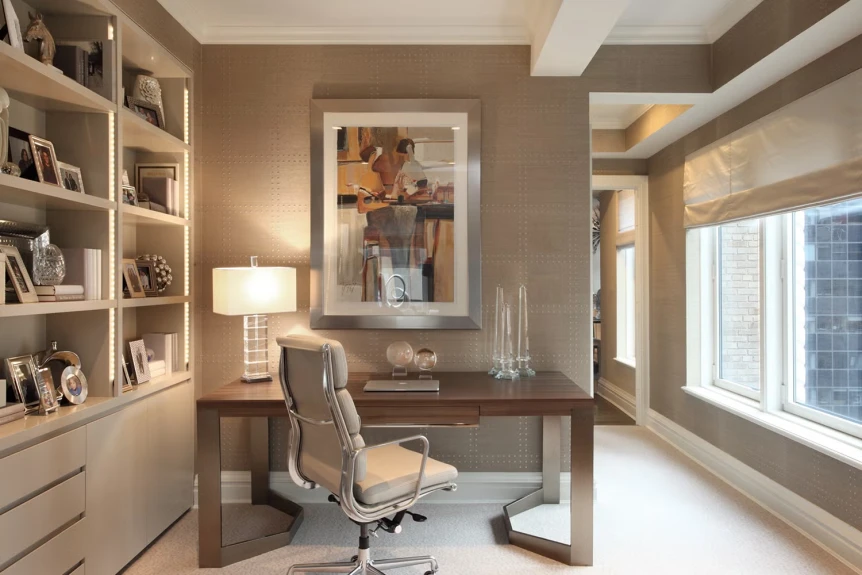
Built in shelving is permanently attached to the architecture of the room. It typically runs floor to ceiling, sits flush against the wall on at least three sides, and is constructed with the wall as part of its structural integrity. Removing it leaves drywall damage, paint touchups, and often subfloor exposure. The unit cannot be sold separately from the home.
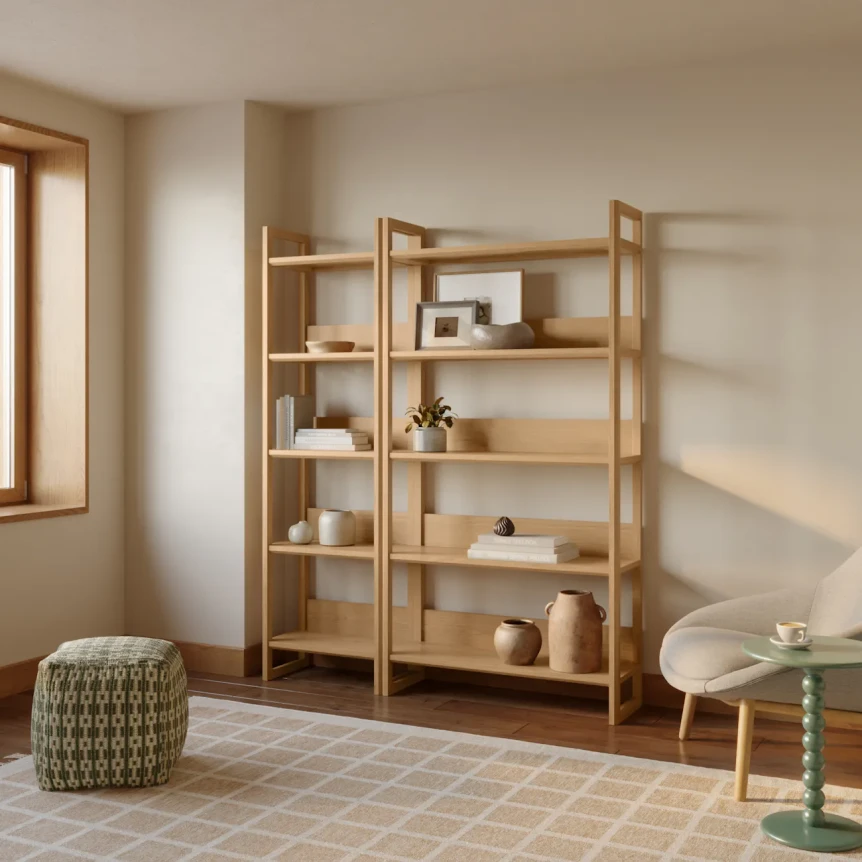
Freestanding shelving is a piece of furniture. It rests on the floor, sometimes anchored to the wall for safety, but it can be unscrewed and moved without architectural impact. The unit retains resale value as furniture and can travel between homes. The visual line between the two is sometimes thin, especially with tall freestanding pieces pushed flush against the wall, but the practical line is sharp.
The full styling principles for either type are covered in the complete guide to bookshelf styling. This post is about the unit itself, and which version to choose before any books or objects go on it.
How much does a built in actually cost?
A custom built in from a finish carpenter typically runs from about $3,000 for a small alcove unit up to $15,000 or more for a full wall floor to ceiling install in solid wood. The wide range reflects materials, finish quality, and complexity. MDF built ins finish much cheaper than solid wood. Painted finishes cost less than stained ones in most cases. Hidden lighting, glass doors, and complex moldings add quickly.
Comparable quality freestanding bookcases run $400 to $4,000 depending on materials, brand, and scale. A solid walnut freestanding mid century unit in good condition can be found in the $1,500 to $3,500 range and will be a piece you keep for decades. The price difference between a built in and a freestanding for similar visual presence is usually four to five times in favor of the freestanding.
Built ins also carry hidden costs. If the install requires moving electrical outlets, removing baseboards, or working around heating vents, those add to the bill. Touchup painting after install is rarely included. And built ins are not deductible from sale price the way some kitchen upgrades are. The return on investment, when you sell, is partial at best.
Which is better for renters?
Freestanding is the only sensible call if you are renting. Built ins forfeit at the end of the lease, and most leases prohibit them entirely. Even semi-permanent installs (heavy wall anchors, modular cube systems screwed into studs) leave damage that comes out of the deposit.
The renter case for good freestanding bookshelves runs deeper than just practicality. A high quality piece of furniture that travels with you is a long term investment. A well made walnut bookcase can pass through four different rooms across three homes and look better in the last one than it did in the first. A built in bought for the same money stays with the apartment.
Modular cube systems are the closest renter-friendly approximation of a built in look. They can be configured to fill a wall and read as architectural, then disassembled and reconfigured in the next home. They lack the flush-to-wall finish of a real built in, but they get most of the visual effect at a fraction of the commitment.
When is a built in actually the right call?
Built ins make sense in three specific situations. First, when the space is awkward enough that no stock furniture fits well. An alcove, a niche around a fireplace, a sloped ceiling area, or a wall that is shorter than standard bookcase widths. In these spaces, a built in is the only way to make the geometry work.
Second, when the home is genuinely long term. If you plan to stay seven years or more, the built in amortizes over the years you actually use it, and the partial resale recovery at the end is less painful. Below five years, the math gets harder to justify.
Third, when the architectural presence matters more than the unit’s contents. If you are designing a library room where the shelving itself is the centerpiece, a built in delivers a level of integration that freestanding cannot match. Floor to ceiling built ins with crown moldings and base trim read as architecture in a way that a freestanding bookcase cannot.
Comparing the design impact
| Factor | Built In | Freestanding |
|---|---|---|
| Visual integration | Reads as architecture, flush with walls | Reads as furniture, can be repositioned |
| Cost | Roughly $3,000 to $15,000 for quality install | Roughly $400 to $4,000 for comparable presence |
| Installation | Days of carpentry, drywall, paint touchups | Delivery and assembly, often same day |
| Reconfigurability | None without renovation | High; can be moved, restyled, sold |
| Resale impact on home | Modest positive in some markets | Neutral on home value |
| Resale value as furniture | Zero; stays with home | Retains value, especially solid wood pieces |
| Renter friendly | No | Yes |
| Best for awkward spaces | Yes | Limited; depends on stock dimensions |
The visual integration advantage of built ins is real but often overstated. A good freestanding piece pushed flush against the wall, with crown moldings continuing across the top, reads almost identical to a custom built in from across the room. The difference shows up in close inspection, not in the lived-in experience of the room.
Why does freestanding work better than people think?
Quality freestanding bookcases hold up to ten and twenty year time horizons in ways built ins cannot. Built ins age with the home; if the rest of the house gets renovated, the built ins start looking dated by association. Freestanding pieces age as furniture, which is a slower and more forgiving timeline. A good walnut bookcase from the 1960s reads better today than a custom built in from the 1990s, almost universally.
The flexibility of freestanding is also underrated. Rooms change use. A living room becomes a nursery, then a kid’s bedroom, then a home office over a span of years. Built ins lock the wall to a single function. Freestanding pieces can move with the room’s evolving purpose, or out of the room entirely.
And the unit can be upgraded. A starter freestanding bookcase can be replaced with a better one when budget allows, with the previous one sold or moved to a different room. Built ins are a single commitment with limited upgrade paths. For more on the long term furniture mindset, the minimalist furniture guide covers the buy-once philosophy in detail.
What about the look of a built in without the commitment?
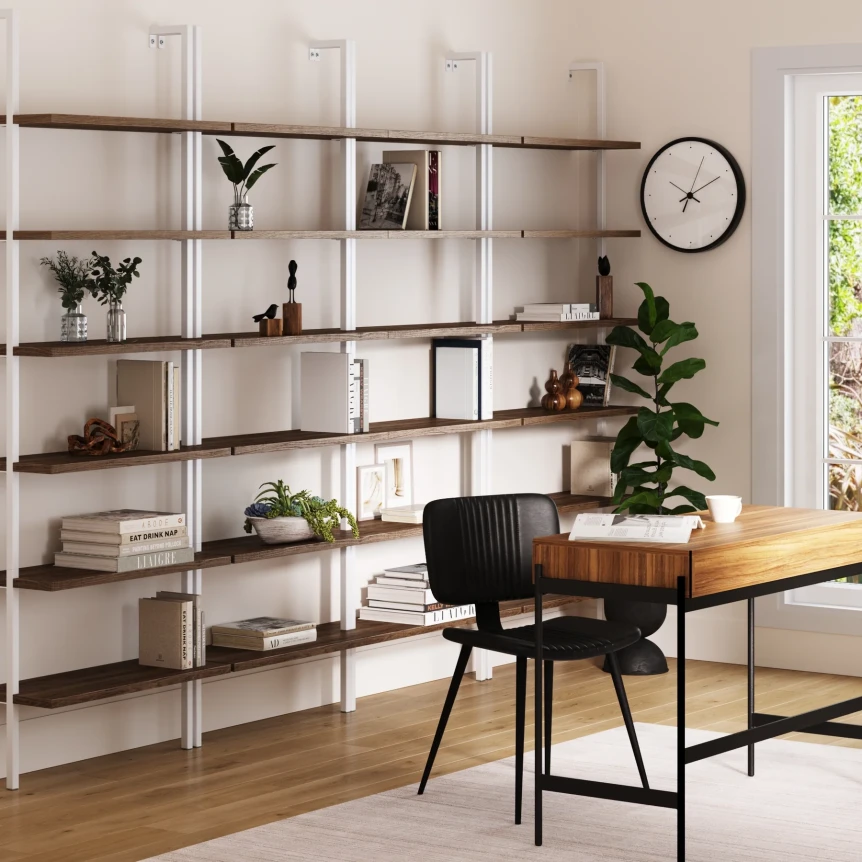
If the architectural look is the appeal, there are several ways to approximate it without the install. A floor to ceiling modular shelving system in a tight tonal palette can read as a wall of built ins from across the room. Two matching freestanding bookcases pushed together with crown molding capped across the top reads similarly. A single tall freestanding piece centered on a wall and flanked by sconces produces the focal moment of a built in without the carpentry.
The styling of these approximations matters more than usual, because the eye is being asked to read freestanding pieces as architectural. The styling needs to be confident and slightly more formal than typical bookshelf styling. The bookshelf styling pillar covers the techniques (symmetrical anchors, tighter color palettes, careful lighting) that pull this off.
Common mistakes in the built in versus freestanding decision
Overestimating how long you will stay. Most people who commission built ins expect to stay in the home longer than they actually do. If you have moved twice in the past decade, you will probably move again within the next, and the built in is a sunk cost.
Underestimating freestanding quality at higher price points. People assume that built ins are the only way to get a high end look, which is mostly a marketing problem. A $3,000 freestanding solid wood bookcase has the same material quality as a $10,000 custom built in, minus the architectural fit. For most living rooms, the architectural fit is not worth the multiple.
Forgetting about earthquake and tip hazards. Tall freestanding bookcases need to be anchored to the wall, especially in homes with kids or in seismic regions. The anchoring is minor (two screws into a stud) and is reversible at move-out, but it is essential. Built ins handle this structurally; freestanding requires the small additional step.
Building in when modular would have done the job. Modular shelving systems have improved dramatically over the past decade. Configurable units that mount partially into the wall and partially stand on the floor can deliver 80 percent of the built in look with 25 percent of the cost and full reversibility. They are worth investigating before committing to a custom carpentry job.
The Renter’s Case for Freestanding Pieces
There is a less practical argument too. Pieces collected over years carry a weight a built in never quite does. A bookcase that has stood in four rooms, a used sideboard that has held three different sets of objects in three different homes: those become part of how a home is understood, in a way an installation that stays behind does not.
If you have moved more than once in the past five years, freestanding is the right answer. If you are not sure where you will be in five years, freestanding is still the right answer. Built in shelving is for the home you know you will not leave. For almost everyone else, the freestanding piece you would have bought instead is the better long term investment.
If you are leaning freestanding, the next read is modern bookshelf ideas, which covers the specific shapes and materials worth considering. For when you have settled the form question and want to focus on what goes on the shelves, how to style open shelving in a living room covers the styling craft.
Frequently Asked Questions
Do built in bookshelves add value to a home?
Modestly, in some markets, and only when the built ins are well executed and match the rest of the home’s design language. The return on investment is partial; most homeowners do not recover the full cost at sale. Built ins are best understood as a quality of life upgrade for the years you live in the home, rather than a value add for resale.
How long does a built in bookshelf take to install?
A custom built in from a finish carpenter typically takes three to seven working days for a single wall install, plus another day or two for paint touchups and finishing. Larger floor to ceiling installs with complex elements such as glass doors or integrated lighting can stretch to two or three weeks. The room is usually unusable during the install.
Can freestanding bookshelves look as good as built ins?
Yes, especially when styled with intention and positioned thoughtfully. A high quality freestanding piece in solid wood, pushed flush against the wall and flanked by sconces or symmetrical lighting, reads very close to a built in from across the room. The visible difference shows up in close inspection (flush trim, perfect wall integration) but rarely in the lived-in experience of the room.
Should I install built in bookshelves if I am renting?
No. Built ins forfeit at the end of the lease and most leases prohibit them. The financial loss is total and you cannot take the unit with you when you move. Quality freestanding bookcases or modular shelving systems give you most of the design effect without the loss of investment, and they travel with you to the next home.
What is the cost difference between built in and freestanding bookshelves?
A custom built in typically costs $3,000 to $15,000 depending on materials and complexity. A comparable freestanding piece typically costs $400 to $4,000. The cost difference is usually four to five times in favor of freestanding for similar visual presence, and freestanding retains resale value as furniture while built ins do not.