Bookshelf Styling When You Have Too Many Books

By Tereza Hower | Published May 24, 2026 | Updated October 12, 2026
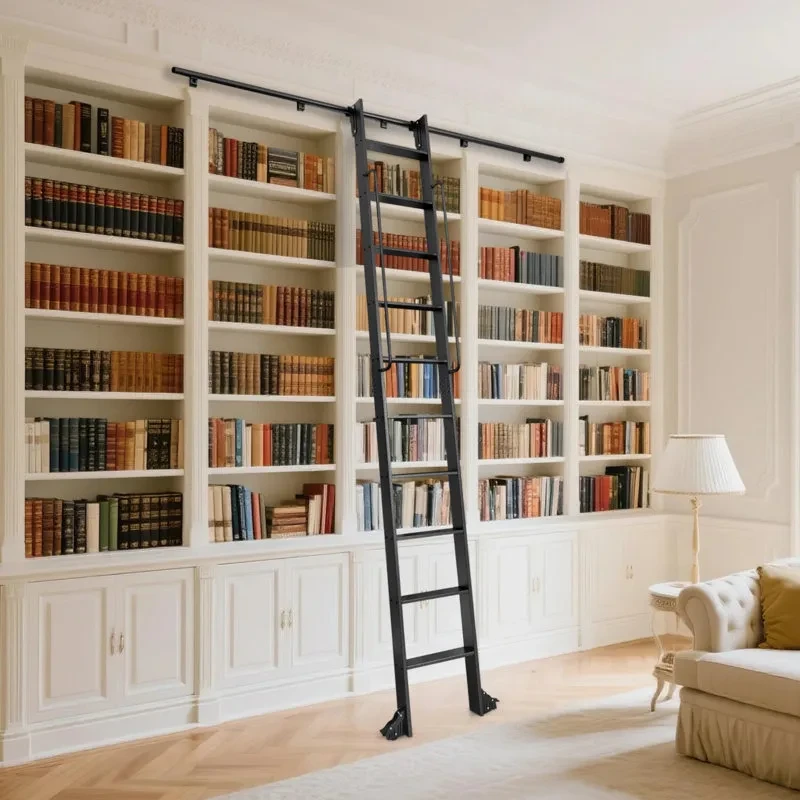
The bookshelves that read as cluttered are almost never about object selection. They are about volume. Too many books, too few inches of shelf, and the styling cannot do its job no matter how thoughtfully you arrange anything else. The question of how to style a bookshelf with lots of books is really two questions stacked together. Which books deserve open display, and where do the rest of them go.
Treating bookshelves as containers for everything you have ever read makes them look like inventory. A first cull that removes roughly 40 percent of the books from the open shelves immediately makes the room read calmer, more confident, and more like a home. Most of those books do not need to leave the house. They move into closed storage. The shelves become less about possession and more about display.
Key Takeaways
- The shelf looks crowded because of book volume, not styling choices.
- Roughly 30 to 40 percent of most home libraries can be moved to closed storage without losing access.
- Edit by visual contribution, not by category or reading frequency.
- Horizontal stacks read denser than vertical rows of the same book count.
- The overflow needs a real home; otherwise the cull will not stick.
What does “too many books” actually mean?
It means your books exceed the volume your open shelves can hold at roughly two-thirds full. That is the styling target from the bookshelf styling pillar, and it is the density that reads as composed rather than stuffed. If you have enough books to fill your shelves to 90 or 100 percent, you have too many books for those shelves.
The problem is not the books. It is the mismatch between collection size and shelf capacity. You can solve it by adding shelves (sometimes the right answer), but more often the better solution is to edit the open display and find a second home for the rest. The shelves get to do their styling job, the books stay in the apartment, and nothing ends up in a donation bin you will regret in two years.
The reading list editing exercise
The cull that works is not based on which books you loved or which ones you might reread someday. Those questions lead nowhere, because the answer to both is usually yes. Sort instead by what each book contributes to the shelf visually, in three rough categories.
Category one is books that look good on a shelf and that you have read or genuinely intend to return to. Cloth bindings, design and art books, beautifully designed paperbacks, the novels with spines you would point to if asked what you read. These earn permanent open display.
Category two is books you love but that look visually busy or mismatched (mass market paperbacks, the third novel in a series with garish covers, the airport thriller you finished on a flight). These can be kept and used, but they live in closed storage or a less prominent shelf. Their value is in reading, not in display.
Category three is books you have not opened in five or more years and do not plan to. Even small donations from this category will reduce shelf pressure significantly. Most homes have more category three books than they realize. The honest cull is small but high impact.
Where does the overflow actually go?
The cull only works if the books that come off the shelf have a real home to go to. Otherwise they end up in boxes in a closet, which is fine until you need to find a specific title and have no idea which box it is in.
Best overflow homes, in rough order of accessibility: a closed bookcase or cabinet in a different room (study, bedroom, hallway), a sideboard with closed doors that doubles as bookstorage (covered in the sideboard buying guide), under bed storage in a fabric box or rolling case, the upper or lower shelves of closet that are not used for clothing, and finally, labeled storage boxes in a less accessible place. Each of these holds different volumes; pick based on collection size.
Keep an inventory of the overflow in a single note on your phone, organized by location (which shelf, which box) and rough category (fiction, design, cookbooks). It takes about 20 minutes to set up and saves hours of searching later. The shelves stay sparse, the books stay findable.
How do you style a bookshelf with lots of books still on display?
If your collection genuinely cannot be reduced (academic libraries, working writers, dedicated readers), the styling approach shifts. You are still styling, but the techniques compress to make density read as intentional rather than overwhelming.
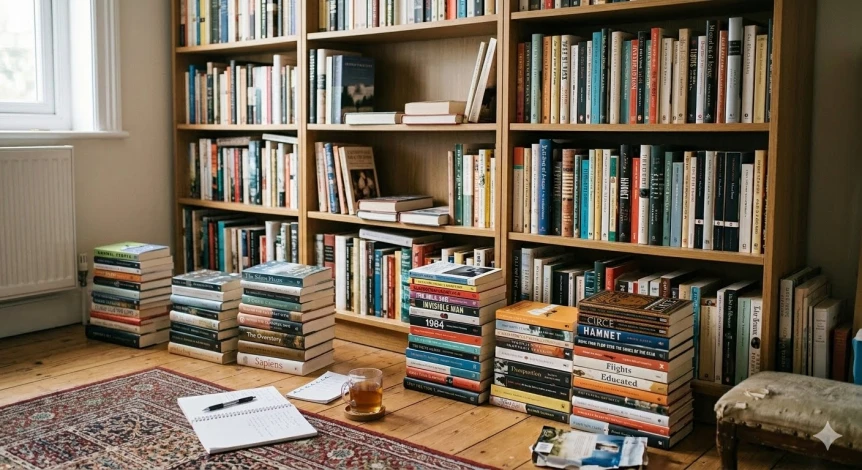
Lean into horizontal stacks. A horizontal stack of five books takes up less visual space than five vertical spines side by side, even when it holds the same number of books. The change in orientation creates rhythm and signals styling intent. Stack two or three horizontal piles per shelf, between or under vertical rows.
Group quiet spines into long runs. Linen and cloth bound books, undyed paperbacks, and matching publisher editions can run together for ten or fifteen spines before you need any break. The eye reads this as one composed block rather than fifteen separate books, which compresses the visual count.
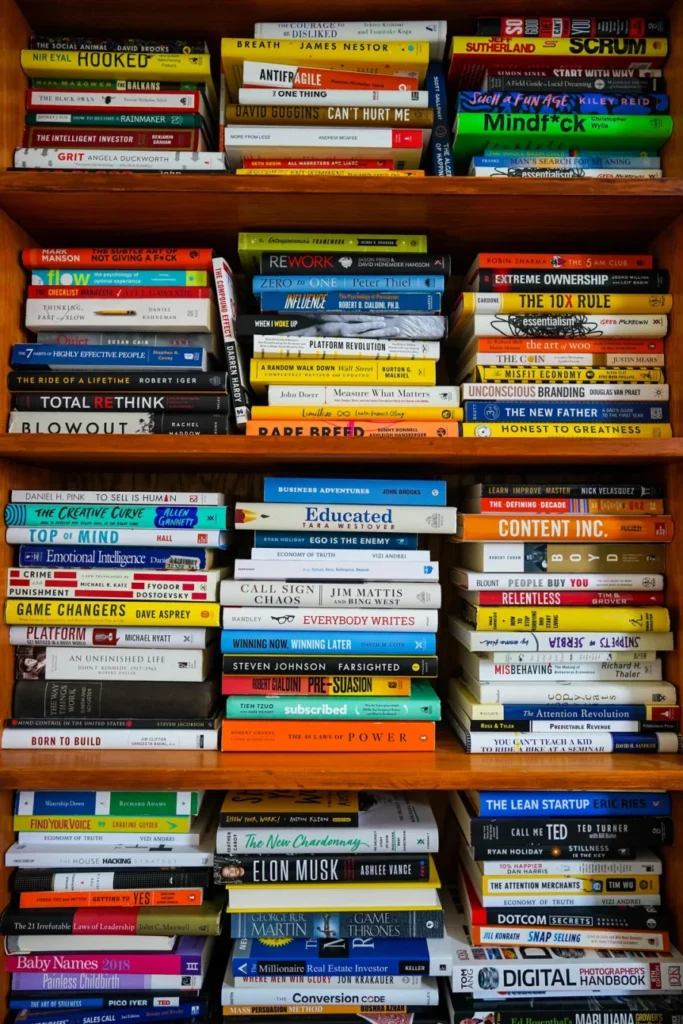
Isolate the loud jackets. Mass market paperbacks with bright covers and pulpy thriller spines tend to be the source of the cluttered read on dense shelves. Concentrate them into one specific section (maybe a single shelf, or one half of a shelf) rather than scattering them throughout. The eye then reads them as a deliberate accent rather than visual noise.
Should every book be visible?
No, and the desire to make every book visible is usually what creates the visual problem in the first place. The best bookshelves are rarely the ones with the largest collections on display. They are the ones with the most confident editing.
A small home library on display, plus a larger working library in closed storage, sends a more interesting signal than a wall of every book you own. The visible shelf becomes a curated portrait of your reading life, not an inventory. Visitors register the curation, even if they cannot articulate what they are responding to.
Practical version: aim for the visible shelf to hold roughly 30 to 60 percent of your total book collection, with the rest accessible nearby. The exact ratio depends on how big your collection is and how much shelving you have. The principle is the same.
What about double stacking books behind each other?
Double stacking, where a second row of books sits behind the front row on a deep shelf, is a workable solution for genuine overflow but it has costs. Access is slow (you move the front row to get to anything behind it), the styled vignettes get pushed to the front edge of the shelf with no breathing room, and the hidden back row tends to become a graveyard for books you forget you own.
If you double stack, only do it on the lower shelves where the styling is less critical, and keep the back row to books you reference but rarely read in full. Reference books, language dictionaries, cookbooks you consult occasionally. Avoid double stacking active reading material; it never gets pulled back out.
What if my partner and I have very different book aesthetics?
Two collections competing for one shelf cause most bookshelf disagreements, and the solution is usually territorial rather than aesthetic. One person’s books take the open shelves in the main room. The other person’s books take a different unit elsewhere (the bedroom, the office, a hallway). Both collections stay intact. Both people get visual ownership of their part of the house.
Mixing two strong book aesthetics on one shelf almost always results in a visually busy compromise. Splitting them across two shelves, even in the same room, gives each collection its own register and prevents the constant low grade tension of styling a unit you both feel ownership over.
Common mistakes when styling around a large collection
Buying more shelving as the first response. The instinct is to add shelf inches when the existing shelves are overstuffed. Sometimes the right answer, but more often the additional shelving just enables continued accumulation. Try the cull before the carpenter or the catalog.
Stacking everything in the same direction. A wall of vertical spines, even if the books are good ones, reads as flat and undifferentiated from across the room. Break it up with horizontal stacks every two to three feet of shelf width.
Treating the styling problem as a furniture problem. If you have too many books for the room, the answer is not always a bigger bookcase. Sometimes the answer is reading less paper, using a library more, or accepting that some books are better stored than displayed. The minimalism question shows up here in a way that is uncomfortable for serious readers, but worth sitting with. The decluttering guide covers the broader framework.
Which Edit Makes the Biggest Difference?
The most useful cull is not the obvious one. It is not removing the books you have not read or did not love. It is removing the books that add nothing to the shelf visually, even when you love them. A run of mass market paperbacks you have read several times, all with loud covers, can move to a closed bedside cabinet. They stay in the house and stay easy to reread. They just stop taking up open shelf space.
That kind of edit is the one that finally separates a shelf from being storage. The open display becomes about what looks good and what you want to be seen with, not about what you own. The rest of the collection sits patiently in closed storage, accessible whenever you want it. Plenty of favorite books end up off the visible shelves, and the visible shelves are better for it.
If you are tackling this kind of edit, the related read on color coding bookshelves walks through one specific approach to organizing what stays visible, and why it sometimes works and often does not.
Frequently Asked Questions
How do you style a bookshelf with lots of books without it looking cluttered?
Edit the open display down to roughly two-thirds full and move the rest to closed storage. Group books with quiet spines into long runs, isolate the loud jackets to one specific section, and break up vertical rows with horizontal stacks every few feet. The cluttered read comes from book volume, not styling choices, so the editing has to happen before any other adjustment.
Is it OK to double stack books on a bookshelf?
Workable but not ideal. Double stacking solves overflow but slows access, pushes styled vignettes to the front edge of the shelf, and tends to bury books you forget you own. If you double stack, do it on lower shelves only and use the back row for reference books you consult occasionally rather than active reading material.
What is the right ratio of visible books to stored books?
Roughly 30 to 60 percent of your total collection on visible shelves, with the rest in closed storage that is still accessible. The exact ratio depends on collection size and available shelving. The principle is that the visible shelf works as a curated edit rather than complete inventory, with the working library accessible but out of sight.
Where should overflow books go?
In rough order: closed bookcases or cabinets in other rooms, sideboards with closed doors, under-bed storage in fabric or rolling boxes, unused closet shelves, and labeled storage boxes in less accessible spots. Keep an inventory on your phone organized by location and rough category to avoid losing track of specific titles.
Should books be organized by color or by category on a styled bookshelf?
Generally by category or just by visual grouping, not by color. Color coding can work in monochromatic interiors but it makes books hard to find and tends to read as performative in most homes. A more useful approach groups books with similar spine tones into long runs while keeping the basic organization functional, which gets the visual calm of color coding without the access cost.