Console Tables for Modern Entryways

By Tereza Hower | Published June 5, 2026 | Updated October 12, 2026
An entryway console table tends to become one of two things: a styled surface that greets you with a lamp and a few considered objects, or a catchall that disappears under mail, chargers, and loose change within a week. The piece is the same. The difference is how it is sized, placed, and set up. This guide is about those design decisions, the proportions and styling that make a console work in a modern entry, rather than a list of specific pieces to buy.
The console suits a narrow entry better than a bench, since it hugs the wall and asks for less depth. It gives you a surface and, with the right design, some storage below, while leaving the floor open. If you already know a console is right and want vetted pieces, our roundup of the best entryway console tables compares finished options. This guide covers how to choose the proportions and set it up well, whichever piece you land on.
Key Takeaways
- A console suits narrow entries where a bench would crowd the path.
- Keep the depth under twelve inches in a tight space to protect the walkway.
- Decide upfront whether the console is a styled surface or a working catchall.
- A drawer or lower shelf adds storage without widening the footprint.
- One metal finish carried across the console, hooks, and lighting reads as considered.
Where Does a Console Belong in an Entry?
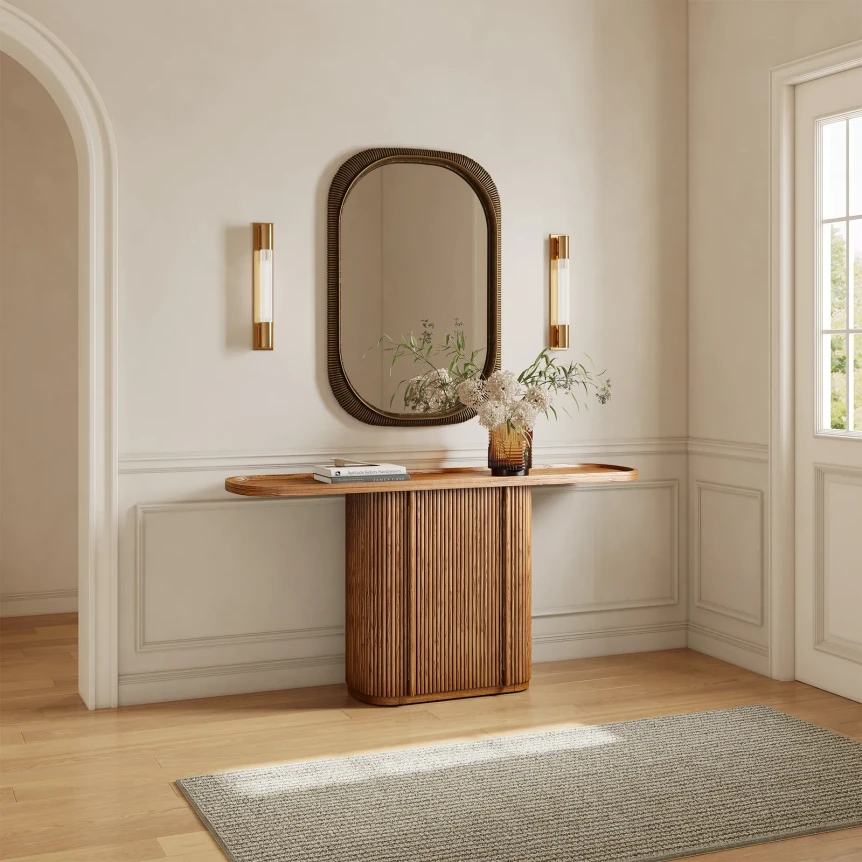
A console belongs against the first long wall you meet inside the door, within arm’s reach so it actually catches keys and mail. Pushed too far in, it stops being a landing spot and becomes a piece of furniture you walk past. The ideal placement puts the surface where your hand naturally drops as you enter.
In an open plan entry, a console can back onto the living space to define the boundary between the door and the room. In a hallway, it sits flat against one wall and relies on shallow depth to stay out of the path. Either way, the console marks the entry zone and gives the eye a place to settle as you come in.
Which Setup Do You Need, Catchall or Styled Surface?
Before settling on a piece, decide what the console is for. A styled surface is mostly decorative, holding a lamp, a tray, and a few objects, with just a small corner kept clear for daily items. A working catchall accepts that keys, mail, and chargers will land here, and is set up with a drawer and a tray to corral them.
Most entries need a bit of both, but choosing a primary purpose prevents the worst outcome, which is a styled surface slowly buried under clutter it was never meant to hold. If the console is your only landing spot, lean toward the working setup with closed storage and an honest catchall tray rather than fighting the pile.
The decision shapes what you buy. A catchall wants drawers or a cabinet base, while a styled surface can be an open leg piece with nothing to hide. Knowing the job first saves you from buying a beautiful surface that cannot keep up with your daily habits.
How Do You Size an Entryway Console Table?
Depth is the measurement that matters most in an entry. A console deeper than about fourteen inches starts to crowd a standard hallway, so in a narrow space aim for under twelve inches. The shallow depth keeps the walkway clear while still giving you a usable surface.
Height should land around the standard table height of thirty to thirty four inches, comfortable for setting things down and for a lamp. Length is flexible, so size it to the wall while leaving space at the ends rather than filling it edge to edge. A console that stops short of the wall reads as intentional and keeps the entry from feeling packed. For specific pieces worth buying, see hall tree buying guide.
Always measure the walking path first and protect the thirty six inches of clear width an entry needs, then size the console to the wall that remains. This ordering is the habit that prevents the most common console mistake, a piece that looked right in the store and blocks the hallway at home. The full sizing logic is in our complete guide to modern entryway design.
Console Styles and Storage Options
| Console style | Storage | Best for | Note |
|---|---|---|---|
| Open leg, no shelf | Surface only | Styled surfaces, small entries | Lightest visually |
| Lower shelf | Open shelf below | Baskets, books, a tray | Adds storage, stays airy |
| Drawer front | Closed drawers | Working catchall | Hides mail and small clutter |
| Cabinet base | Closed doors | Open plan, double duty | Most storage, largest look |
| Wall mounted | Surface, sometimes a drawer | Very tight hallways | Frees the floor entirely |
An open leg console reads lightest and suits a styled surface in a small entry, overlapping with our small entryway ideas. A drawer or cabinet base adds the closed storage a working catchall needs. For an open plan entry where the console doubles as living room storage, a cabinet base blurs into the territory of a sideboard.
Materials and Finish
A modern entry console looks best in honest materials with clean lines. Solid wood in white oak or walnut brings warmth, while a metal and glass console reads lighter and more open. A mixed material piece, such as a wood top on a blackened steel frame, carries a modern look and hides daily wear better than a pale lacquer surface.
Carry one metal finish across the console hardware, the wall hooks, and the lighting. That consistency is the detail that separates a considered entry from a collected one. A walnut tone pairs naturally with a mid century modern approach, while pale oak suits a lighter Scandinavian or Japandi entry.
Consider the wear the surface will see. A natural matte wood or a stone top hides rings and scratches far better than a glossy finish, which shows every fingerprint in an entry that gets touched constantly. For a high use catchall, durability of the surface matters as much as the look.
How to Style an Entryway Console Table
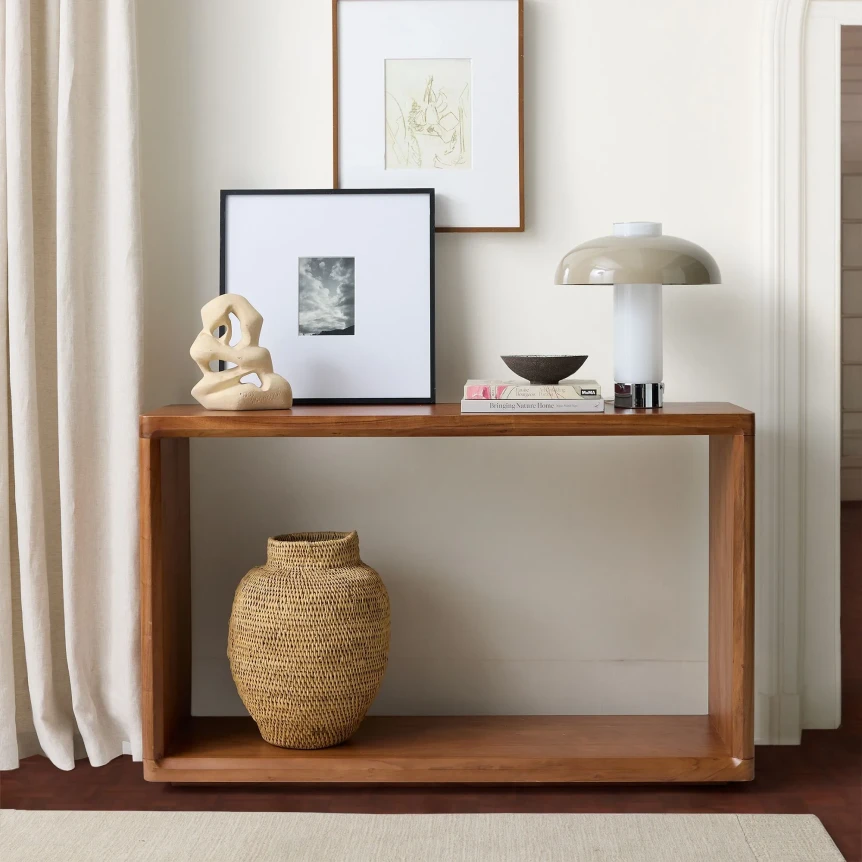
The styling formula for a console is simple and worth following. Anchor one end with a lamp, add a tray or a low vessel for keys, lean a piece of art or hang a mirror above, and keep a working corner clear on purpose. Two or three objects of varying height is plenty.
- A lamp at one end for the task light layer.
- A tray or bowl to corral keys and daily items.
- A small stack of two or three books or one sculptural object.
- A mirror or single piece of art above to finish the vignette.
- A deliberately clear corner so daily items have a home.
Vary the height of the objects so the eye travels across the surface rather than scanning a flat row. The lamp does double duty as styling and as the task lighting layer covered in our entryway lighting ideas. Protecting that clear corner is the single habit that keeps a console from sliding into catchall chaos.
If you hang a mirror above, leave a gap of six to eight inches between the surface and the bottom of the frame so the two read as a pair rather than a stack. A piece of wall art works just as well and adds color the console alone cannot.
Console or Bench: Which Fits Your Entry?
The console wins in a narrow entry, against a wall where seating is not realistic, and when you want a styled surface more than shoe storage. A bench wins when shoes are the main clutter and you want somewhere to sit. Many entries do best with one or the other rather than both, since space is tight.
If you decide a bench better fits your habits, our guide to entryway bench and storage solutions covers the choice in depth. Some wider entries can fit a console on one wall and a bench on another, splitting the styled surface and the seating between them.
What Goes Below a Console?
The space beneath a console is easy to waste. An open leg or single shelf console leaves a gap that can hold a pair of baskets, a slim shoe tray, or a single stool that tucks fully underneath. Filling it turns a surface only piece into one with real storage without changing the footprint.
Keep what goes below tidy and matched, since it sits in full view. Two identical baskets read as intentional, while a jumble of mismatched bins reads as clutter. A low tray for shoes contains drips and grit in a defined spot, and a tucked stool gives you seating that appears only when needed. In a small entry, this underused zone is often where the storage you thought you lacked has been waiting.
Common Console Mistakes
- Choosing a console too deep, which crowds a narrow walkway.
- Buying a surface only design when you really needed closed storage.
- Placing it too far inside the door, so it stops catching keys and mail.
- Over styling the top so there is no room for daily items.
- Mixing several metal finishes across the console, hooks, and lighting.
- Treating a delicate styled console as a catchall and burying it in clutter.
A console is the right call for plenty of entries, as long as you choose it for the job you actually have and place it where it can do that job. For how it fits the full plan of layout, storage, and lighting, start with our complete guide to modern entryway design.
Frequently Asked Questions