How to Style Open Shelving in a Living Room

By Tereza Hower | Published May 23, 2026 | Updated September 7, 2026
A shelf above a credenza can easily take six tries. Not six small adjustments. Six full restylings, separated by weeks of staring at it from the sofa and admitting it is not working. The first attempt is too cluttered. The second is too sparse. The third has the right object count but the wrong material mix. The fourth is photogenic and lifeless. The fifth is warm and busy. The sixth finally clicks, and almost always because the way it is being evaluated changed rather than what is going on it.
Open shelving styling fails most often because we judge it from the wrong distance. We arrange it from arm’s length, while standing in front of the shelf with objects in our hands, and we evaluate it by walking back two steps. The shelf has to work from the sofa, eight feet away, in the medium afternoon light when the room actually gets used. Arrange from that distance and walk forward to make adjustments, rather than the other way around, and the styling starts cooperating.
Key Takeaways
- Style open shelving from the distance the room is actually used at, not from arm’s length.
- Open shelves need tighter editing than closed ones because there is no back panel to ground objects.
- The silhouette read at 10 to 15 feet matters more than the close-up detail.
- Anchor each shelf with one object that has visual weight, then build out from there.
- Leave more negative space on open shelving than you would on a closed-back unit.
Why open shelving is harder to style than closed shelving
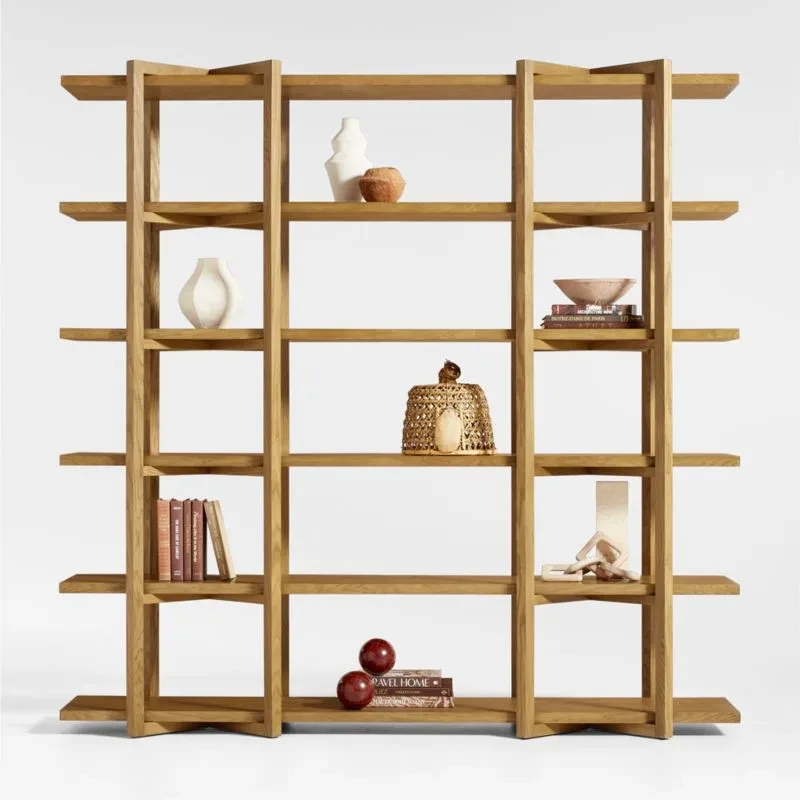
Open shelving has no back panel. That sounds obvious until you realize how much visual work the back panel is doing on a regular bookcase. It grounds the objects, gives leaning frames something to lean against, creates a contained vignette, and pulls the eye into the depth of the shelf. Open shelving removes all of that.
What you see instead is the wall behind the shelving, the objects on the shelf, and the silhouette of those objects against the wall. Every piece is read in profile. Every gap is more visible. The texture of the wall paint becomes part of the composition whether you planned for it or not. The editing has to be tighter, and the negative space has to do more work. For the same approach in another style, see paint color combinations for open concept homes.
The general principles in the complete guide to bookshelf styling still apply (the thirds rule, the empty shelf, leaning in pairs) but the execution shifts. Open shelving is a more disciplined version of the same craft.
What is the multi-distance test for open shelving?
Open shelving has to work at three distances. The silhouette read from across the room (10 to 15 feet), the medium read from the sofa or main seating (six to eight feet), and the close read from standing in front of it (one to two feet). Most styled shelves only succeed at one of these distances. The good ones succeed at all three.
The silhouette read is about object shape and rhythm. From across the room, you cannot make out detail. What you see is the outline of objects against the wall, the spacing between them, and whether the overall composition has a sense of balance. This is where heavily styled shelves often fall apart. They have detail but no shape.
The medium read is where most evenings actually happen, viewed from wherever you sit most. This is the test that matters most for living room shelving specifically. The close read is the one you do when you walk over to grab a book or dust the shelf. It needs to hold up, but it should not be the primary design driver.
Practical method: arrange the shelf, walk to your usual sofa spot, take a phone photo, and look at the photo. The camera flattens the depth in a way that exposes problems your eye smooths over in person. If the photo from the sofa looks composed, you are most of the way there.
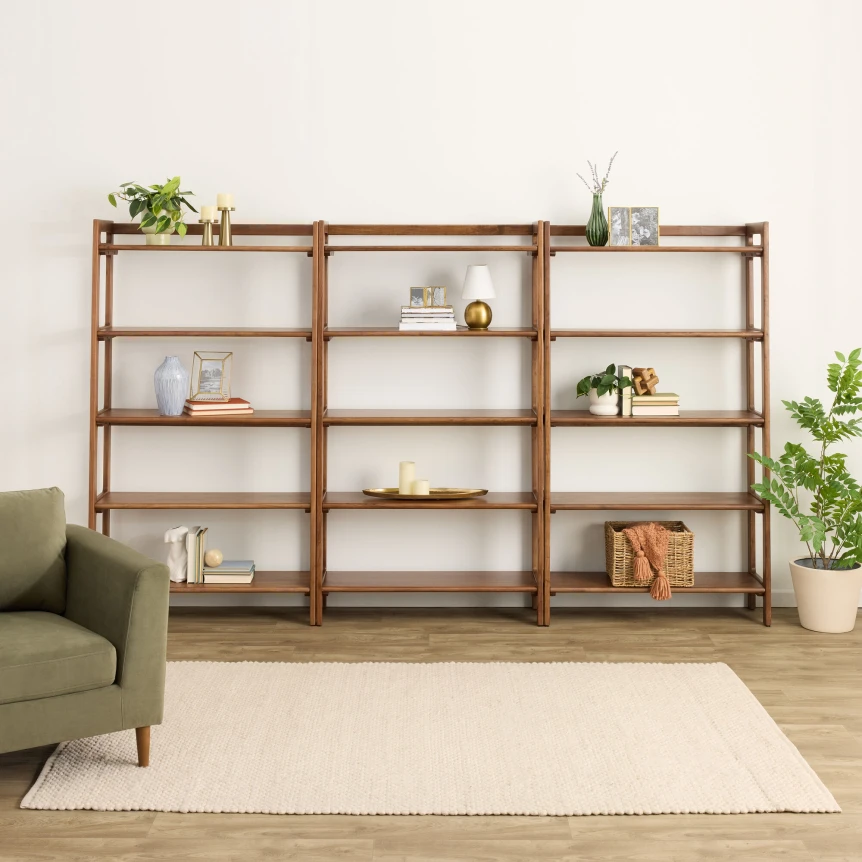
Anchoring each shelf with weight
Each shelf needs one object that carries visual weight. Not necessarily physical weight, although heavy materials help. Visual weight comes from size, density, color saturation, or material contrast against the rest of the shelf. The anchor is the piece your eye lands on first when scanning that shelf, and the rest of the styling builds around it.
On a shelf like that, the anchor is often something plain: a single low ceramic vessel in a matte oatmeal glaze, about eight inches across, frequently a piece that has been sitting in a kitchen cabinet for years. Once it is the anchor, the rest of the composition (two books leaning behind it, a small dark wood object beside it, a deliberate gap of about a foot of empty shelf) falls into place inside an afternoon.
Anchors should not all be the same height across shelves. A tall anchor on shelf one, a low anchor on shelf two, a medium anchor on shelf three. The varied heights create the rhythm that the multi-distance read picks up on, and it prevents the unit from reading as a grid of similar vignettes.
How much should an open shelf hold?
Less than you think. The default for a closed bookcase is about two-thirds full. For open shelving in a living room, drop that to closer to half. Three to five total elements per shelf is usually the ceiling. More than that and the shelf reads as cluttered from the sofa, even if it looks fine up close.
The elements to count: one anchor object, one short book stack or short row of vertical books, and one secondary object. That is three elements. A fourth might be a single leaned print or a small piece of art. A fifth is usually one too many. The temptation to add a fifth is what fails most styling attempts.
If you have many more books than the open shelves can hold without crowding, the open shelving is not the right home for the bulk of your collection. Put the working library on a closed bookcase or behind doors, and use the open shelving for the books you actually want on display. The dedicated cluster post on how to style a bookshelf with too many books covers the system in detail.
Material mix on open shelving
Open shelves benefit from a tight material palette. Three materials across the whole unit, four at the absolute maximum. The shelves that read as quiet usually run: wood, ceramic, and one metal. Or: wood, linen-bound books, ceramic, and a single piece of glass. Adding leather, brass, woven baskets, raw stone, and plants on top of that becomes texture overload very quickly.
Color follows the same logic. Three colors maximum, with one being the wall behind the shelving. If the wall is warm white, your tonal palette runs through warm whites, soft taupes, and one accent. If the wall is a deeper tone, the shelving objects can be lighter to contrast. The single most common open-shelving mistake is trying to bring in too many tonal directions at once.
For broader context on how shelving fits into a living room as a whole, the modern living room design guide covers the rest of the furniture relationships and helps with the bigger color palette decisions before you get to the shelf-level styling.
Where should objects sit on the shelf depth?
On open shelving with no back panel, objects sit on the shelf with no wall to lean against. That means front-to-back positioning becomes a styling decision rather than something the shelf back resolves for you. The rule: anchor objects sit roughly in the middle of the shelf depth, and secondary objects can edge slightly forward to create a layered foreground.
Books on open shelving look better pulled forward to about an inch from the front edge. This is the reverse of closed shelving, where pulling them forward from the back creates the shadow gap. On open shelves, the books need the visual line at the front edge to anchor the row. Leaving them recessed creates a fuzziness from across the room that reads as unstyled even when the composition is otherwise correct.
Lighting open shelving
Open shelving lives or dies by the light hitting it. With no back panel reflecting light onto the objects, the shelves rely entirely on ambient room light and any directional source you add. A shelf in a corner with no nearby lamp will read as flat and dim regardless of how well you have styled it.
The fix is usually a nearby floor lamp or table lamp positioned so its glow reaches the shelf at an angle, not from directly in front. Side lighting reveals the texture of the objects and the shadow lines between them. Direct front lighting flattens the composition. If the room is naturally lit, the same logic applies to where the windows are.
Picture lights mounted above open shelving are a possibility for the right room, but they tend to look fussy in modern living rooms and better in traditional ones. A simple floor lamp angled toward the shelves usually does more work for less commitment.
What if the room behind the shelving is busy?
Open shelving in a busy room (lots of art on adjacent walls, patterned upholstery, multiple light sources, layered textiles) reads as busier than the sum of its parts. The shelving competes with everything around it instead of cooperating. The fix is one of two directions: simplify the shelf, or simplify the room.
Simplifying the shelf is the easier move and usually the right one. Pull the shelf back to two or three elements per row, all in a tight tonal palette, and let it become the quiet visual contrast to a busy room. This works particularly well in bohemian and eclectic spaces, where the open shelving can serve as the calming neutral within an otherwise layered environment.
The opposite move (simplifying the room and letting the shelf carry more visual weight) works well for minimalist and Japandi spaces, where the open shelving can be the rare moment of accumulated detail in an otherwise spare room. The choice depends on which direction your room is already leaning. See bookshelf styling by style for the specific moves each direction calls for.
Common open shelving mistakes
Over-leaning. With no back panel, leaning frames have nothing to lean against. People prop them on small easels, which usually reads as fussy. If you want leaned art on open shelving, choose pieces with a sturdy base that can angle slightly backward against an object behind them, and limit it to one per shelf.
Treating it like a regular bookcase. Open shelving and closed shelving are different design objects, even when they hold the same things. Open shelving needs to be edited harder, lit better, and styled with the room behind it in mind.
Using it for active storage. Open shelving is a poor home for the books you read constantly, the office supplies you use weekly, and the things you grab and put back in a hurry. Put working items in closed storage. Reserve the open shelves for objects that earn their visibility.
Ignoring proportional balance with the wall. If the open shelving covers half the wall, the styling needs to acknowledge the rest of the wall as part of the composition. If the shelving is a smaller statement piece, it can be styled more densely because the wall around it is doing the breathing-room work.
When open shelving is the wrong choice
Open shelving is not the right answer for every living room. If your collection is heavy on visually busy paperbacks rather than cloth-bound books, if you have small kids who treat shelves as ladders, if your space gets very little natural light, or if you find styling stressful rather than enjoyable, a closed bookcase or built in unit will serve you better. Color coded bookshelf covers the same ground for a different style.
The decision between built-in and freestanding closed shelving is its own question, covered in built in vs freestanding bookshelves. The decision between open and closed is mostly a question of how much editing you are willing to do on an ongoing basis. Open shelving asks more of you. The reward, when it works, is a room that feels lighter and more confident than a wall of full bookcases ever does.
The Six-Try Lesson
The lesson underneath all six attempts is that styling open shelving is less about picking the right objects and more about establishing the right view. Evaluated from the sofa rather than from arm’s length, the editing rules become obvious. The anchor needs to be visible from there. The leaned frames have to read at that distance. The empty space has to feel composed rather than accidental from that seat.
If you have a shelf that has been bothering you for months, the issue is probably not the objects. It is the angle of evaluation. Try restyling from where you actually sit. Walk forward to adjust, then back to judge. The shelf usually resolves itself within an hour.
For the next step in the cluster, modern bookshelf ideas covers the larger question of what shape of bookshelf actually works in contemporary homes, and where the gap between aspiration and daily use tends to show up.
Frequently Asked Questions
How is styling open shelving different from styling a regular bookshelf?
Open shelving has no back panel, which removes the visual ground that a regular bookcase provides. Objects are read in silhouette against the wall behind them, leaning frames have nothing to lean against, and negative space has to do more work. The editing is tighter, the material palette is smaller, and the styling has to hold up at viewing distance rather than just arm’s length.
How many objects should an open shelf hold in a living room?
Three to five elements per shelf is usually the ceiling. That typically breaks down as one anchor object, one short book stack or row of books, one secondary object, and an optional fourth element such as a leaned print. Anything beyond five tends to read as cluttered from sofa distance even if it looks fine up close.
Should open shelving be styled symmetrically?
Generally no. Symmetrical open shelving reads as architectural and formal, which works in traditional spaces but flattens modern interiors. Asymmetrical styling, with anchor objects at varied heights across shelves and one shelf left intentionally light, produces the rhythm that reads as composed without feeling staged.
What lighting works best for open shelving?
Side lighting from a floor lamp or window beats direct front lighting. Side angles reveal texture and create shadow lines between objects that give the composition depth. Open shelves without nearby ambient light tend to read as flat and dim regardless of how well they are styled, so positioning a lamp within five or six feet of the unit is part of the styling, not a separate decision.
Is open shelving practical for living rooms with kids or pets?
For very young children or jumpy pets, open shelving on lower shelves is not the place for fragile objects or valuable books. Many homes solve this by styling the top half of the unit and using closed storage or baskets on the lower shelves. Once children are past the climbing stage, the full unit can be opened up again.