Modern Home Office Lighting: 9 Fixtures Worth Buying

By Tereza Hower | Published May 7, 2026 | Updated October 12, 2026
Two desk lamps can share the same silhouette, the same matte black finish and almost the same product photo, and only one of them will still hold its angle after a year of daily use. Modern home office lighting is mostly bought that way, from a picture, which is why so many workspaces end up with a lamp that droops, a bulb that buzzes on the dimmer, and an overhead that turns every video call grey.
Below are nine fixtures worth buying, with price bands and the specs that decide whether a light works: lumens, Kelvin, color rendering and glare. After the picks come the details that separate a well made fixture from one that only photographs well.
Key Takeaways
- Light a home office in three layers: an overhead for the room, a task lamp for the desk, and a third lamp away from the desk to balance shadows.
- Plan on 20 to 30 lumens per square foot from the overhead and 450 to 800 lumens from the task lamp.
- Buy every bulb at 2700K or 3000K with a CRI of 90 or higher, and keep the whole room at one color temperature.
- A spring-balanced task lamp with a replaceable bulb outlasts one with friction joints and a sealed LED head, and the price gap is often under $100.
- A workable setup costs about $200 to $300, while design originals and a hardwired dimmer push it past $1,200.
What Lighting Suits a Home Office?
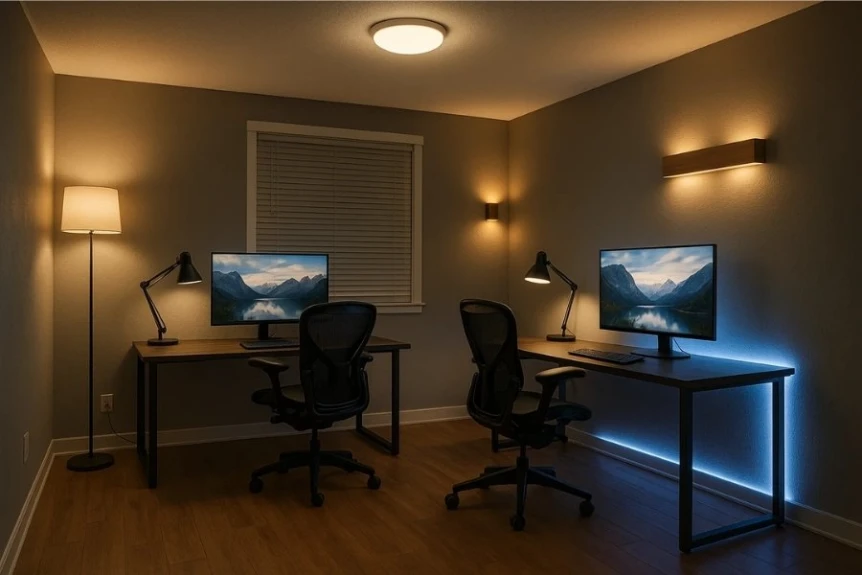
A home office needs three kinds of light working at once: ambient light from overhead that fills the room, task light aimed at the desk surface, and an accent or fill source placed somewhere else in the room. Each layer has a different job, and no single fixture can do all three without either glaring on the screen or leaving the corners dim.
The layer most rooms skip is the third. Without it, the room splits into a bright desk zone and a dim everywhere else, which reads as cramped in person and as a dark cave behind you on camera. The guide to layered lighting for living rooms uses the same logic, but an office adds a monitor, which limits where every fixture can go.
How Much Light Does a Home Office Need?
Lumens measure how much light a bulb puts out; watts only measure what it draws. For the ambient layer, plan on 20 to 30 lumens per square foot. A 10 by 12 foot room is 120 square feet, so it needs roughly 2,400 to 3,600 lumens from overhead, which is three to four standard 800 lumen bulbs, not the single bulb most builder fixtures hold.
The task lamp needs far less: 450 to 800 lumens aimed at the work surface. More than that at close range bounces off paper and a glossy desktop as glare.
| Spec | Ambient overhead | Task lamp | Third layer |
|---|---|---|---|
| Light output | 20 to 30 lumens per sq ft | 450 to 800 lumens | 300 to 800 lumens |
| Color temperature | 2700K or 3000K | 3000K, matched to the room | Same as the overhead |
| Color rendering | CRI 90 or higher | CRI 90 or higher, R9 above 50 | CRI 90 or higher |
| Diffusion | Opal glass, fabric or paper | Shade hides the bulb from the chair | Fabric, paper or opal |
Color temperature is measured in Kelvin, and every bulb in the room should sit at 2700K or 3000K. The better default for a working room is 3000K: crisp enough for long screen sessions, without the blue cast of 4000K that turns skin grey on camera by late afternoon. Mixing a 2700K lamp with a 4000K overhead is the usual reason a room looks wrong for no obvious reason.
Color Rendering Index, or CRI, scores how faithfully a bulb shows color compared with daylight, on a 100 point scale. Budget LEDs often sit around 80, which flattens wood grain and textiles, and a CRI of 90 or more fixes it for a dollar or two per bulb. For video calls, check the R9 value as well: it measures saturated red, which governs how skin reads, and anything above 50 is good.
Nine Modern Home Office Lighting Picks, Layer by Layer
These are fixture types rather than single products, each with a reference design worth knowing. Prices are typical new prices at the time of writing; the reference designs sit at the top of each band.
| Pick | Layer | Best for | What to check | Price band |
|---|---|---|---|---|
| Opal glass flush mount | Ambient | Ceilings under 9 ft | Glass, not acrylic; two or three bulbs | $80 to $300 |
| Fabric or paper pendant | Ambient | Ceilings 9 ft and up | Hangs 30 to 36 in above the desk | $100 to $600 and up |
| Recessed wafer lights | Ambient | Minimalist rooms, low ceilings | LED rated dimmer; set in front of the desk | $15 to $40 each, plus labor |
| Spring-balanced task lamp | Task | Most desks | Holds its angle; replaceable bulb | $80 to $550 |
| Monitor light bar | Task | Small desks, screen work | Asymmetric beam; CRI 90 or higher | $40 to $180 |
| Plug-in wall sconce | Third layer | Renters, tight floor plans | Fabric or opal shade; cord cover | $60 to $250 |
| Linen shade floor lamp | Third layer | Behind the chair, on camera | Heavy base; shade hides the bulb | $100 to $400 |
| Ceramic or stone table lamp | Third layer | Credenza or bookshelf | Solid base; low shade | $80 to $300 |
| Dimmer or smart bulbs | Control | Every overhead | LED rated; dimmable bulbs | $15 to $80 |
1. Opal glass flush mount, for ceilings under 9 feet
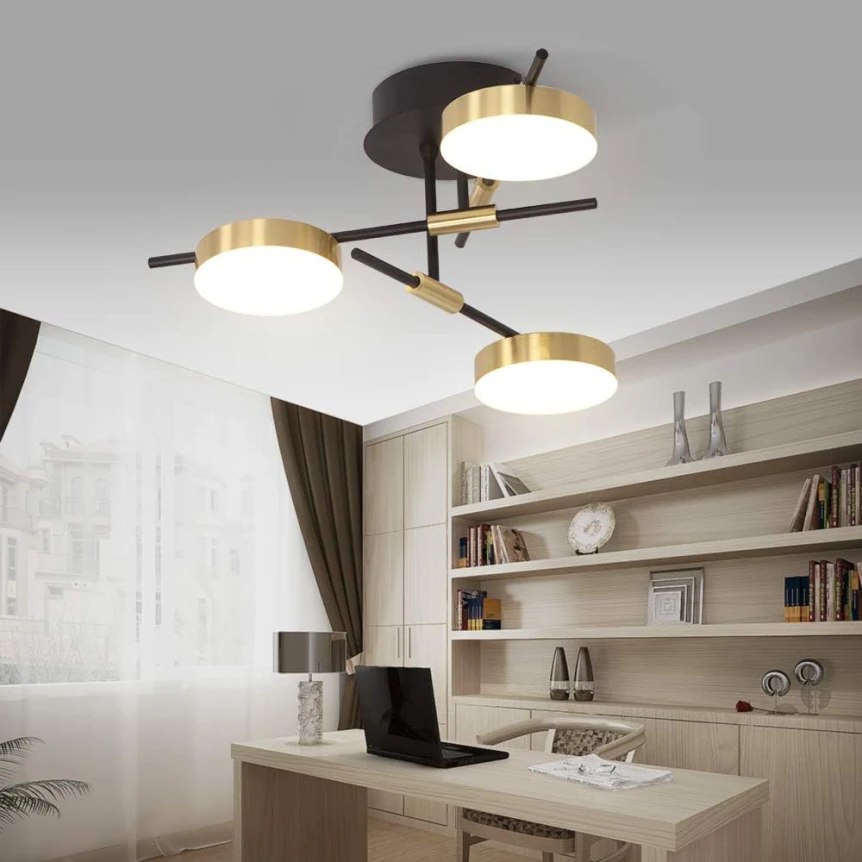
An opal glass drum or dome holding two or three bulbs is the safest overhead for a standard 8 foot ceiling. Opal glass diffuses evenly and stays white for decades, while frosted acrylic is lighter and cheaper but can yellow near hot bulbs. Size it from the room: add the length and width in feet and use that number in inches, so a 10 by 12 foot room takes a fixture about 22 inches across. Expect $80 to $300.
2. Fabric or paper pendant, for ceilings 9 feet and higher
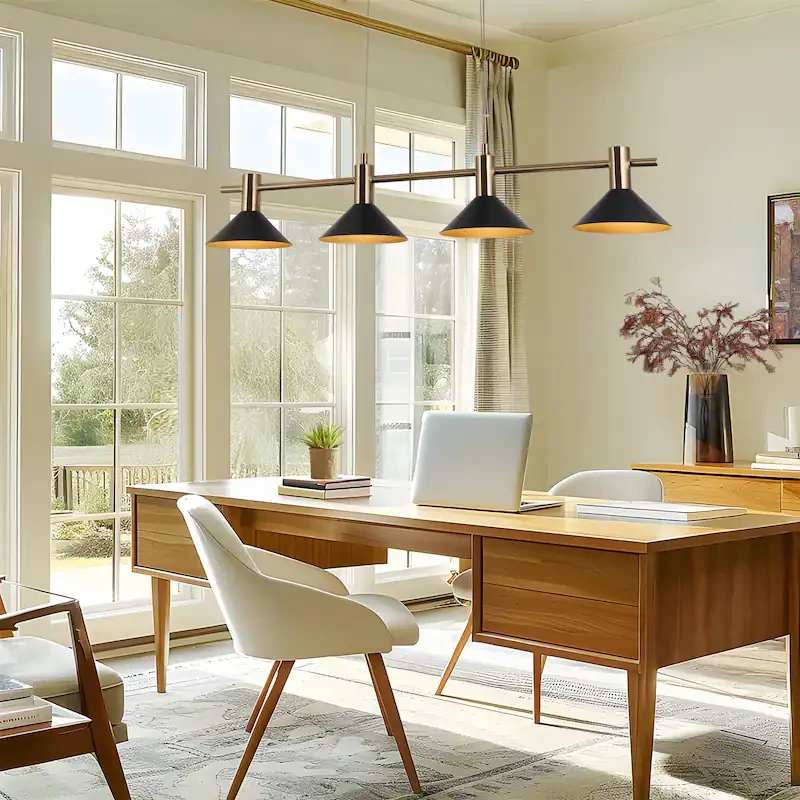
A fabric drum or paper shade softens the light on every side. Isamu Noguchi’s Akari paper lanterns are the reference design for Japandi and minimalist rooms, from about $150 for small shades into the high hundreds for large ones, while linen drums run $100 to $350. Hang the bottom of a pendant 30 to 36 inches above the desk, and keep anything over a walkway at least 7 feet off the floor.
3. Recessed wafer lights on a dimmer
Ultra thin LED wafer lights need no housing above the ceiling, which makes them the easiest recessed option to add to a finished room. Four 4 inch wafers light a 120 square foot office evenly; set them in front of the desk, not over the chair, or the screen catches a reflection. The fixtures cost $15 to $40 each, but the electrician is most of the bill.
4. Spring-balanced articulating desk lamp
This is the lamp to spend on. A spring-balanced arm holds any angle without tightening a knob, and a deep shade keeps the bulb out of sight from the chair. The Anglepoise Type 75 and Artemide’s Tolomeo are the reference designs, at roughly $250 to $550 for the originals, while well built versions with real springs and a weighted base cost $80 to $200. On a desk 30 inches deep, look for a reach of about 20 inches.
5. Monitor light bar
A light bar clamps to the top of the screen and throws an asymmetric beam down onto the desk, with almost no light reaching the screen itself. It suits small desks and anyone whose glare comes from a lamp beside the monitor. BenQ’s ScreenBar line set the category at $40 to $180; pay for a model with color temperature control and a stated CRI of 90 or more.
6. Plug-in wall sconce
A plug-in sconce with a cord cover needs no electrician, which suits renters. Choose a fabric or opal shade and mount it about 60 to 66 inches from the floor, beside a shelf or above a credenza rather than behind the monitor. Most cost $60 to $250, and hardwired versions cost about the same before installation.
7. Floor lamp with a linen shade
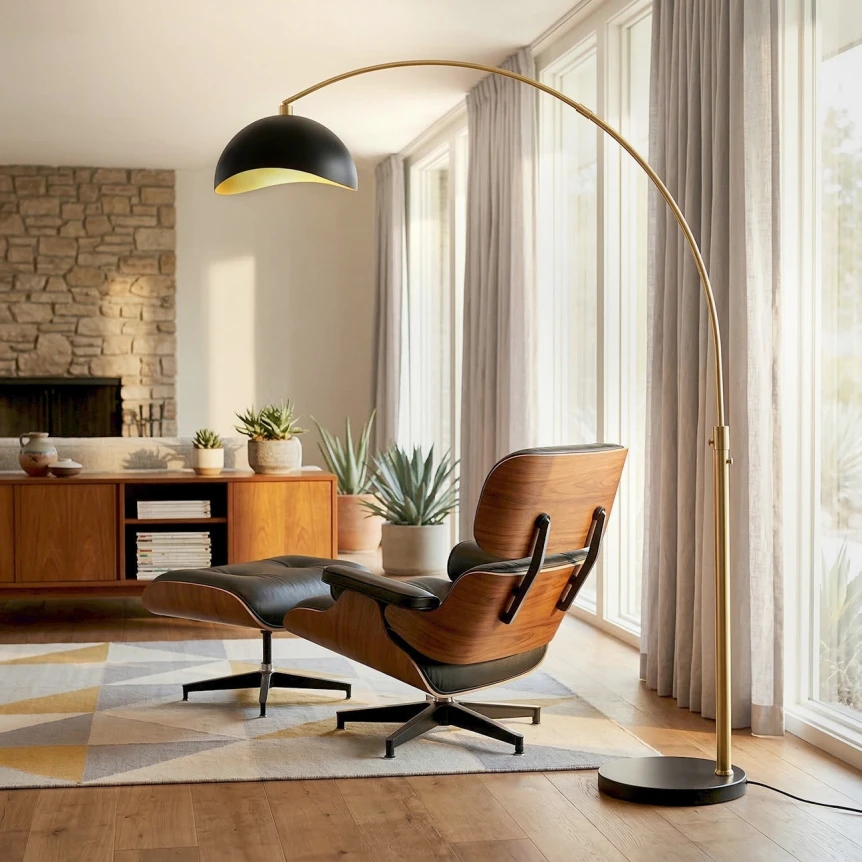
A floor lamp behind the chair fills in the part of the room the camera sees. A linen drum on a slim stem spreads light evenly, and an arc lamp reaches over a lounge chair without needing a side table. Budget $100 to $400, and check that the base is heavy enough not to rock when the shade is nudged.
8. Ceramic or stone table lamp for the credenza
A ceramic or stone base with a linen shade, set on a credenza or bookshelf, adds a warm pool of light that breaks up a single overhead. Look for a solid base of at least 3 pounds and a shade that sits low enough to hide the bulb from a standing eye, and expect $80 to $300.
9. A dimmer or smart bulbs on the overhead
An overhead on a plain on and off switch is the most common missed upgrade in a home office. A wall dimmer rated for LED loads costs $20 to $80, with smart versions such as Lutron’s Caséta near the top of that range, and smart bulbs cost $15 to $50 each and suit rentals. Either way, buy bulbs marked dimmable, or they will buzz and flicker at low settings.
How to Tell a Good Light Fixture from a Cheap One
Most lighting is sold from a photograph, and a photograph hides everything that decides whether a fixture lasts. These checks separate a lamp worth owning from one that only looks right on a screen, and most take ten seconds in hand.
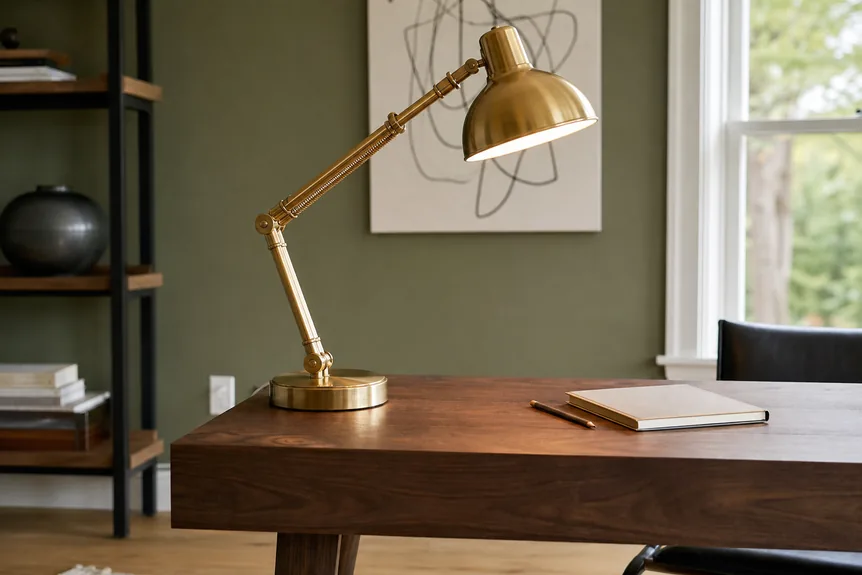
- The arm holds its angle. Raise and lower a task lamp’s head a few times. A spring-balanced arm stays put, while a friction joint that already needs tightening will droop within months.
- The base has weight. Extend the arm fully. If the lamp tips or the base slides, it will do the same on the desk, so look for cast iron or steel rather than hollow plastic.
- The light source can be replaced. An integrated LED is fine when the module can be swapped. When it is sealed into the head, the first driver failure ends the lamp.
- The diffuser is glass or lined fabric. Opal glass stays white and thin acrylic can yellow. An unlined fabric shade shows the bulb as a hot spot once it is lit.
- The safety listing is on the fixture. Look for a UL or ETL mark on the lamp itself, not only on the box. Unlisted fixtures are the cheapest category for a reason.
- The finish is real. Solid brass, powder coat and anodized aluminum wear well. Thin painted finishes chip at the joints, which is exactly where a hand touches the lamp every day.
The test that catches the most problems is the simplest: switch the lamp on and look at it from the chair. If the bulb is visible from a seated eye height of about 45 inches, the shade is too shallow or the arm sits too high, and the lamp will glare for as long as it is on the desk.
Where Should Each Light Go?
Set the desk so the window is to the side of the monitor rather than behind it or behind you, then put the task lamp on the side opposite your writing hand so the hand never shadows the page.
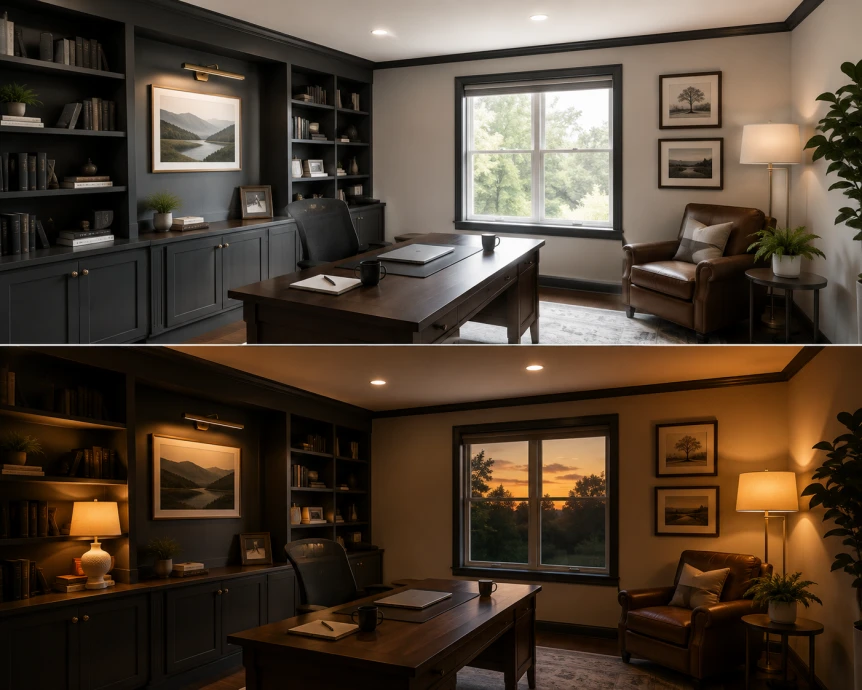
For screens, run the glare test: turn the monitor off and look at the black screen from the chair. Any fixture reflected in it is in the wrong place, and it is usually an overhead directly behind the chair or a lamp beside the monitor at screen height.
On video calls, the main light should come from in front and slightly above, about 45 degrees to one side of the camera. A window behind you turns you into a silhouette, while a soft lamp behind the monitor at eye height does most of what a ring light does. A lamp on the credenza behind you keeps the background from going black.
What Does a Good Home Office Lighting Setup Cost?
A three layer setup rewards spending in the right place. The task lamp is used every working hour and wears at its joints, so it earns the money. In the third layer, a $70 lamp and a $400 lamp light the room about equally; the difference buys the look.
- About $200 to $300. High CRI 3000K bulbs for the existing overhead, a well built articulating lamp at $80 to $150, and a $60 to $100 table lamp for the credenza.
- About $500 to $900. All of the above, plus an opal flush mount or linen pendant, an LED rated dimmer, and a floor lamp or plug-in sconce.
- $1,200 and up. A design original task lamp, a paper or linen pendant from a known maker, and hardwired sconces or wafer lights installed by an electrician.
Which Lighting Suits Each Office Style?
The layers and specs stay the same in every style. Only the finishes and shapes change.
- Japandi. A paper pendant in the Akari mold, a wood and paper table lamp, and an oak or matte black task lamp. See Japandi home office ideas.
- Minimalist. Wafer lights on a dimmer, a slim white or sand task lamp, and a monitor light bar in place of a second lamp. See minimalist home office ideas.
- Scandinavian. A linen drum pendant, plug-in sconces, and a pale ash or white task lamp. See the Scandinavian interior design guide.
- Mid century modern. A brass globe or Sputnik pendant on a high ceiling, a brass task lamp, and an arc floor lamp. See mid century modern lighting ideas and the mid century modern home office guide.
- Industrial. An enamel or metal dome pendant with a frosted bulb, a black task lamp, and a caged sconce. See the guide to industrial interior design.
Building the Lighting Plan in the Right Order
Buy the overhead and dimmer first, since they are the hardest to change later. Add the task lamp once the desk position is settled, and the third layer last, when the furniture shows where the dark corner is.
For the desk, chair and storage the lighting has to serve, see modern home office furniture essentials and the shortlist of minimalist desks worth buying. The whole room, from layout to finishes, is in the complete guide to modern home office design, and the modern bedroom lighting ideas apply the same layers to a room built for rest.
Frequently Asked Questions
What lighting suits a home office?
Three layers: an overhead for the whole room, an adjustable task lamp at the desk, and a third lamp or sconce away from the desk to balance shadows. Use 2700K or 3000K bulbs with a CRI of 90 or higher throughout, put the overhead on a dimmer, and keep every fixture out of the monitor’s reflection.
How many lumens does a home office need?
Plan on 20 to 30 lumens per square foot from the overhead, which is roughly 2,400 to 3,600 lumens for a 10 by 12 foot room, plus 450 to 800 lumens from a task lamp aimed at the desk.
Is 4000K too cool for a home office?
For most home offices, yes. 4000K reads clinical in a residential room and turns skin grey on camera. 3000K keeps the room warm while staying crisp enough for screen work; for cooler light while focusing, use a tunable task lamp and leave the room at 3000K.
Is an integrated LED desk lamp worth buying?
Only if the LED module can be replaced. The LEDs themselves last for years, but the driver often fails first, and in a sealed head that ends the lamp. A lamp with a standard bulb socket can be kept for decades.
How much should a good desk lamp cost?
A well built articulating lamp with a real spring-balanced arm and a weighted base costs about $80 to $200. Design originals such as the Anglepoise Type 75 or Artemide Tolomeo run roughly $250 to $550. Below about $50, expect friction joints and a light base.