The Complete Guide to Industrial Interior Design

By Tereza Hower | Published April 6, 2026 | Updated October 12, 2026
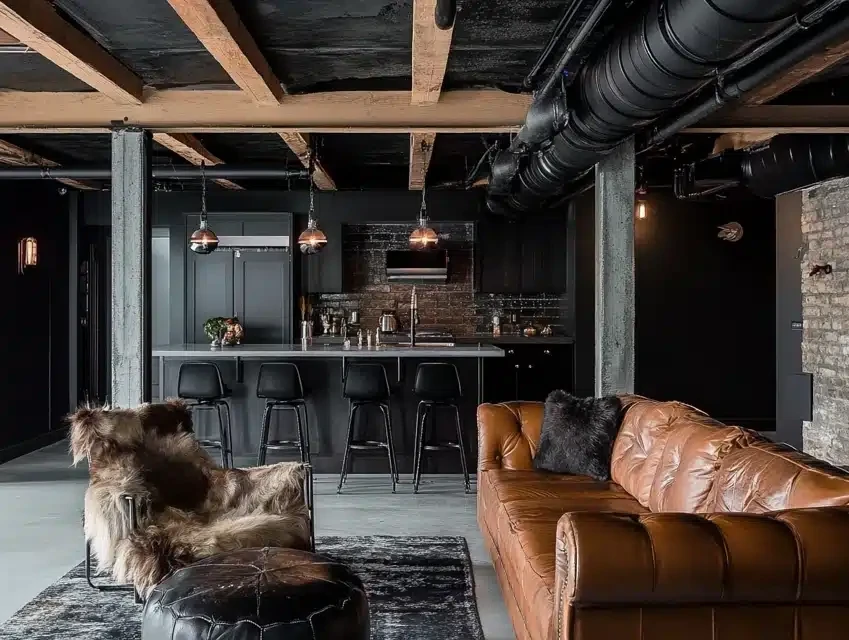
Every other style hides the building. Industrial interior design does the opposite: it leaves the brick, the steel, the ductwork, and the concrete in plain view and builds the room around them. That single decision explains everything else about the style, from the furniture it favors to the mistakes people make with it, and it is why a converted warehouse and an ordinary apartment need different versions of the same idea.
What makes the style hold up is that it does not pretend. The materials are real, the construction is visible, and the atmosphere comes from function rather than decoration. Whether the home is a loft with original bones or a standard apartment that needs more character, industrial design offers a vocabulary that is easy to recognize and surprisingly easy to get wrong. That honesty is also why the style is so often bought badly from a photograph: a steel chair or a leather sofa has to be sat in before it is bought.
This guide covers the style in the order it should be built: what it is and where it came from, the elements and materials that define it, how to tell quality pieces from imitations, color, furniture, lighting, and the room by room application. It ends with the main variations and the mistakes that turn an honest room into a theme park.
Key Takeaways
- Industrial interior design exposes the structure of a building and balances it with warm wood, leather, and heavy textiles.
- The five materials that matter are brick, concrete, steel, reclaimed wood, and leather, and each has a cheap imitation worth learning to spot.
- Weight, welds, and grain tell quality industrial pieces from stamped and printed copies faster than any label.
- Pick one base metal, usually blackened steel, and allow one warm accent metal; mixing four finishes in a normal sized room reads as clutter.
- Choose one or two strong industrial elements per room and let textiles, plants, and personal objects do the rest.
What’s Covered in This Guide
- What Is Industrial Interior Design?
- Where Did Industrial Style Come From?
- Key Elements of Industrial Design
- What Are the Best Materials for Industrial House Interiors?
- How to Tell Quality Industrial Pieces from Cheap Ones
- Industrial Color Palettes
- Choosing Industrial Furniture
- Industrial Lighting
- Industrial Design Room by Room
- Which Industrial Variation Fits Your Home?
- What Most People Get Wrong
- Recommended Resources and Related Guides
What Is Industrial Interior Design?
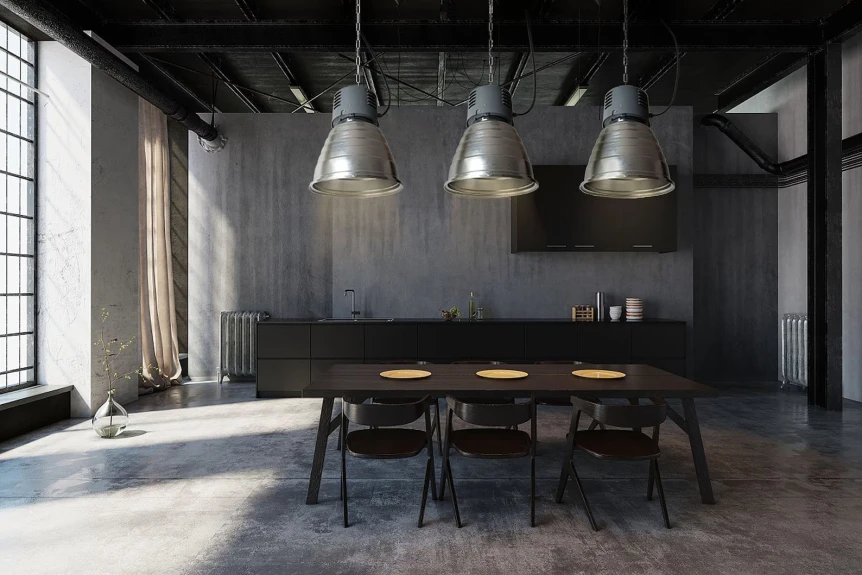
Industrial interior design is a style drawn from factories, warehouses, and workshops that exposes the architectural elements other styles cover: brick walls, ductwork, steel beams, and concrete floors. It pairs those raw surfaces with a neutral palette of gray, black, and warm wood, metal and reclaimed materials, open floor plans, and light fixtures that look like equipment. The visible bones of the building are the decoration.
The style also values function. Furniture and fixtures look as though they have a job: a metal cart as a side table, a leather chair built to outlast its owner, a pendant shaped like a factory lamp. Nothing is purely decorative, and everything has weight. A leather sofa that photographs like a loft piece and sits like a bench is the most common industrial purchase to regret.
Where Did Industrial Style Come From?
From factories to lofts
The roots of the style go back to the late twentieth century, when artists in cities like New York moved into abandoned factories and warehouses in neighborhoods like SoHo. The buildings offered something rare: enormous open floors, high ceilings, walls of steel framed glass, and original features no residential building had.
Rather than make those raw spaces look conventional, the new residents kept what was there. Brick stayed exposed, ductwork stayed visible, and the furniture was built or scavenged to suit the bones of the building. A practical response to cheap square footage became a deliberate design language.
From niche to mainstream
Within a generation, the look had moved from artist lofts into restaurants, cafes, hotels, and offices, and furniture makers began producing industrial pieces for people who did not live in converted warehouses but wanted the character. That is where most industrial interiors now sit: applied to ordinary rooms rather than inherited from a building.
Industrial design endures because it does not depend on polish or novelty. Its strength is honesty in materials, and its usefulness is that it mixes with modern, rustic, and mid century pieces without losing its identity.
Key Elements of Industrial Design
Exposed structure
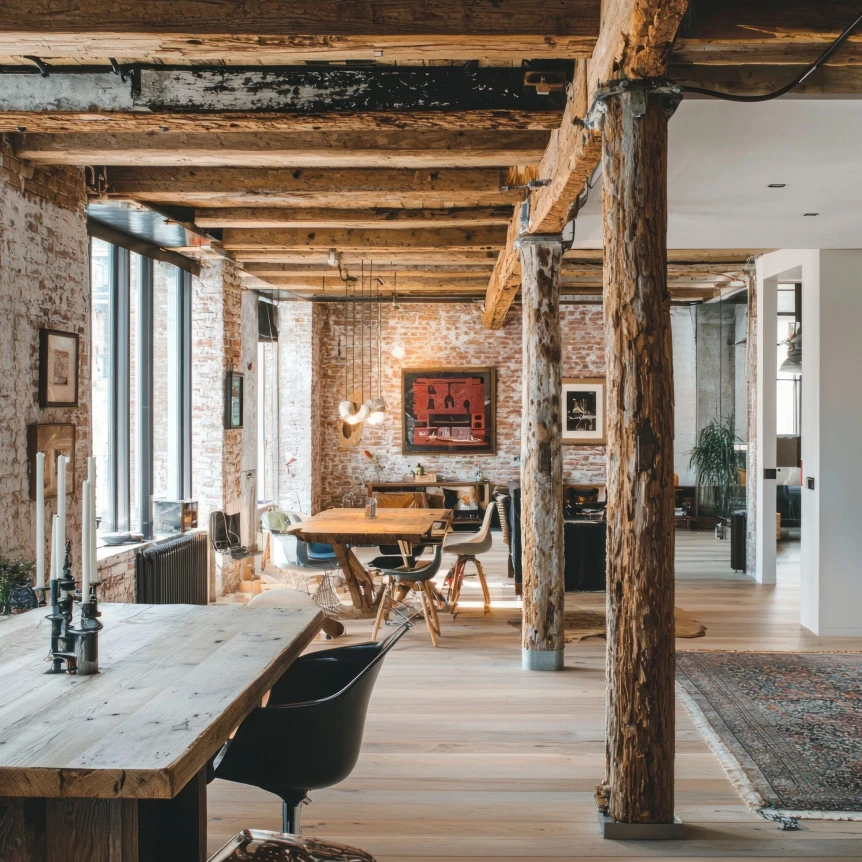
This is the single most distinctive feature. Brick, concrete columns, steel beams, ductwork, pipes, and even conduit are left visible rather than boxed in. In a true industrial building those elements are the architecture. In an applied version, the same effect comes from a single brick or concrete wall, black steel window frames, or open pipe shelving, and it is better to add one honest element than four imitations.
Open floor plans
Industrial spaces favor openness. Walls are minimized and rooms flow into one another, which reflects the loft layouts that started the style. In a smaller home, removing an unnecessary partition or using a shelving unit and a rug to define zones instead of walls carries the same feeling without a renovation.
Metal, chosen with discipline
Steel, iron, brass, copper, and aluminum all belong in industrial interiors, in furniture frames, fixtures, hardware, and shelving. The common advice that mixing metals is encouraged is true in a 2,000 square foot loft where the pieces sit thirty feet apart. In a normal room it produces clutter. Pick one base metal, usually blackened or powder coated steel, and allow one warm accent, brass or copper, in lighting or hardware.
Reclaimed and distressed wood
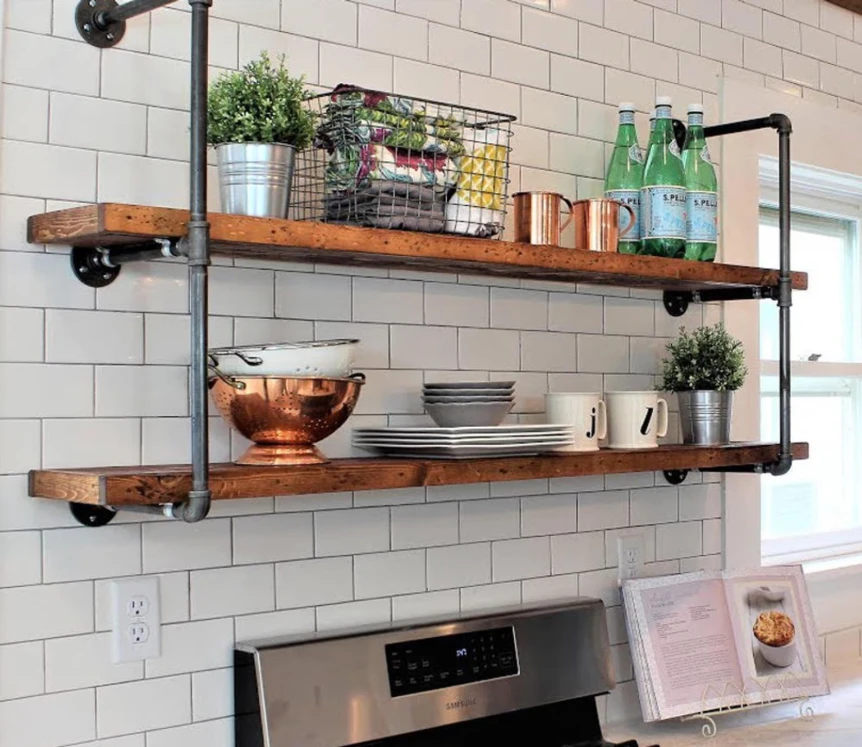
Wood balances the coolness of metal and concrete, and in industrial design it is rarely smooth or polished. Reclaimed barn boards, weathered beams, and planks with visible knots, nail holes, and saw marks bring warmth and a sense of history. The wood should look as though it had a previous life, because the best of it did.
Leather and heavy textiles
Leather in warm brown or black, worn rather than glossy, is the signature upholstery. Beyond it, industrial textiles run heavy: canvas, wool, and thick linen in neutral tones, on cushions, curtains, and throws. These are not accents; they are what stops the room from echoing and what makes it possible to sit in.
Functional lighting
Lighting is a structural element of the style, not a finishing touch. Factory pendants, exposed filament bulbs, articulated arm lamps, and cage fixtures are sculptural, visible, and unmistakable. One well chosen fixture does more for an industrial room than any other single purchase.
What Are the Best Materials for Industrial House Interiors?
Five materials carry the style: brick, concrete, steel, reclaimed wood, and leather, with steel framed glass as the connective tissue between them. Each has a real version, an honest applied version, and a cheap imitation. The table gives the short answer; the sections below say where each belongs and what it costs to do properly.
| Material | Best use | Honest applied version | Imitation to avoid | Typical cost |
|---|---|---|---|---|
| Brick | One feature wall behind the sofa or bed | Thin brick veneer, 1/2 to 3/4 inch, mortared and sealed | Printed brick wallpaper or foam panels | $12 to $25 per square foot installed for veneer |
| Concrete | Floors, countertops, one accent wall | Microcement over existing surfaces | “Concrete look” paint effects | $8 to $15 per square foot for microcement |
| Steel | Furniture frames, shelving, window frames, lighting | Powder coated or blackened steel, 1/8 inch or heavier | Thin tube with a matte black spray finish | $400 to $1,500 for a solid steel frame table |
| Reclaimed wood | Table tops, shelves, headboards, one wall | Kiln dried reclaimed boards with a matte oil finish | Printed “barn wood” veneer over particleboard | $10 to $20 per board foot |
| Leather | Sofa, armchair, desk chair, strap details | Top grain or full grain aniline leather | Bonded leather and polyurethane “vegan leather” | $1,800 to $4,000 for a full grain sofa |
| Steel framed glass | Interior partitions, doors, shower screens | Powder coated steel or aluminum with true divided lites | Stick on muntins over a single pane | $150 to $400 per square foot for a steel partition |
Brick
Exposed brick is the most recognizable industrial material. Original brick should be left exposed, cleaned, and sealed with a matte masonry sealer so it stops shedding. Without original brick, thin brick veneer laid with real mortar joints is the honest substitute; it reads as brick from a foot away because it is brick. Brick should look weathered and varied rather than uniform, and the variation in color and surface is the point.
Concrete
Concrete floors, countertops, and accent walls are industrial staples because the material is durable, grounding, and quiet. A polished concrete floor with a matte sealer is the refined version. Microcement, a thin cementitious coating troweled over existing floors and walls, gives the same look on an ordinary slab or drywall without the structural weight, and it is the right choice for most applied industrial rooms.
Metal
Black powder coated or blackened steel is the base finish for furniture frames, shelving, and lighting. Brass and copper add warmth in small doses; galvanized steel brings a rougher, utilitarian note that suits kitchens and utility spaces. Raw steel is beautiful and rusts under a wet glass, so it belongs on surfaces that will not see water or on pieces that have been waxed.
Wood
Reclaimed wood with visible age is the standard, and oak, walnut, and old growth pine are the species most often salvaged. Finishes stay matte: oil or a matte water based sealer, never gloss. Live edge slabs, with the natural edge of the tree kept on one side, suit dining tables and benches, and a slab thicker than 1.5 inches on a steel base is the piece most likely to outlive the room.
Glass
Industrial glass is functional. Steel framed windows with divided panes, glass doors in black metal frames, and clear glass shades on filament bulbs all reinforce the warehouse reference. A steel and glass partition between a kitchen and a living area is the single most effective architectural move for an applied industrial home, and seeded or lightly frosted glass adds texture where privacy matters.
For how these materials combine into a palette, and which paint tones flatter each one, see the guide to industrial color palettes and materials.
How to Tell Quality Industrial Pieces from Cheap Ones
Industrial is the style most often imitated in flat pack, because its surfaces are easy to print and its shapes are simple to stamp. The imitations photograph well and fail within a few years. The checks below are the ones that separate a piece worth owning from one that only looks the part.
Steel: weight, gauge, and welds
Lift one end. A steel framed dining table or shelving unit should be heavy enough to make one person hesitate; a frame one person carries easily is thin tube with a black finish. Look for solid bar or heavy gauge tube, 1/8 inch wall or more, and for welds that are ground smooth or left as clean, even beads. Spot welds with gaps, or bolts where a weld should be, mean the frame will rack and wobble.
Leather: grain, edge, and smell
Full grain and top grain leather show natural variation, small scars, and pores, and they smell like leather. Bonded leather, which is leather dust glued to a fabric backing, is perfectly uniform, smells of chemicals, and peels within two to three years. Check the underside of a cushion or an unseen edge: real hide has a suede back, and bonded leather shows a woven fabric.
Wood: grain that wraps the edge
Real reclaimed boards show grain, nail holes, and checking that continue over the edge and onto the end grain. Printed veneer repeats its pattern every few feet and stops dead at a hard edge, where a thin line of substrate shows. Run a hand along a table edge: solid wood has slight irregularity; veneer over particleboard is perfectly straight and slightly hollow to the knuckle.
Lighting: cast versus stamped
Quality industrial fixtures are cast or spun from metal thick enough to hold a shape, with cloth covered cord and a porcelain or heavy bakelite socket. Cheap versions are stamped from thin sheet, painted rather than finished, and wired with plastic cord that yellows. Pick the fixture up; a factory pendant should feel like a tool, not a can.
Brick and concrete: real, applied, or painted
Brick veneer and microcement are honest because they are the material, applied thin. Wallpaper, foam panels, and faux concrete paint are not, and they read as fake within a week of living with them. If the budget does not stretch to veneer or microcement on a whole wall, paint the wall a deep warm gray and spend the money on one real piece of furniture instead.
Industrial Color Palettes
Industrial color is dominated by neutrals, and the palette exists to show off materials rather than compete with them. Gray, black, off white, and warm wood tones form the backbone, with accent color used sparingly and on purpose.
The neutral foundation
Charcoal, warm gray, off white, and black appear on walls, furniture, and structure. Pure bright white reads too clean for the style; a white with a gray or warm undertone works better against brick and steel. Dark walls suit the style more than most people expect, provided the room has daylight or well layered lighting.
Wood warmth
Warm browns from reclaimed wood balance the cooler grays and blacks, usually in medium to dark tones with visible character. This warmth is not optional. An industrial room without wood or leather feels like a parking structure, however well the steel was chosen.
Accent colors
When color appears, it is a single saturated but slightly muted tone: deep rust, forest green, mustard, or burnt orange, carried by one piece of furniture, one canvas, or one textile. The accent should look earned, as though it arrived with an object that had a reason to be there. Two accent colors in one industrial room start to look like a brand.
Choosing Industrial Furniture
Industrial furniture looks as though it was built to last and to work. Frames are metal or wood, often both; upholstery is leather or heavy canvas; forms are simple, with visible joinery, exposed bolts, and structure that other styles would hide. The best pieces are heavy, and the weight is the first thing to check.
The key pieces
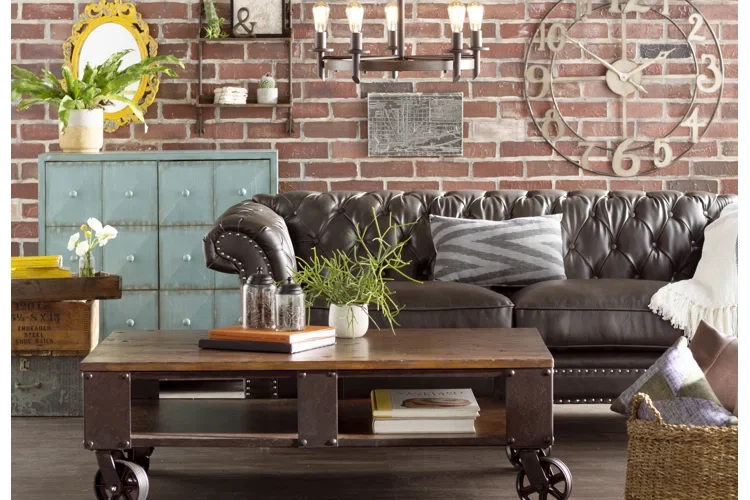
A leather sofa or armchair anchors the living room, in distressed brown or black. A reclaimed wood dining or coffee table on a steel base anchors the larger spaces. Open shelving with a steel frame and wood shelves provides storage and display. Those three purchases set the style; everything else is supporting cast and can be found slowly.
Vintage and repurposed
Some of the best industrial furniture comes from actual industry. A workshop cart becomes a side table, a metal locker becomes bedroom storage, a drafting table becomes a desk. These pieces carry an authenticity no reproduction matches, and they cost less than reproductions more often than people expect. Check that drawers run, wheels turn, and nothing is seized before buying; a locker that will not open is sculpture.
For selecting and sourcing pieces, including what to pay for steel, wood, and leather at each quality tier, the industrial furniture guide goes piece by piece.
Industrial Lighting
Lighting is arguably the most important element in an industrial interior. The right fixture shifts a room from generic to unmistakably industrial in one change, and the wrong one, or too many, turns a home into a restaurant.
Pendant lights
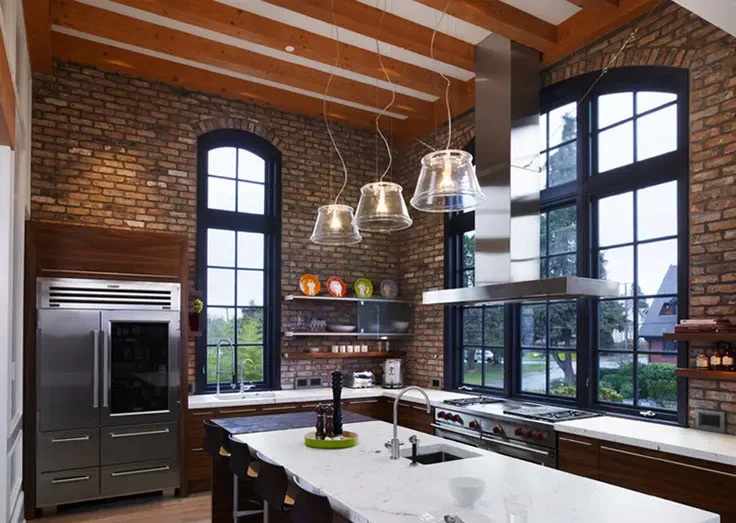
Factory pendants in enameled or spun metal, with a glass or metal shade, are the most recognizable fixtures. Hang them over a kitchen island, a dining table, or a work surface, with the bottom of the shade 30 to 36 inches above the counter. Two or three in a row over an island create rhythm; one large pendant over a dining table reads calmer than a cluster.
Filament bulbs and cage lights
Exposed filament bulbs have become shorthand for the style, which is exactly why they need restraint. Use them where the bulb itself is the feature, in a cage fixture, a bare socket sconce, or a small cluster, and keep them warm, at 2700K or lower, and on a dimmer. A filament bulb at full brightness is a glare source, not an atmosphere.
Articulated and task lighting
Adjustable arm lamps, descended from drafting tables and machine shops, make the best task lighting in studies, bedrooms, and reading corners. The exposed springs and joints are part of the appeal, and a wall mounted version beside a bed or a sofa frees the surface below it. Layer all of it: an overhead fixture, a task light, and a third low source, so the room can be dim without being dark.
Industrial Design Room by Room
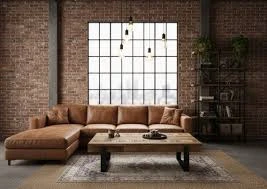
Industrial living room
Anchor the room with a leather sofa or sectional, then add a reclaimed wood coffee table on a steel base and an armchair in leather or canvas. Open shelving with steel brackets holds books and a few chosen objects, and one or two oversized pendants or a floor lamp with an exposed bulb supply the light. Keep the rug simple, a flat weave or a wool loop in a neutral, sized so the front legs of every seat sit on it.
For layouts, seating combinations, and how to warm the room without losing its edge, see industrial living room ideas and inspiration.
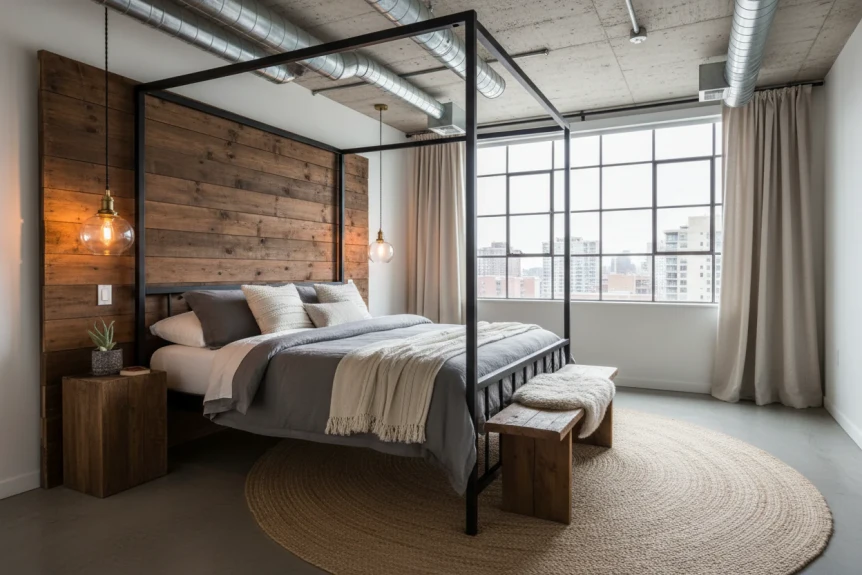
Industrial bedroom
An industrial bedroom starts with a black steel or reclaimed wood bed frame against brick, concrete, or a dark painted wall. Bedding stays neutral and heavy, in linen with a wool throw, and storage comes from a vintage locker or a solid wood dresser with black hardware. Articulated sconces at the bedside and one dimmable pendant supply the light. The room should feel grounded and slightly raw, and it should still be the most comfortable room in the house.
The full treatment, including bed frame comparisons and the mistakes that make the room cold, is in industrial bedroom design ideas.
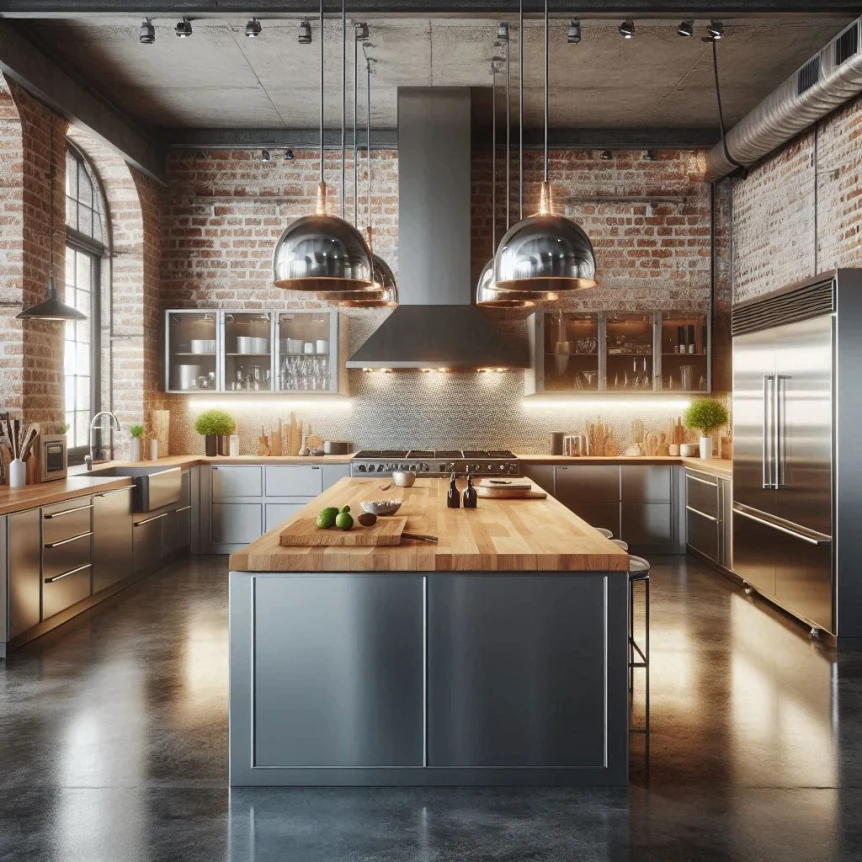
Industrial kitchen
The kitchen is the room where industrial function and industrial aesthetics overlap completely. Stainless steel counters, open steel shelving, a concrete or thick wood worktop, a brick or dark tile backsplash, and pendants over the island all belong there because commercial kitchens used them first. Keep upper cabinets to a minimum and let the shelving carry the everyday dishes.
For cabinet, counter, and lighting decisions in detail, see industrial kitchen ideas and design tips.
Industrial bathroom
A concrete or microcement vanity, exposed pipe shower fittings, black hardware, and a mirror in a thin steel frame bring the look into the bathroom. White or black subway tile with dark grout is the classic wall, and a single cage sconce or a bar fixture above the mirror finishes it. Keep towels heavy and neutral, because the bathroom is the room where the style tips coldest fastest.
Industrial home office
The home office is the most natural fit for the style, because the workshop is where it came from. A reclaimed wood desk on a steel base, a leather desk chair, an articulated arm lamp, and metal storage make a workspace that looks like it means it. Buy the pieces in sequence: desk first, chair second, lighting third, storage fourth, textiles and art last, because each one sets the size and position of the next.
Which Industrial Variation Fits Your Home?
Industrial style has three main directions, and the choice between them is mostly a question of how raw the room should feel and what the building already offers. The table compares them; the sections below say who each one suits.
| Variation | Character | Signature materials | Best for | Watch for |
|---|---|---|---|---|
| Modern industrial | Clean, precise, restrained | Polished steel, smooth concrete, dark paint, minimal wood | New builds, urban apartments, small rooms | Tipping into cold without leather or wood |
| Rustic industrial | Warm, weathered, lived in | Reclaimed timber, distressed leather, aged iron, vintage factory pieces | Older houses, larger rooms, homes that mix with farmhouse | Tipping into farmhouse or theme park |
| Industrial chic | Softened, slightly luxurious | Brass and copper, velvet with leather, subtle pattern | Upscale interiors that want the edge without the rawness | Losing the honesty that makes the style work |
Modern industrial
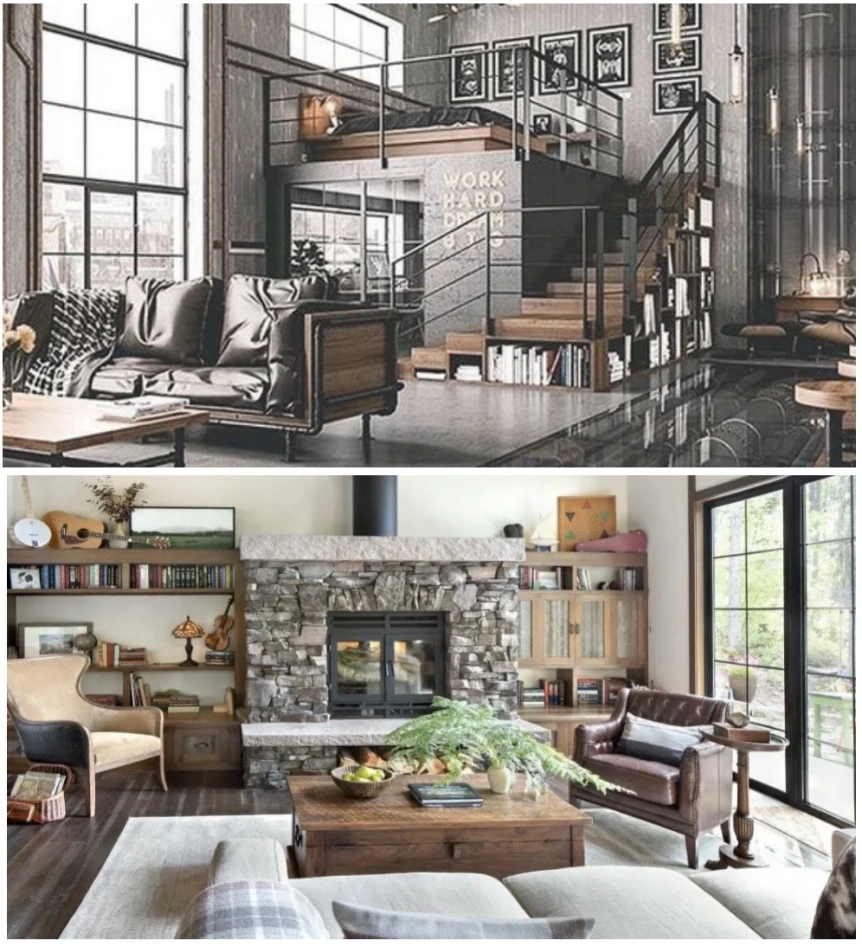
Modern industrial keeps the metal, concrete, and exposed structure and pairs them with sleeker furniture, tighter styling, and a controlled palette. Less reclaimed wood and more polished steel; less weathering and more precision. It suits new apartments and small rooms best, and it is the version most at risk of reading cold.
Rustic industrial
Rustic industrial leans warmer and older. Reclaimed wood, distressed leather, visible age on the metal, and a lived in atmosphere define it, and it often blends with farmhouse style. It suits older houses and larger rooms, and its risk is collecting so many weathered pieces that the room becomes a set.
Industrial chic
Industrial chic softens the rawness with refined finishes, subtle pattern, and a little glamour. Brass and copper appear more than black iron; velvet sits alongside leather. It works in upscale interiors that want the edge of the style without its coldness, and it stops working the moment the materials stop being real.
For a side by side comparison with room examples, see modern industrial versus rustic industrial design.
What Most People Get Wrong
Going too cold
The most frequent mistake is forgetting warmth. Concrete floors, steel furniture, and gray walls with no wood, leather, or textiles feel like a parking garage. Every hard surface needs a soft one within reach: a rug under the seating, a throw on the sofa, curtains at the steel windows.
Collecting every cliche
Filament bulbs, pipe shelving, factory pendants, distressed wood, and exposed brick in one room feel like a theme restaurant. Choose two or three strong elements per room and let them carry the style. A brick wall and a leather sofa do not need pipe shelving to prove the point.
Faking the materials
Brick wallpaper, foam brick panels, concrete effect paint, and printed barn wood veneer all read as fake within days. A style built on honest materials cannot survive dishonest ones. If real brick or microcement is out of reach, a deep gray wall and one genuine piece of furniture is the better spend.
Mixing every metal
Black steel, brass, chrome, copper, and galvanized zinc in one normal sized room read as accumulated rather than designed. One base metal and one warm accent is the rule that holds in every room short of a full loft.
Ignoring comfort
Industrial does not have to mean hard. A leather sofa should still be soft enough to sink into, and a metal chair should still be one you would choose to sit in for dinner. Sit in the piece before buying it; the style’s most handsome chairs are also some of its least comfortable.
Skipping personality and acoustics
Pure industrial style feels impersonal without art, books, plants, and objects that belong to the people who live there. Those same soft additions solve the other problem hard surfaces cause: brick, concrete, and metal make a room echo, and rugs, curtains, and upholstery are what quiet it. Personality and acoustics are the same fix.
Recommended Resources and Related Guides
Industrial Living Room Ideas and Inspiration
Designing an industrial living room from the leather sofa out, with layout, seating, and lighting strategies and the balance that keeps it warm.
Industrial Bedroom Design Ideas
Bed frames compared, wall treatments, layered lighting, and the mistakes that make an industrial bedroom cold instead of restful.
Industrial Kitchen Ideas and Design Tips
Open shelving, stainless steel, concrete worktops, and the lighting that suits a working kitchen with an industrial edge.
Industrial Color Palettes and Materials
Paint tones and material pairings for an industrial home, with the combinations that warm a cool palette without softening the style.
Industrial Furniture Guide: Metal, Wood, and Leather
Selecting and sourcing industrial furniture, including vintage finds, reproductions, and what to pay at each quality tier.
Modern Industrial vs. Rustic Industrial Design
The two most popular variations compared room by room, and how to decide which one fits your house and how you live.
Where to Go From Here
Industrial interior design offers something rare among popular styles: a look that does not depend on polish, novelty, or constant updating to feel current. It rewards real materials, weight, and patience. Start with two or three honest elements, balance every hard surface with wood, leather, or textile, and let the room gather character over time rather than buying it in one afternoon.
If the house is not a loft, begin with the furniture guide, because the sofa, the table, and one fixture will carry the style further than any wall treatment. If the question is how raw to go, the modern versus rustic comparison settles it before the first purchase.
Frequently Asked Questions
What is industrial interior design?
Industrial interior design is a style drawn from factories, warehouses, and workshops. It exposes the structure of a building, such as brick, concrete, steel beams, and ductwork, and pairs it with reclaimed wood, leather, heavy textiles, and light fixtures that look like equipment. The palette is neutral, the furniture is heavy and functional, and the warmth comes from what is layered over the hard surfaces.
What are the best materials for industrial house interiors?
Brick, concrete, steel, reclaimed wood, and leather, with steel framed glass connecting them. Use the real material where the building has it, and the honest applied version where it does not: thin brick veneer with real mortar, microcement over existing surfaces, powder coated steel of 1/8 inch or heavier, kiln dried reclaimed boards, and full grain or top grain leather. Avoid printed wallpaper, foam panels, concrete effect paint, printed veneer, and bonded leather, which all read as fake within weeks.
How do I make my home look industrial without exposed brick?
Start with furniture and lighting rather than walls: a leather sofa, a reclaimed wood table on a steel base, open steel shelving, and one factory style pendant establish the style on their own. If a wall treatment is wanted, thin brick veneer or microcement are the honest options, and a deep warm gray paint is a better choice than brick wallpaper.
What colors work best in industrial design?
Charcoal, warm gray, off white, and black form the foundation, with warm wood tones supplying the essential warmth. Accent color is used once per room, in a saturated but slightly muted tone such as deep rust, forest green, mustard, or burnt orange, carried by one piece of furniture, one canvas, or one textile.
Can industrial design work in a small apartment?
Yes, with restraint. Choose one or two strong elements, such as a leather armchair, a steel pendant, or a reclaimed wood shelving unit, and build around them. Keep the palette tight, pick one base metal, and use wall mounted lighting to free the floor. Trying to fit every industrial element into one small room is what makes it feel like a set.