Best Minimalist Desks: 7 Types Worth Buying and One to Skip

By Tereza Hower | Published September 8, 2026 | Updated October 13, 2026

The photograph that sells a minimalist desk is always the same: a pale wood top, two thin legs, a single lamp, nothing else on the surface. The desk that shows up at the door is often a different object, with a laminate top that lifts at the corners and a base that rocks the moment a forearm rests on it. Picking a minimalist desk is mostly the work of telling those two apart before the box is open.
This guide is the buying list. It covers the seven desk types that hold up in a minimalist room, what each one costs, what it is made of, and who it suits, and it names the one type that looks right online and disappoints in person. For the room around the desk, the minimalist home office ideas guide covers the palette, chair, lighting, and storage.
At a Glance
- A solid wood trestle desk is the best minimalist desk for most people, and the one worth stretching the budget for.
- Wall-mounted floating desks are the right answer under 70 square feet, and the wrong answer for anyone with two monitors.
- The quality jump happens between $400 and $800; above $1,200 you are paying for wood species and joinery, not function.
- Solid wood beats veneer, veneer beats laminate, and laminate should be left in the catalog.
- Buy the desk first, then the chair, then lighting; the desk sets the proportions for everything else.
Minimalist Desks Compared
Every desk below belongs in a minimalist room; they differ in footprint, weight, and cost. The table is the short version and the sections that follow explain the tradeoffs.
| Desk type | Best for | Material to favor | Typical size | Price range |
|---|---|---|---|---|
| Solid wood trestle | Most people; a dedicated office | White oak, ash, or walnut top on a wood or steel trestle | 55 to 71 in wide, 28 to 30 in deep | $600 to $1,800 |
| Wall-mounted floating | Rooms under 70 sq ft; laptop-only work | Solid wood or thick veneer on concealed steel brackets | 36 to 48 in wide, 18 to 22 in deep | $150 to $600 |
| Steel and oak writing desk | Renters; a desk that moves house | Oak top, powder-coated steel frame | 47 to 59 in wide, 24 to 28 in deep | $300 to $900 |
| Sit-stand with a clean base | Full-time screen work | Solid wood or bamboo top, two-leg frame in matte black or white | 48 to 60 in wide, 28 to 30 in deep | $500 to $1,500 |
| Compact secretary | Shared rooms; hiding work at night | Solid wood carcass with a fold-down or slide-out surface | 30 to 40 in wide, 16 to 20 in deep closed | $400 to $1,200 |
| Slab on cabinet legs | Long walls; two-person offices | Butcher block or solid wood slab on two closed cabinets | 72 to 96 in wide, 25 to 30 in deep | $400 to $1,000 |
| Pedestal desk with hidden drawer | Anyone who needs paper storage at hand | Solid wood or veneer with push-to-open drawer fronts | 48 to 60 in wide, 26 to 30 in deep | $500 to $1,400 |
| Ladder desk | Skip it | Usually particleboard and thin steel | 24 to 30 in wide, 20 in deep | $120 to $350 |
Which Minimalist Desk Should Most People Buy?
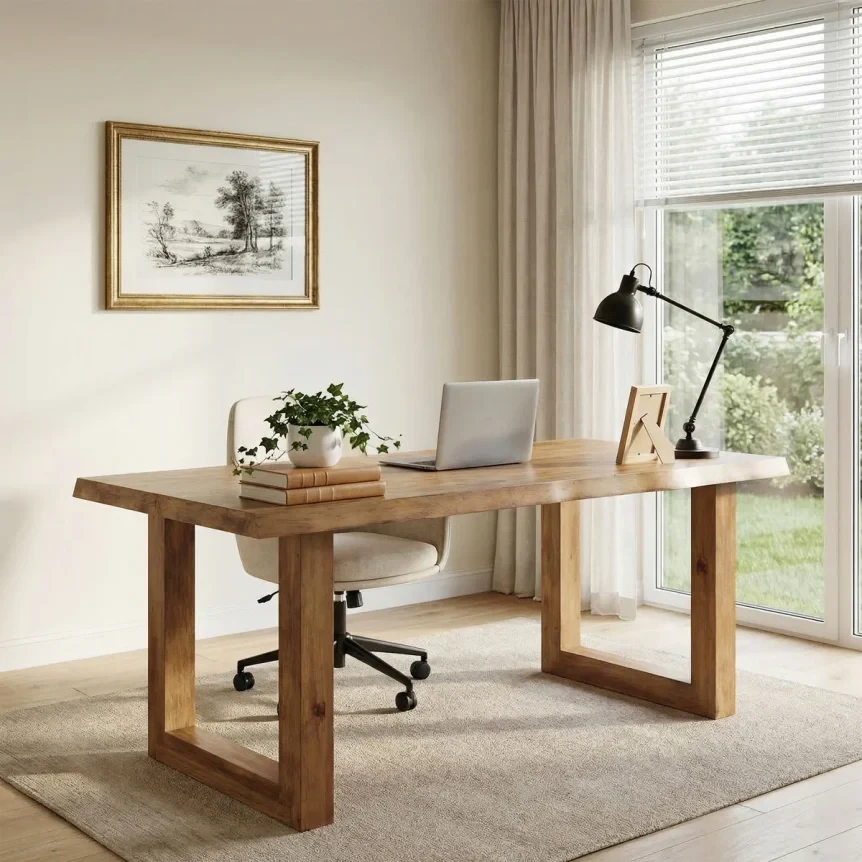
The solid wood trestle desk. It is the plainest object on the list and the one that ages best, because a solid top can be sanded and re-oiled every few years, and a trestle base has nothing to loosen, wobble, or peel. Most people should buy one at 60 inches wide and 28 to 30 inches deep, in white oak or ash if the room is light and in walnut if the room leans warm.
The exception is the small room. Under about 70 square feet a trestle desk eats the floor, and a wall-mounted floating desk does the same job on a laptop with no legs in the way. Everyone else ends up happier with the trestle. Which wall you face is the first decision in modern minimalist office design, and it determines where the desk belongs and how the room feels.
The Minimalist Desk Types Worth Buying
Solid Wood Trestle Desk
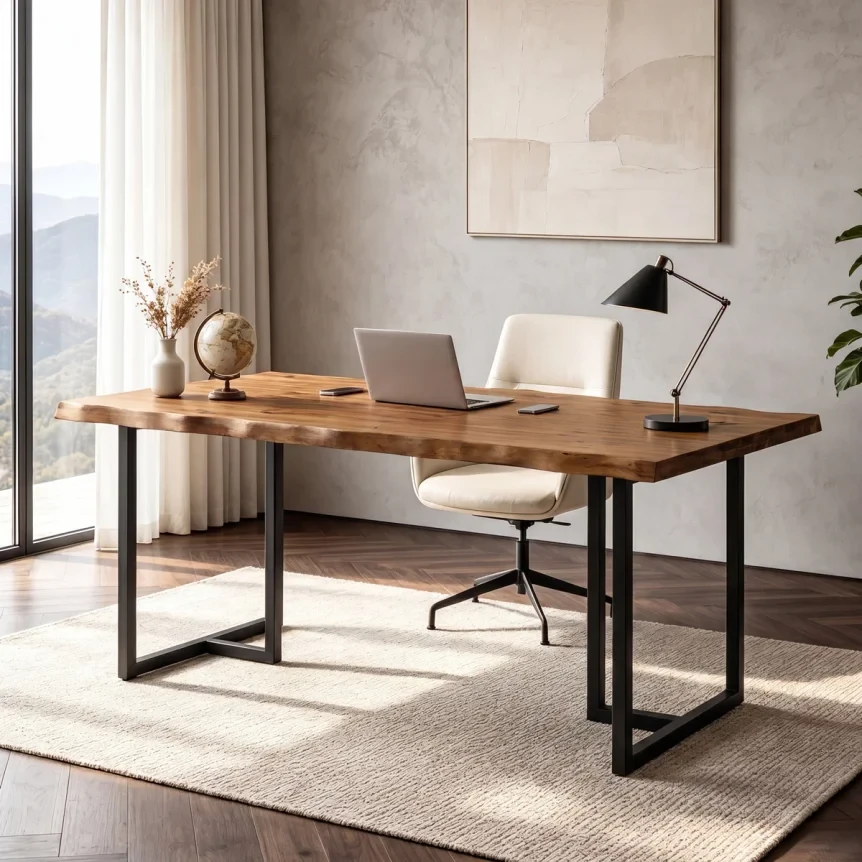
A trestle desk is a solid top resting on two A-frame or sawhorse supports, sometimes joined by a stretcher. The form has been in studios for a century because it is honest: the top does the work, the base holds it up, and there is nothing else to look at.
Look for a top at least 1 inch thick in a single species, with a hardwax oil finish rather than a thick polyurethane. Expect $600 to $1,000 for an oak or ash top on a steel trestle, and $1,200 to $1,800 for walnut on a matching wood base from a small maker. Solid wood over veneer matters most on a trestle desk, because the edge of the top is on display from every angle.
Wall-Mounted Floating Desk
A floating desk is a shelf sized for work, bolted into studs on concealed brackets, with no legs at all. In a room under 70 square feet, or a bedroom corner that has to read as a bedroom again at night, it is the right pick.
The limits are depth and weight. Most floating desks are 18 to 22 inches deep, which suits a laptop and a notebook and nothing more. Two monitors, a printer, or a habit of leaning on the front edge will find the bracket’s limit. Budget $150 to $300 for a veneer top on steel brackets and $400 to $600 for a solid oak plank on heavy-duty hardware, and hire someone to mount it if the wall is anything other than standard drywall over wood studs.
Steel and Oak Writing Desk
The steel and oak writing desk is the workhorse: a rectangular oak top, usually 47 to 59 inches wide, on a thin powder-coated steel frame in matte black or white. It ships flat and survives three moves without complaint, which is why it is the right choice for renters.
Prices run $300 to $900, and the spread is almost entirely the top. At $300 the top is oak veneer over particleboard; at $600 and above it is solid stave oak. Check the frame joints for welded rather than bolted corners, since bolted steel frames loosen within a year and start the wobble that no amount of tightening fixes for long.
Sit-Stand Desk With a Clean Base
Most sit-stand desks fail the minimalist test on the base: thick columns, a control box hanging underneath, and a crossbar that reads as office equipment. The ones worth buying use a two-leg frame with slim columns, a recessed controller, and a solid wood or bamboo top instead of the standard laminate.
Expect $500 to $800 for a good frame with a bamboo top and $1,000 to $1,500 with solid oak or walnut. Spend here only if you genuinely stand to work; a sit-stand desk that stays at sitting height is an expensive way to buy a wobbly base. Stability at full height is the spec that matters, and cheap frames sway noticeably above 40 inches.
Compact Secretary Desk
A secretary desk is a cabinet with a work surface that folds down or slides out, and it closes when work stops. In a living room or a guest room, it is the piece that keeps a minimalist room minimalist. Closed, it reads as a slim cabinet 30 to 40 inches wide and under 20 inches deep.
Prices run $400 to $1,200, and the mechanism is where to spend. A fold-down surface on cheap hinges sags at the pivot; a slide-out surface on full-extension metal runners lasts. The open surface is rarely more than 20 inches deep, so this is a laptop desk, not a two-monitor desk.
Slab on Cabinet Legs
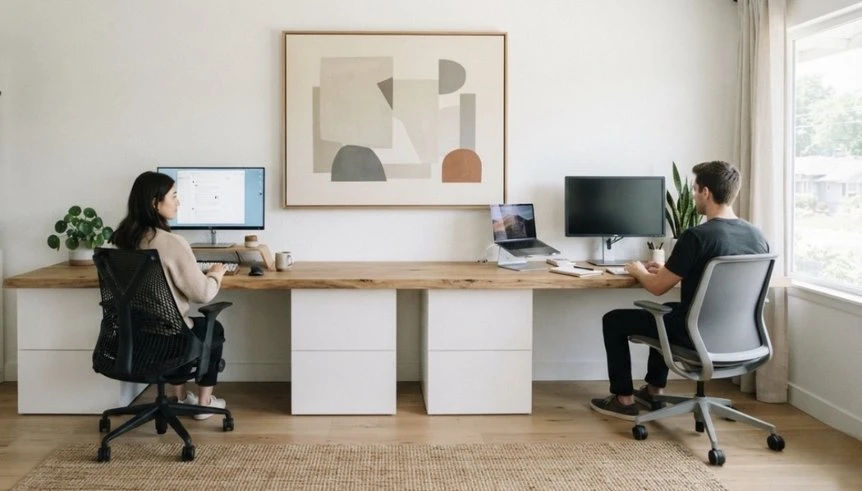
A long slab across two closed cabinets is the minimalist answer to a shared office or a long blank wall. A 72 to 96 inch butcher block or solid wood slab on two low cabinets gives two people a surface, closed storage at each end, and a single unbroken line that reads as built in.
This is also the best value on the list: a hardwood butcher block top and two flat-front cabinets come to $400 to $1,000, less than most trestle desks of half the width. Keep the cabinets at 26 to 28 inches tall so the surface lands at desk height, and choose push-to-open fronts rather than visible pulls.
Pedestal Desk With a Hidden Drawer
For anyone who works with paper, a pedestal desk with one or two drawers is the honest choice, provided the drawers disappear. The minimalist version has push-to-open fronts flush with the apron and no visible hardware. It looks like a plain table until a drawer opens.
Prices run $500 to $1,400. Under $500 the drawers ride on plastic runners and the veneer fronts chip where fingers push. Above $800 expect solid wood drawer boxes and soft-close metal slides, the difference between a drawer that works for a decade and one that sticks by the second winter.
The Ladder Desk: The One to Skip
The ladder desk, a narrow surface with shelves climbing the wall above it, photographs as the most minimalist option and lives as the least. The surface is usually 24 to 30 inches wide and 20 inches deep, too small to work at, and the shelves above become the clutter a minimalist office is supposed to hide. Almost every version under $350 is particleboard on a thin steel frame that racks sideways when a chair bumps it.
If the appeal is the footprint, a floating desk is narrower and far more stable. If the appeal is the shelving, one closed cabinet does the job without clutter at eye level. For specific pieces worth buying, see minimalist bedroom furniture.
How Much Should a Minimalist Desk Cost?
Under $400, nearly every desk is laminate or thin veneer over particleboard on a bolted base. Between $400 and $800 is where the quality jump happens: solid wood tops appear, steel frames get welded, and drawer runners turn to metal. Between $800 and $1,200 you are paying for thicker tops, better wood species, and a maker’s name.
Above $1,200 the improvements are real but small: hand-cut joinery, book-matched grain, a rubbed rather than sprayed finish. Spend there if the desk is the only piece of furniture in the room. Otherwise the $600 to $900 band buys a desk that will outlast the chair, the lamp, and probably the house.
How to Tell a Quality Minimalist Desk from a Cheap One
A minimalist desk has nowhere to hide its construction. Five checks separate a desk that lasts from one that only photographs well.
- Solid wood, veneer, or laminate. Look at the end grain on the edge of the top. Solid wood shows grain wrapping around the corner; veneer shows a thin line where the face meets a different material; laminate shows a printed pattern that stops dead at a glued edge. Solid wood can be refinished, veneer cannot, and laminate bubbles.
- Edge banding. Run a fingernail along the underside edge of the top. On a cheap desk the plastic band catches, lifts, or shows a glue line. Any lift at all will grow within a year.
- Leg wobble. Press down on one corner and push sideways. A welded steel frame or a stretcher-joined wood base does not move; a bolted frame flexes a few millimeters, and that flex becomes a rock as the bolts loosen.
- Cable management. A good minimalist desk has a grommet or a channel in the top and a tray under the back edge. A cheap one has nothing, which means cables down the front leg and the clean silhouette gone by the first afternoon.
- Drawer slides. Pull a drawer all the way out. Full-extension metal slides with a soft close are the mark of a desk built to last; wood-on-wood or plastic runners are the mark of one built to ship.
The wider logic of buying fewer, better pieces runs through the minimalist furniture guide, and the same five checks apply to a credenza or a bookcase.
What Size Minimalist Desk Do You Need?
Depth matters more than width. A desk 24 inches deep feels tight the moment a laptop, a monitor, and a cup share the surface; 28 to 30 inches gives room to work without spreading sideways. Width should be at least 60 percent of the wall it sits against, because a small desk floating on a wide wall reads as undersized rather than restrained.
Height is standard at 29 to 30 inches; check that clearance under the apron is at least 25 inches so a chair with arms slides under. Desk facing the window is the layout I use and the one I recommend to anyone who spends more than two hours a day on screen, so measure the window wall rather than the longest wall. The complete guide to modern home office design covers the layout options in full.
Common Mistakes When Buying a Minimalist Desk
- Buying for the photograph. A 24 inch deep desk looks lighter online and is unusable with a monitor.
- Choosing white laminate because it looks clean. It looks clean for six months, then the edges yellow and the banding lifts. A pale oak top reads just as light and ages the other direction.
- Ignoring the cables. A desk with no grommet or tray is a desk with cables down the front leg. In a minimalist room that single detail undoes everything.
- Buying the chair first. The desk sets the height, the depth, and the visual weight of the room. Choose it first and buy a chair that fits it.
- Filling the surface. A monitor, a lamp, and one object. If the desk needs more than that on top, the room needs a piece of closed storage, not a bigger desk. The decluttering guide covers what to keep and what to move.
Where Does the Desk Fall in the Buying Order?
First. For a minimalist office, the order is desk, chair, lighting, art, then storage and accessories. The desk fixes the proportions of the room, the chair is bought to fit the desk, and the lighting is placed around both.
Once the desk is in, the home office lighting guide covers the three layers that keep the room from looking flat. For the philosophy behind choosing one good piece over three adequate ones, the complete guide to minimalist interior design is the place to go next.
Frequently Asked Questions
What is the best minimalist desk for a small room?
A wall-mounted floating desk. At 36 to 48 inches wide and 18 to 22 inches deep with no legs, it keeps the floor visible and the room feeling larger than a freestanding desk would. Mount it into studs on concealed brackets, and treat it as a laptop desk.
Is a solid wood minimalist desk worth the extra cost over veneer?
Yes, if the desk is the main piece in the room. Solid wood can be sanded and re-oiled; veneer chips at the edges within a few years and cannot be repaired. The gap is usually $200 to $400 on a desk in daily use for a decade.
How deep should a minimalist desk be?
At least 28 inches for any setup with a monitor. A 24 inch deep desk feels cramped the moment a laptop, a screen, and a cup share the surface. With two monitors, 30 inches is the comfortable minimum.
Can a sit-stand desk look minimalist?
It can, with the right base. Look for a two-leg frame with slim columns, a controller recessed under the top rather than hanging from it, and a solid wood or bamboo top instead of laminate. Thick columns and a visible crossbar read as office equipment no matter what sits on top.
What should I avoid when buying a minimalist desk online?
Laminate tops, bolted steel frames, and any desk with no cable grommet or tray. Look for the top material named, the word welded in the frame description, and a depth of at least 28 inches. If the material is not stated, assume particleboard.