Minimalist Furniture Design: Six Traits and Four Looks to Know

By Tereza Hower | Published September 25, 2026
Put a plain white bookcase from a flat pack box next to a white oak cabinet with flush doors and both look simple from across the room. Walk closer and only one of them is minimalist furniture design. The other is furniture with the details left off, and the difference shows up in the edges, the proportions, and the way the piece handles what it hides.
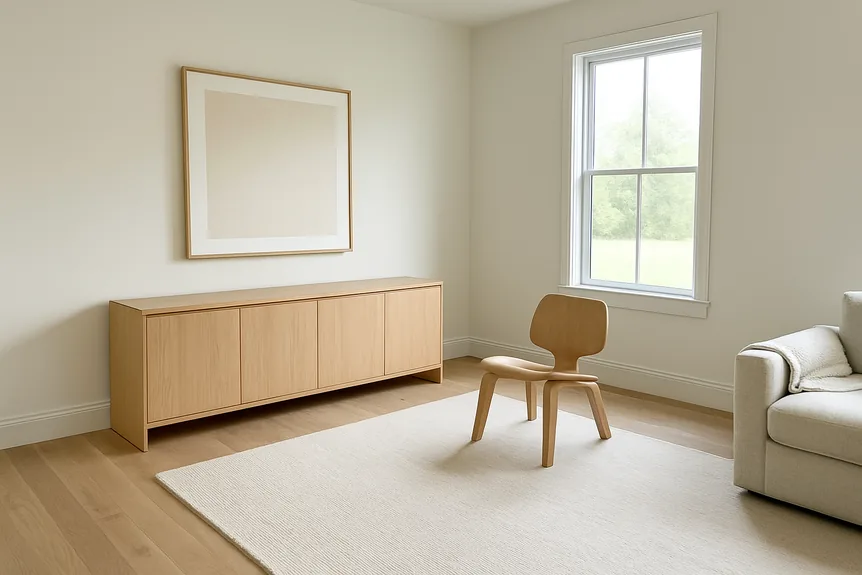
This is a guide to recognising the real thing: the traits that make a piece minimalist, the four looks the style takes in a home, and the signs that separate considered design from cheap plainness. What to buy, piece by piece and room by room, lives in our minimalist furniture buying guide.
Key Takeaways
- Minimalist furniture design is defined by what a piece leaves out on purpose, not by how little it costs or how bare it looks.
- Six traits do most of the work: one clear silhouette, controlled visual weight, honest materials, hidden storage, careful edges, and a restrained palette.
- The style splits into four looks (warm, Nordic, Japanese leaning, and stark modern) that share the traits but use different woods, metals, and colors.
- Thin veneer edges, visible fixings, and wobble are the quickest ways to tell plain furniture from considered minimalist design.
What Is Minimalist Furniture Design?
Minimalist furniture design is an approach in which every line, joint, and surface on a piece has a job, and anything purely decorative is removed. A piece designed this way reads as calm because the eye has nothing to stop on except the form and the material. It is a way of designing, not a color or a price bracket.
That definition matters because the word gets stretched. Plenty of furniture sold as minimalist is simply undecorated: no carving, no hardware, no finish worth mentioning. Minimalism asks for more attention to the few details that remain, which is why a genuinely minimalist chair is often harder to make than an ornate one.
The lineage is short and worth knowing. Shaker makers in nineteenth century America built furniture with no ornament and exacting joinery. The Bauhaus designers of the early twentieth century, Marcel Breuer among them, stripped chairs down to bent steel tube and canvas. Danish modern designers such as Hans Wegner and Børge Mogensen brought the same restraint to solid wood, and Japanese cabinetmaking contributed joinery that hides its own fixings.
Later, the industrial designer Dieter Rams summed up the idea as “less, but better.” The phrase is useful as a test in a showroom or on a product page: if you removed one more element, would the piece stop working? If the answer is no, it is not minimalist yet. The broader history of the style in whole rooms is covered in our complete guide to minimalist interior design.
The Six Traits That Define Minimalist Furniture
These are the details to look for, whether the piece is a dining chair, a bed, or a media cabinet. A piece does not need all six, but the best examples get at least five right.
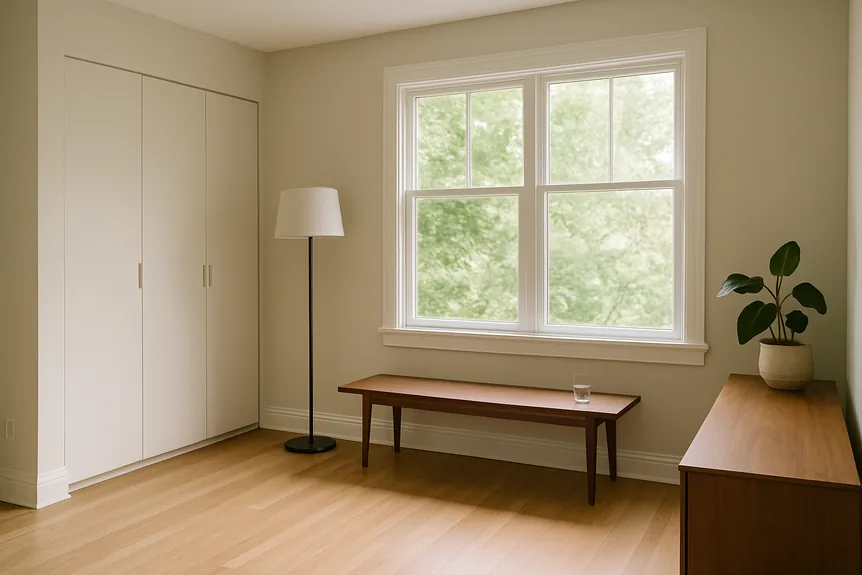
One Clear Silhouette
A minimalist piece can be described in a single sentence: a long low box on four legs, a slab on a trestle, a cube with a seat cushion. If the outline needs a paragraph, with a curved apron, a gallery rail, and a contrasting crown, it has left the style. Squint at the piece from across the room; the silhouette should hold up as one shape.
Visual Weight Kept Low or Lifted
Minimalist designers control how heavy a piece looks. They either drop it close to the floor on a recessed plinth, which makes a sofa or bed read as a single calm block, or they lift it on slim legs so the floor runs underneath. Legs 5 to 8 inches tall make a room feel larger; a plinth makes it feel grounded.
What rarely works is the middle ground: chunky legs that are too short to show floor and too tall to disappear. That proportion is the one most often seen on budget pieces trying to look Scandinavian.
Honest Materials
With ornament gone, the material is the decoration. White oak, ash, and walnut are the core woods because their grain carries a plain surface. Powder coated steel, travertine, and limestone appear in cooler versions, and upholstery sticks to linen, wool bouclé, and tight weaves in one color.
“Honest” means the material is what it appears to be. A printed wood grain on foil pretends to be oak, and in a minimalist piece there is no ornament to distract from the pretense. Real veneer over plywood is honest; a photograph of wood is not.
Storage That Disappears
Flush doors, push latches, finger pulls routed into the edge of a drawer front, and doors that close with a gap no wider than a coin. Handles, when they exist, are a slim bar or a leather tab rather than a decorative knob. The goal is a front that reads as one plane when closed.
Edges and Joinery
This is where minimalist furniture design earns its price. Edges are eased with a small radius so they catch light softly, corners are mitered or joined with visible dovetails or finger joints, and screws stay out of sight. When a joint shows, it is shown on purpose, as a piece of craft.
A Restrained Palette
Most minimalist pieces use one wood, or one wood and one metal. Two woods can work if the contrast is deliberate, such as an oak case with a walnut top, but three is a collection rather than a design. Finishes stay matte or satin, since gloss draws attention to itself.
Which Look of Minimalism Suits Your Home?
The six traits hold across every version of the style, but the materials and colors shift enough that two minimalist rooms can look almost unrelated. Four looks cover most homes, and choosing one before buying keeps the pieces from arguing with each other.
| Look | Woods | Metals and fabrics | Colors | Signature piece |
|---|---|---|---|---|
| Warm minimalist | White oak, walnut | Brass accents, linen, bouclé | Oatmeal, clay, cream | Low plinth sofa in textured cream |
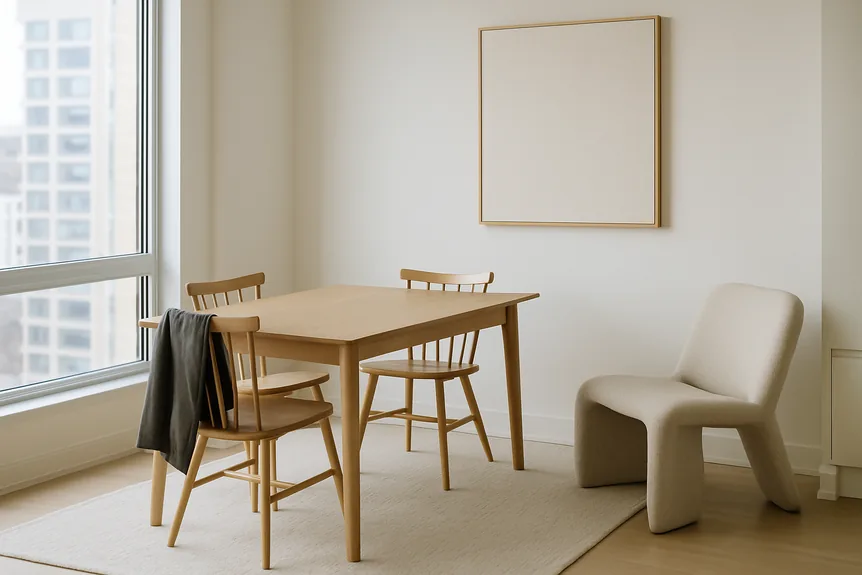
| Nordic minimalist | Ash, birch, pale oak | Wool, cotton canvas | White, soft grey, muted blue | Spindle back dining chair |
| Japanese leaning | Hinoki, dark stained oak | Paper, rush, linen | Charcoal, warm white, moss | Low platform bed on a slatted base |
| Stark modern | Black stained oak or none | Powder coated steel, leather, stone | White, black, concrete grey | Steel frame table with a stone top |
Warm minimalist is the most forgiving in a family home. Rounded edges, textured upholstery, and honey toned oak soften the restraint, which is why it tends to survive real life better than the colder versions. The difference between this and the cooler look is covered in depth in warm minimalism vs modern minimalism.
Nordic minimalist furniture ideas start with pale wood and slender turned or spindle details, which are allowed because they are structural. Expect lighter frames, more visible legs, and a willingness to use soft color. Our Scandinavian furniture guide goes further into the woods and makers behind this look.
Japanese leaning minimalism sits lower and darker. Platform beds, floor cushions, low tables, and sliding panels keep the eye line down, and joinery is often the only detail on a piece. If the look you are after is Japandi rather than pure minimalism, the Japandi furniture guide covers how it borrows from both traditions.
Stark modern is the gallery version: steel, stone, black and white, and almost no softness. It photographs beautifully and asks the most of a household, because every scuff and stray object shows. It suits a loft or a new build with strong architecture better than a traditional home with small rooms.
How Does Minimalist Furniture Look in a Living Room?
The living room is where minimalist furniture design is easiest to get wrong, because it is the room with the most pieces competing for attention. The traits above translate into a few recognisable choices.
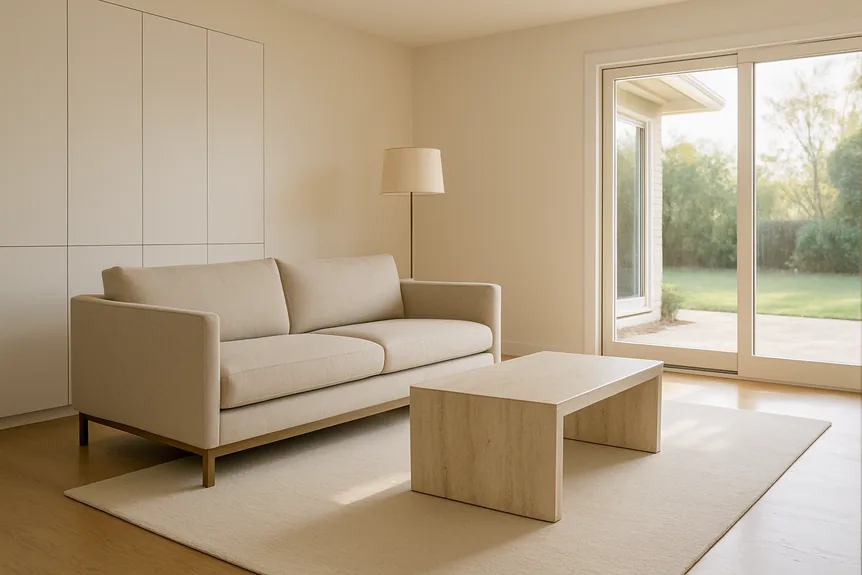
The sofa has slim or no arms, a back no higher than the shoulder blades, and a single seat cushion or two at most. Loose back cushions are fine if they are the same fabric as the frame. It sits either on a plinth or on legs tall enough to show a clear band of floor.
The coffee table is one material and one shape: a solid oak slab, a stone drum, a steel frame with a single top. Lower shelves and trays add clutter surfaces, so the most minimalist tables skip them. A media cabinet is long, low, and closed, with every cable and box behind flush doors.
Just as telling is what the room leaves empty. A minimalist living room usually keeps one wall bare and one corner open, and it resists the extra side chair that nobody sits in. For layouts and piece counts in rooms of every style, see our furniture ideas for the living room.
How to Tell Minimalist Design From Furniture That Is Just Plain
A plain piece and a minimalist piece can share a silhouette and a color. The difference is in the few details that remain, and because there are so few, each one carries more weight. These are the checks worth making before paying for the look.
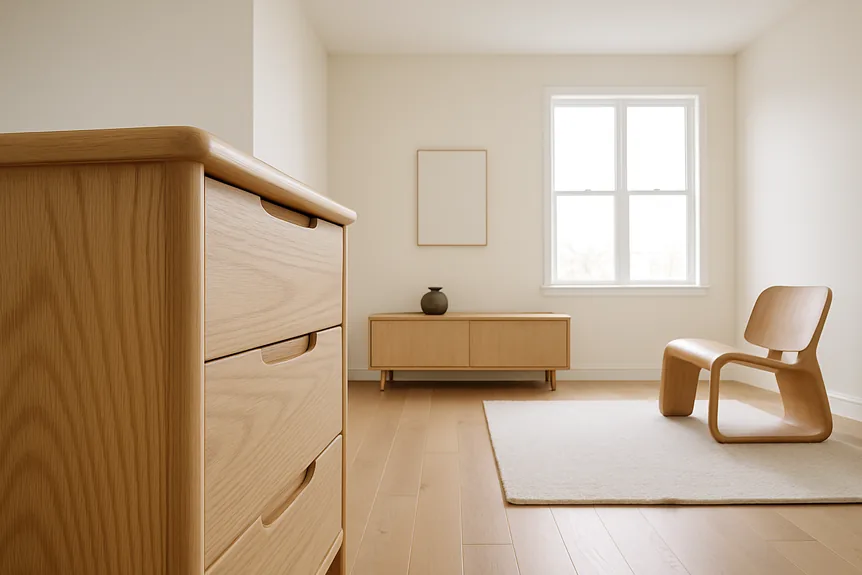
Look at the edges. On a cheap piece, the edge of a panel is a strip of banding that is a slightly different color from the face and often starts to lift at the corners. On a considered piece, the edge is solid wood or a thick veneer wrapped cleanly around the corner. Run a finger along it: a sharp ridge means banding.
Look for fixings. Round metal cam locks inside a cabinet, plastic caps over screw heads, and legs bolted to a flat metal plate under the frame are the marks of flat pack construction. None of them is a disaster, but together they tell you the design stopped at the outside surface.
Check the thickness. Minimalist pieces often use thin looking tops and shelves, and good makers get there with solid wood or steel that stays flat. A thin top made from particleboard sags under books within a few years. Press the middle of a shelf; any flex now becomes a visible dip later.
Push the corner. A table or cabinet that racks when pushed diagonally will only loosen with time. With no ornament to distract the eye, a lean or a gap that opens at a door is the first thing anyone notices.
Common Mistakes With Minimalist Furniture
Buying everything as a matching set. A bed, two nightstands, and a dresser in the same finish from the same line reads as a showroom rather than a minimalist room. Minimalism is about restraint in each piece, not uniformity across all of them; one wood and one contrasting material across the room looks more deliberate.
Choosing pieces that are too small. Undersized furniture in a sparse room floats and looks temporary. A minimalist room has fewer pieces, so each one has to be generous: a sofa that fills its wall, a rug that reaches under the front legs, a dining table with room at every place.
Making every surface hard. Stone, steel, lacquer, and bare floors look sharp in photographs and sound like a stairwell in person. Wool, linen, and a large rug keep a minimalist room quiet without adding visual clutter.
Assuming white is required. Some of the most convincing minimalist furniture design is dark: smoked oak, charcoal linen, blackened steel. What matters is the discipline of the form, not the paint color, and a room of warm wood and deep tones can be as minimalist as a white one.
Where to Go Next
Once the traits are familiar, shopping gets faster, because most pieces fail one of the six checks within a few seconds. For specific pieces worth buying, start with the minimalist furniture guide, then the minimalist bedroom furniture picks and our best minimalist desks for the home office.
For how these pieces come together with color, light, and editing in a whole home, the minimalist interior design guide is the natural next read.
Frequently Asked Questions
Is minimalist furniture the same as modern furniture?
No. Modern furniture refers to a period and a family of styles, including mid century pieces with tapered legs and sculptural shapes. Minimalist furniture is defined by restraint: a single clear silhouette, hidden storage, and no decoration. Many modern pieces are minimalist, but a curvy mid century chair with contrasting upholstery is modern without being minimalist.
Does minimalist furniture have to be white?
No. Color has nothing to do with it. Smoked oak, charcoal linen, and blackened steel are all common in minimalist furniture design. What makes a piece minimalist is its form, material, and detailing, so a dark walnut cabinet with flush doors is more minimalist than a white one covered in molding.
What wood is best for minimalist furniture?
White oak is the most versatile choice because its grain is visible but calm, it takes both light and dark finishes, and it is hard enough to keep crisp edges. Ash is a paler, slightly more open grained alternative common in Nordic pieces, and walnut suits warmer, darker rooms. Avoid printed wood grain, which cannot hide behind ornament on a plain piece.
Can minimalist furniture be comfortable?
Yes, provided the restraint is in the form and not in the padding. A minimalist sofa can have deep seats and soft cushions as long as the frame is simple and the upholstery is one fabric. Hard, thin seating is a choice some designers make, not a requirement of the style, so sit on a piece before assuming it will be austere.