Industrial Living Room Ideas for a Bold, Grounded Space

By Tereza Hower | Published April 10, 2026 | Updated October 13, 2026

The best industrial living room ideas start with what is already in the room. A loft with brick and ductwork needs restraint; a drywall apartment needs the character brought in through a leather sofa, a steel and wood shelf, and a factory pendant. Either way, the room works when hard materials meet soft ones and the lighting is warm. Below are the walls, furniture, colors, light, and layout that get it right.

Key Takeaways
- Anchor the room with a leather or canvas sofa, a reclaimed wood and steel coffee table, and one open steel shelf.
- Keep the palette to charcoal, warm gray, black, off white, and wood, with at most one accent such as rust or forest green.
- Balance every hard surface with a soft one: concrete with leather, steel with wool, brick with linen.
- Light with warm bulbs at 2700K and a statement pendant; cool light makes the materials look harsh.
What Makes a Living Room Feel Industrial?
An industrial living room borrows from converted factories and warehouses: raw or reclaimed materials, a neutral palette, statement lighting, and substantial furniture with visible construction. Leather, wood, and textiles add the warmth that keeps it from feeling cold.
The style does not depend on decorative tricks. It earns its character through honest materials and a few strong pieces, which is why it ages better than most trend driven looks. For the wider principles, see the complete guide to industrial interior design.
How to Get the Industrial Look Without Brick or Concrete
Exposed brick helps, but most homes have drywall. Thin brick tile on one accent wall gives the real texture without major construction, and a limewash or concrete effect plaster on one wall gives a softer version. The simplest route is paint: a charcoal, warm greige, or muted off white, with the furniture carrying the industrial character.
For floors, polished or sealed concrete is the most authentic, but wide plank wood in a medium to dark tone, reclaimed boards, or large format concrete look tile all work. Choose matte or satin finishes over gloss. If the ceiling has ductwork or beams, leave them exposed; if it is plain drywall, a shade darker than the walls adds weight overhead.

Which Furniture Anchors an Industrial Living Room?
The sofa comes first. Leather in warm brown or black is the classic choice, with clean lines and visible stitching; distressed leather looks better with age. Heavy canvas or linen on a metal frame is the alternative. A single sofa plus a separate accent chair usually feels more like a loft than a large sectional.
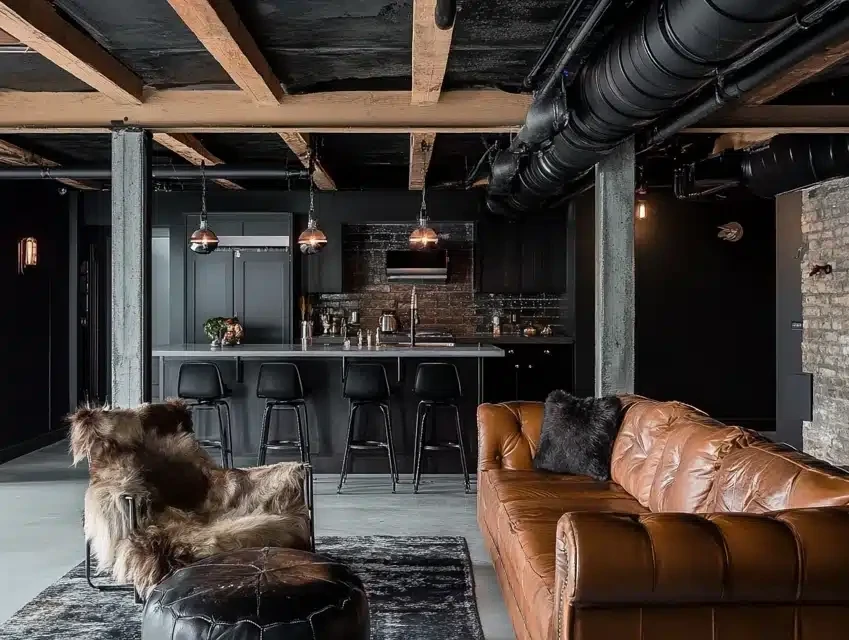
The coffee table is thick reclaimed wood on black iron or raw steel, or a vintage trunk or factory cart. Keep it 16 to 18 inches from the sofa edge and about two thirds of the sofa’s length. For accent chairs, mix rather than match: a leather club chair, a steel sling chair, or a vintage office chair.
Open shelving with a steel frame and wood boards is the defining storage piece. Leave some shelves partly empty; industrial styling values negative space. Anchor tall units to the wall. The industrial furniture guide covers quality checks, materials, and prices, and the sofa buying guide covers frames and cushions.

Industrial Living Room Colors and Materials
The palette is charcoal, warm gray, black, off white, and warm wood brown, with one restrained accent at most: deep rust, forest green, or burnt orange in a rug, a cushion, or art. The table shows three directions with paint colors to start from.
| Direction | Walls | Furniture | Accent | Paint to start with |
|---|---|---|---|---|
| Dark and moody | Charcoal or near black | Cognac leather, dark wood | Brass, rust | Iron Ore SW 7069, Kendall Charcoal HC-166 |
| Warm loft | Warm gray or greige, brick | Brown leather, reclaimed oak | Forest green, burnt orange | Agreeable Gray SW 7029, Urbane Bronze SW 7048 on one wall |
| Light industrial | Off white, white brick | Tan leather or canvas, black steel | Black, natural wood | White Dove OC-17, Chelsea Gray HC-168 on trim or doors |
Mixing hard and soft materials matters more than the paint. Pair concrete with leather, steel with wool, and brick with linen; the contrast keeps the room from feeling cold. The industrial color palettes and materials guide goes deeper on combinations.

How Should You Light an Industrial Living Room?
Start with a statement: one or two large factory pendants, a cluster of cage lights, or exposed bulb fixtures. Over a walkway, keep the bottom of a pendant at least 7 feet above the floor; over a coffee table it can drop a little lower without blocking sight lines.

Then add lower layers. An articulated metal floor lamp beside the reading chair, a wall mounted swing arm sconce, and a table lamp on a steel or wood base fill in the corners. Use warm bulbs around 2700K throughout; filament style bulbs glow amber and suit leather and wood, while cool daylight bulbs make the same room look harsh. For fixture types and layering, see modern lighting for living rooms.

What Should Be the Focal Point?
Every industrial living room needs one place the eye lands first. In a loft, it is often the windows or a brick wall; leave them clear and point the seating toward them. A fireplace with a blackened steel surround, a concrete hearth, or a simple plaster finish makes a strong focal point in a house.
Where the room has neither, create one: a large piece of art over the sofa, a full height steel and wood shelving wall, or an oversized pendant over the coffee table. Mount a television on a dark wall, or inside the shelving, so it does not compete with the focal point when it is off.
Layout and Space Planning
Industrial rooms suit open layouts that let the architecture breathe. Pull the sofa off the wall to define a seating area, and leave at least 30 to 36 inches for walkways. In an open plan space, the back of the sofa or an open shelving unit can divide the living zone from the dining or kitchen area.
Anchor the seating with a rug even when the floor is attractive. An 8 by 10 foot rug suits most sofa groups, with at least the front legs of every piece on it; 9 by 12 suits larger rooms. Wool, jute, or a vintage style flat weave adds warmth over concrete or dark wood. The modern area rugs guide covers sizes and materials.
Window Treatments and Textiles
Large factory style windows look best nearly bare, but most rooms need privacy and some light control. Linen or heavy cotton panels in oatmeal, charcoal, or rust, hung from a black iron rod mounted close to the ceiling, keep the industrial line. Roller shades in a textured weave are the quieter option for apartments.
Textiles are where the warmth lives. Wool throws, canvas and linen cushions, a sheepskin over a leather chair, and a vintage style rug soften every hard surface. Keep patterns simple: stripes, a muted kilim, or plain weaves suit the style better than florals or bold geometrics.
Styling: Art, Plants, and Objects
Large art works best: one oversized photograph, a vintage map, or an abstract canvas in a slim metal frame. Over a sofa, aim for art about two thirds of the sofa’s width, hung 8 to 10 inches above the back. Several smaller pieces work if they are hung tight and aligned, not scattered across the wall.

Plants soften the hard surfaces. A large snake plant, rubber tree, or fiddle leaf fig in a metal or concrete pot suits the scale of the style, with one or two smaller plants on the shelving. For objects, choose a few pieces with real age, such as old books, a vintage camera, or a brass instrument, over mass produced industrial themed decor.
Industrial Living Room Ideas for Small Spaces
A converted warehouse is not required. In a small room, pick three or four strong elements: one leather chair or a compact leather sofa, one statement light, an accent wall in brick tile or charcoal paint, and a reclaimed wood piece. Keep everything else simple and light enough to let the room breathe.
Leggy furniture on steel frames shows more floor and feels lighter than skirted pieces. A wall mounted shelf saves floor space, and a plug in swing arm sconce replaces a floor lamp. For a cleaner or more weathered take, compare modern industrial vs rustic industrial design.

Can Industrial Mix With Other Styles?
It mixes well, and a blend often suits a family living room better than pure industrial. With mid century modern, walnut and tapered legs soften the steel; a cognac leather sofa bridges both styles. With Scandinavian or warm minimal rooms, pale wood and off white walls lighten the palette while black steel and one leather piece keep the edge.
The rule is to let one style lead. Choose industrial for the architecture and the anchor pieces, then borrow two or three elements from the other style rather than splitting the room evenly. For the mid century side of that blend, see the complete guide to mid century modern design.
Industrial Living Room Ideas on a Budget
Spend on the sofa, since it gets the most use, and save almost everywhere else. Factory carts, metal lockers, and wood crates turn up cheaply at estate sales and resale listings and make good side tables and storage. A can of charcoal paint on one wall changes the room more than any accessory.
Swap a builder grade ceiling fixture for a black metal dome pendant, use plug in sconces where wiring is not possible, and replace every bulb with a warm filament style one. A thick reclaimed board on simple steel legs makes a convincing coffee table for far less than a finished piece.
Common Industrial Living Room Mistakes
All hard, no soft. Concrete, steel, and leather without a rug, throws, or curtains reads as a showroom. Add at least two soft textures.
Cool bulbs. Daylight bulbs turn brick gray and leather flat. Keep every lamp warm.
Theme decor. Gear clocks, metal signs, and pipe everything turn a style into a theme. Choose one or two real vintage objects instead.
Too many dark surfaces in a dim room. A north facing room with charcoal walls, dark floors, and black furniture closes in. Keep one of the three light.
Bringing It Together
An industrial living room is built on substance: real materials, well made furniture, and lighting that doubles as sculpture. Start with the walls and floor, choose the sofa and coffee table with care, and layer in warmth through leather, wood, wool, and warm light. For the same approach in other rooms, see industrial bedroom design ideas and industrial kitchen ideas, or return to the complete guide to industrial interior design.
Frequently Asked Questions
What sofa works best for an industrial living room?
A leather sofa in warm brown or black with clean lines and visible stitching is the classic choice. Heavy canvas or linen on a metal frame is the alternative where leather is not wanted.
How do I make my living room look industrial without renovating?
Use furniture, lighting, and paint: a leather sofa, a reclaimed wood and steel coffee table, an open steel shelf, a factory style pendant, and charcoal or warm gray walls. Thin brick tile on one wall adds texture without construction.
How do I keep an industrial living room from feeling cold?
Balance hard materials with soft ones: a wool or jute rug, linen or canvas cushions, a throw, warm wood, and warm 2700K bulbs throughout.
What colors go in an industrial living room?
Charcoal, warm gray, black, off white, and warm wood brown, with at most one accent such as rust, forest green, or burnt orange.
Can an industrial living room work in a small apartment?
Yes. Choose three or four strong elements, such as a leather chair, a statement light, an accent wall, and one reclaimed wood piece, and keep the rest simple and leggy.