Minimalist Bedroom Furniture: 7 Pieces Worth Buying and What to Skip

By Tereza Hower | Published September 16, 2026 | Updated September 18, 2026
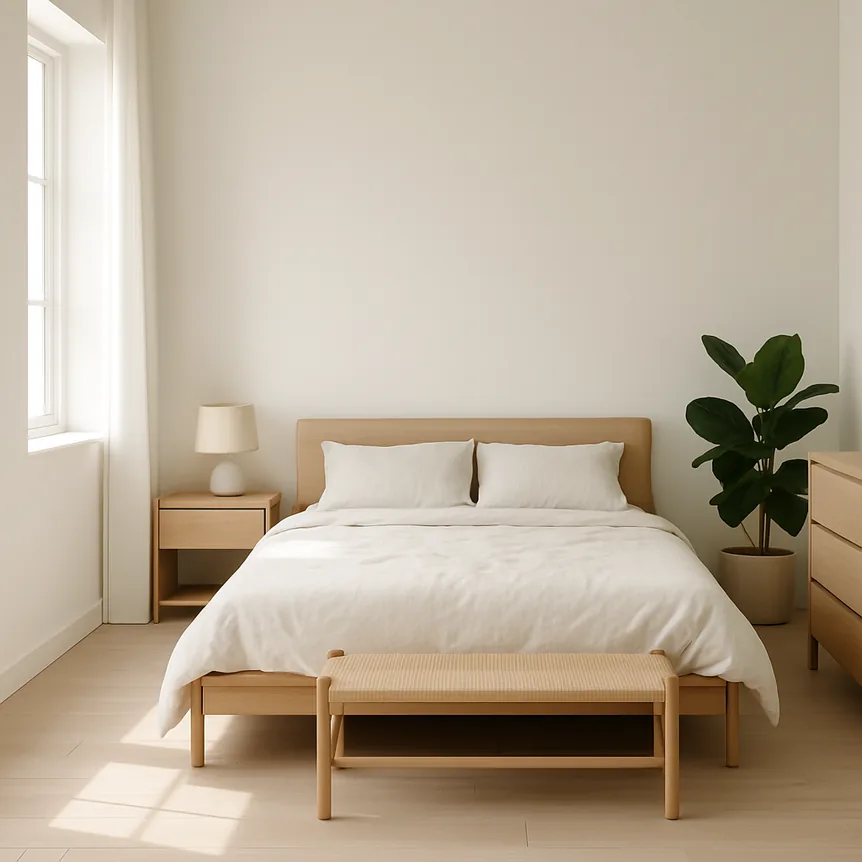
A minimalist bedroom exposes furniture the way a white gallery wall exposes a painting. With no layered rugs, no stack of pillows, and no wall of art to pull the eye, a bed frame with a bowed rail or a nightstand with a peeling edge is the first thing anyone sees from the door. That makes minimalist bedroom furniture the one category where buying a little better matters more than buying a little more.
This guide is the buying list: the pieces a minimalist bedroom actually needs, what each one should measure and cost, and how to tell a solid frame from one that only photographs well. It also answers the question the matched sets get wrong. For the room around the furniture, the minimalist bedroom design ideas guide covers palette, lighting, and styling.
Key Takeaways
- A low platform bed in solid wood is the one piece worth stretching the budget for; everything else can be bought modestly.
- Four pieces cover almost every minimalist bedroom: a bed frame, two nightstands, and one dresser or wardrobe, with a bench as the only optional fifth.
- Skip the matched bedroom set; buy the bed and the storage separately and let one wood species tie them together.
- Weight, drawer glides, and slat spacing tell quality from cheap faster than any product description.
What Are the Minimalist Bedroom Essentials?
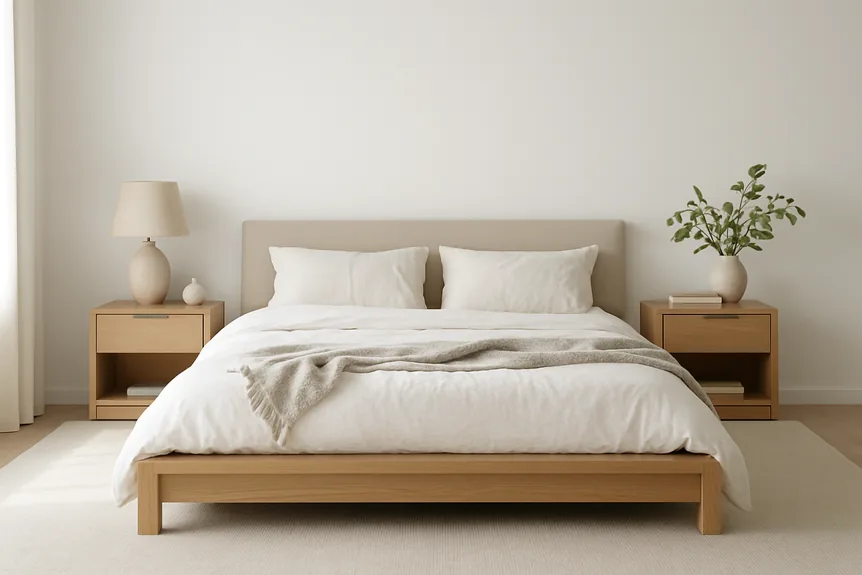
A minimalist bedroom is a sleeping room reduced to the furniture it uses daily, with clear surfaces, one dominant material, and storage that closes. It is not an empty room. It is a room where nothing is on display by accident.
Minimalist bedroom furniture follows the same rule, and the essentials list is short. A bed frame, one nightstand per sleeper, and a single piece of closed storage, either a dresser or a wardrobe, cover the room. A bench or a chair is the fifth piece, and only when the room is over about 140 square feet.
- Bed frame: a low platform, 10 to 14 inches to the top of the rail, in solid wood or a plain upholstered frame.
- Nightstands: one per sleeper, top within 2 inches of the mattress surface, one drawer at most.
- Closed storage: a long low dresser or a flat front wardrobe, sized to hold everything that is not in the closet.
- Bench or chair: optional, at the foot of the bed or in a corner, never both.
Everything else in a minimalist bedroom is textile or light, not furniture. A second dresser, a vanity, a television stand, and a desk are the four additions that turn a minimalist bedroom back into an ordinary one.
Minimalist Bedroom Furniture Compared: Sizes and Price Bands
The table below is the shortlist, with the dimension that matters most for each piece and the price band where solid construction begins. Prices are for a queen bed and full width case pieces. King frames and 72 inch dressers run about 20 percent more.
| Piece | Best for | Material to favor | Key dimension | Price range |
|---|---|---|---|---|
| Solid wood low platform bed | Most rooms; the piece to spend on | White oak, ash, or walnut, slats included | Rail 10 to 14 in high; slats 3 in apart or less | $900 to $2,500 |
| Upholstered platform bed | Rooms with hard floors and bare walls | Linen or wool blend over a hardwood frame | Headboard 36 to 44 in tall | $600 to $1,800 |
| Storage platform bed | Rooms without a closet or under 120 sq ft | Plywood carcass; gas lift or solid wood drawers | Drawer depth 20 to 24 in | $800 to $2,200 |
| Single drawer nightstand | Every bed, one per sleeper | Solid wood with an undermount glide | 18 to 24 in wide; top within 2 in of the mattress | $150 to $600 each |
| Long low dresser | Rooms with a clear wall over 8 ft | Solid wood fronts on a plywood carcass | 60 to 72 in wide, 30 to 34 in tall | $700 to $2,000 |
| Flat front wardrobe | Rooms without a built in closet | Oak or ash veneer on plywood, solid wood doors | 39 to 47 in wide, 78 to 83 in tall | $800 to $2,400 |
| Foot of bed bench | Rooms over 140 sq ft | Solid wood frame, linen or boucle seat | 48 to 60 in wide, 18 in tall | $250 to $800 |
| Matched five piece set | Skip it | Usually MDF with a paper foil finish | Sold by set, not by fit | $900 to $2,500 |
Which Minimalist Bed Frame Is Worth Buying?
The bed is the piece the room is built around, and the only one where the budget should go up rather than down. In a minimalist room the frame sits in open floor with nothing beside it but a nightstand, so every rail, joint, and leg is visible from the door. The best minimalist bed frames share three traits: a low profile, a solid material, and no detail that needs explaining.
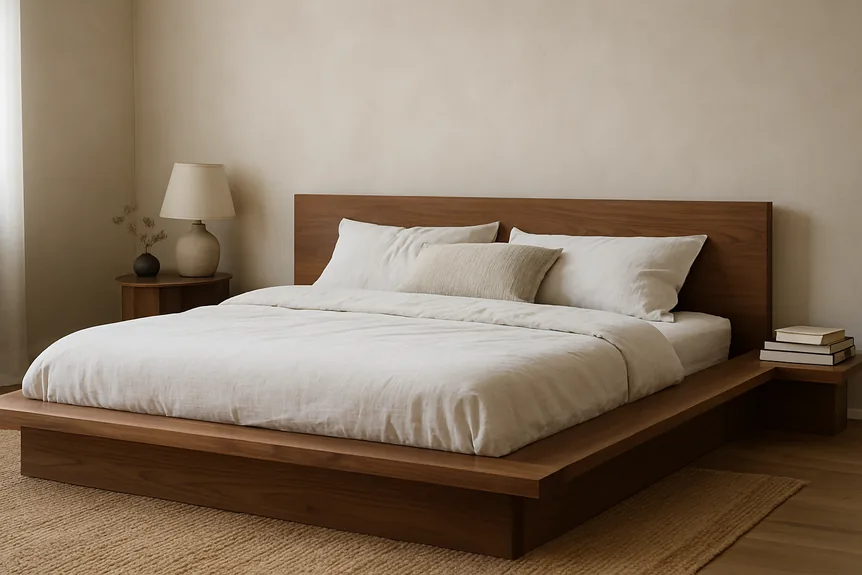
The low platform bed in solid wood
This is the default for good reason. A platform frame in white oak or ash, with side rails 10 to 14 inches off the floor and a headboard under 40 inches, gives the room a horizontal line that makes the ceiling feel higher. Look for rails at least 1.25 inches thick, slats spaced 3 inches apart or less, and a center support leg on any queen or king.
This is one piece where I always pushed customers toward solid wood over veneer. A solid oak rail takes a knock from the vacuum and can be sanded; a veneered rail chips at the corner and stays chipped. The difference is usually $300 to $500 on a queen, and it is the best money in the room.
The upholstered platform bed
An upholstered frame is the right choice when the floor is hard and the walls are bare, because the fabric absorbs sound and softens the corner where the bed meets the wall. Choose a flat, tight headboard in linen, wool, or a wool blend, 36 to 44 inches tall, and avoid tufting, channel stitching, and wings. A frame described only as gray fabric is polyester over foam, and one that wraps a metal base rather than a wood platform squeaks within a year.
The storage platform bed
In a room under 120 square feet, or one without a proper closet, a storage bed replaces the dresser and earns its bulk. Gas lift frames give the most space; drawer frames are easier to live with when the bed has a clear side. The storage beds guide covers the mechanisms and the sizes that fit a small room.
The one that photographs best and disappoints
A floating bed, where the platform sits on a recessed plinth so the mattress appears to hover, photographs better than any frame on this list and is the one to pass on. The recessed base makes the bed awkward to make, the strip light most of them include reads as a hotel, and the cantilevered rails are the first to bow on a king.
Nightstands: Height, Depth, and the One Drawer Rule
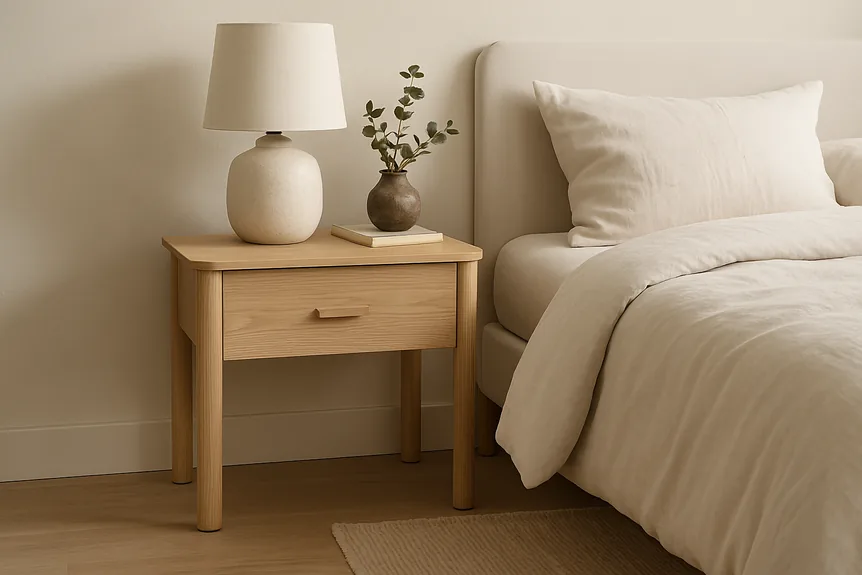
A nightstand in a minimalist bedroom has one job: to hold a lamp, a book, and a glass of water at a height where a hand finds them in the dark. The top should sit within 2 inches of the mattress surface, which for a low platform bed usually means 20 to 24 inches tall. Taller than that and the lamp looms over the pillow; shorter and the surface becomes a shelf for the floor.
One drawer is enough. A single drawer hides the charger, the earplugs, and the hand cream, which is exactly the clutter that undoes a minimalist room. Two or three drawers make the piece a small dresser, and a dresser beside a bed reads heavy.
Dressers and Wardrobes: Where the Storage Lives
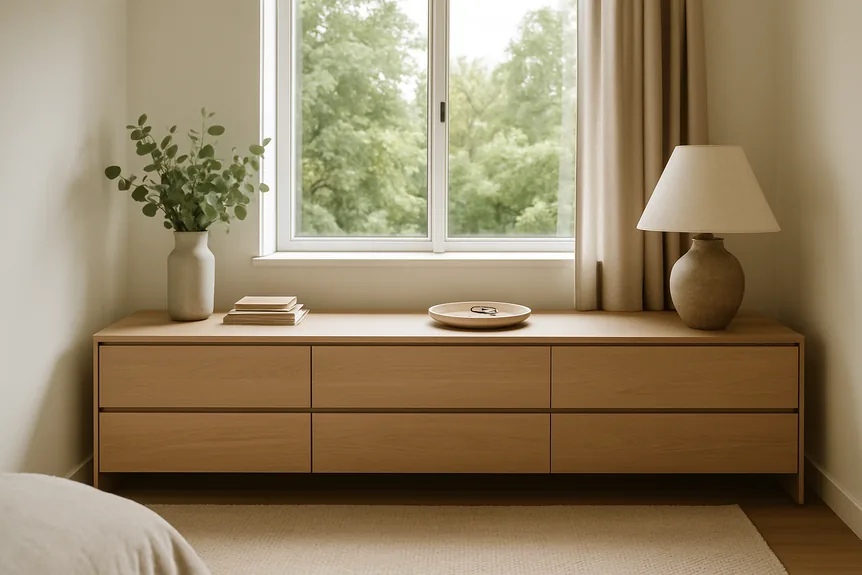
The storage piece does the quiet work of a minimalist bedroom. Every drawer in the room besides the nightstands lives here, so it has to be sized to the wardrobe, not to the wall. Measure what is folded rather than hung before choosing a width: a couple with a full closet needs a 60 inch dresser, a couple sharing a small closet needs 72 inches or a wardrobe as well.
A long low dresser, 30 to 34 inches tall with flat fronts, is the minimalist choice because it holds the horizontal line the bed started. Push to open or finger pull fronts beat hardware; if there have to be handles, one wood or leather pull per drawer, centered, is the limit. Skip mirrored, high gloss, and rattan fronts, which all fight the calm.
A wardrobe belongs in a room without a built in closet, and it should be the plainest piece there: two or three flat doors in the same wood as the bed, 78 to 83 inches tall, hinges hidden. A wardrobe in a second wood species is the most common reason a minimalist bedroom looks assembled rather than designed.
Should You Buy a Minimalist Bedroom Set?
No, in most cases. A minimalist bedroom set, meaning a bed, two nightstands, and a dresser sold as one order, solves the matching problem and creates three worse ones. The pieces are sized to each other rather than to the room, the quality is set by the cheapest item in the box, and the sameness reads as a showroom rather than a home.
What I learned is that minimalism is not a single look. A warm minimalist room wants an oak bed with a linen bench; a cooler, more modern one wants a black steel frame with white lacquered storage, and no set covers both. The warm minimalism vs modern minimalism comparison explains which direction a room is already heading before anything is ordered.
The exception is a two piece set: a bed frame and nightstands from the same maker in the same wood. The proportion of a nightstand to its bed is the hardest thing to get right buying separately, and a maker who cut both from the same boards has solved it. Buy the dresser separately, in the same species, from whoever builds the better drawer. For specific pieces worth buying, see bohemian bedroom set.
How Do You Tell Quality Minimalist Furniture From Cheap?
Plain furniture has nowhere to hide its construction, so the tells are easy to read once they are named. After a decade of buying for a store floor, these are the five checks that separate the pieces worth owning from the pieces that only look right in a listing.
- Weight. A queen platform frame in solid oak weighs 120 to 180 pounds boxed. A frame under 80 pounds is veneered particleboard, whatever the listing says.
- Slats. Solid wood or bent plywood slats 3 inches apart or less, on a center rail with its own leg. Most mattress warranties require that spacing, and the cheap frames use fabric straps or 5 inch gaps.
- Drawer boxes. Solid wood sides with dovetail or dowel joints on undermount soft close glides. A stapled drawer on a plastic side runner is the mark of a set built to a price.
- Edges. Run a thumbnail along a drawer front or a rail. A solid edge is continuous grain, a veneered edge shows a thin seam, and a foil edge has no grain at all.
- Finish. Hardwax oil or matte lacquer on solid wood can be repaired in place. A paper foil finish on MDF cannot be touched up and shows every scratch in white.
Two things do not signal quality: the word solid in a product name, and a high price. Read the materials line instead. A frame described as oak without the word solid is oak veneer, and one described as wood without a species is MDF.
What Most People Get Wrong
The mistake that costs the most to undo is buying the storage first. A dresser chosen before the bed sets the wood species and the finish for the whole room, and the bed, the piece everyone sees, then has to match down to it. Buy the bed, then match everything to the bed.
The second mistake is buying to fill the floor. A 130 square foot bedroom with a queen bed has room for two nightstands and one dresser, and the empty corner is doing work. A chair there becomes the place clothes go to wait.
The third is buying tall. A chest holds the same as a long dresser and breaks the low horizon that makes the room feel calm; on a short wall, a 48 inch dresser with deeper drawers wins.
What Color and Curtains Suit Minimalist Bedroom Furniture?
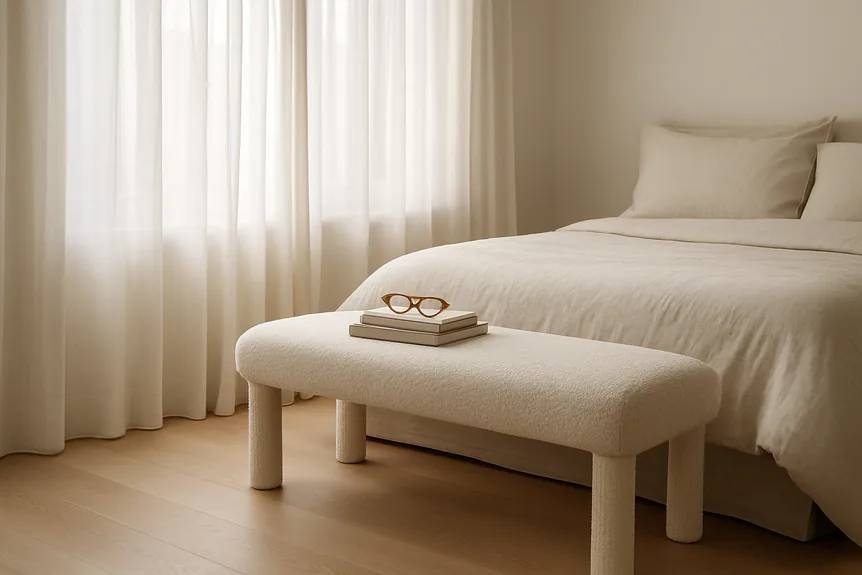
Minimalist bedroom color starts from the wood. Pale oak and ash want warm whites and greige on the walls; walnut and black frames take a cooler white or a deep clay. Keep the bedding within a shade of the walls and let the frame be the darkest thing in the room. The minimalist color palettes guide names paint colors for each of these directions.
Sheer curtains do more for minimalist bedroom furniture than any accessory, because diffused light softens the hard edge of a platform bed. The best sheer curtains for a minimalist bedroom are linen or a linen and cotton blend, hung from a ceiling track or a slim rod set just below the ceiling, at twice the window width for fullness, and cut to touch the floor. Polyester voile is the budget version and works, but it holds static and pulls to one side within a season. Skip grommet tops, tie backs, and any pattern.
Putting the Room Together
The order to buy: bed first, nightstands second, storage third, curtains and bedding fourth, and the bench or chair last, only if the floor still has room. Give each piece a week in the room before ordering the next. The bed alone changes where the dresser can go.
For the rooms beyond the bedroom, the minimalist furniture guide applies the same quality over quantity rule to living, dining, and office pieces. And for how the furniture fits the whole approach, from palette to decluttering, start with the complete guide to minimalist interior design.
Frequently Asked Questions
What furniture does a minimalist bedroom need?
A bed frame, one nightstand per sleeper, and one piece of closed storage, either a long low dresser or a flat front wardrobe. A bench at the foot of the bed is the only optional fifth piece, and only in rooms over about 140 square feet.
Is a minimalist bedroom set worth buying?
Usually not. A full set is sized to itself rather than to the room, and its quality is set by the cheapest piece in the box. The exception is a bed frame and nightstands from the same maker in the same wood.
What is the best bed frame for a minimalist bedroom?
A low platform bed in solid white oak or ash, with rails 10 to 14 inches off the floor, slats 3 inches apart or less, and a center support leg. Expect $900 to $2,500 for a queen. An upholstered platform in linen is the alternative for rooms with hard floors and bare walls.
What color works with minimalist bedroom furniture?
Match the wall to the wood. Pale oak and ash suit warm whites and greige; walnut and black frames suit cooler whites or a deep clay. Keep bedding within a shade of the wall and let the frame be the darkest element in the room.
What are the best sheer curtains for a minimalist bedroom?
Linen or a linen and cotton blend in white or undyed flax, hung from a ceiling track or a rod set just below the ceiling, at twice the window width, and cut to touch the floor. Avoid grommet tops, tie backs, and patterns.