Best Modern Area Rugs: Define Your Space with Style

By Tereza Hower | Published March 9, 2026 | Updated September 7, 2026
The rug is the piece of living-room furniture that decides whether the rest of the room reads as a single composed space or as several pieces of furniture sitting on a floor. The right rug anchors the seating zone, absorbs the room’s acoustics, and adds the textural depth a quiet color palette needs. The wrong rug, or one that is too small, undoes the work of every other piece in the room.
Most modern living rooms treat the rug as the last decision and give it the smallest budget; both choices end up costing more in the long run. The picks below are organized by material, with the size, placement, and construction details that decide which rug earns its place.
A modern area rug is a low-pile or tightly woven floor covering, sized to the seating zone, in a neutral or restrained pattern, with clean rectangular or oval edges. Standard living-room sizes run 5×8, 6×9, 8×10, and 9×12 feet, and the rug should anchor the seating arrangement so that at least the front legs of the sofa and accent chairs sit on it.
As an Amazon Associate, Curated by Hower earns from qualifying purchases. Pieces are selected on construction, proportion and value, not on commission.
Key Takeaways
- Buy the size first and go one size up; an undersized rug is the most common and least fixable mistake.
- For most living rooms with an 84-inch sofa, an 8×10 is the right size.
- Match the material to your household: wool for low-traffic rooms, performance synthetic for kids and pets.
- Keep the pattern quieter than your first instinct, since the rug supports the room rather than leading it.
- Always use a rug pad, and place the coffee table fully on the rug.
Why Do Area Rugs Matter in Modern Design?
An area rug is one of the most impactful single decisions in a living room, and it does more than the catalog listing suggests. The role of a rug is structural, not decorative; the visible pattern is incidental to what the rug actually does for the room.
- Defines the seating zone: a rug establishes a visual boundary that pulls the sofa, coffee table, and chairs into a single arrangement
- Adds warmth, both literal and visual: rugs make a room feel cozier, soften the acoustics, and absorb cold from hard floors in winter
- Reduces noise: a wool or wool-blend rug measurably lowers the echo in a room with hard flooring; the difference is most obvious in open-plan layouts
- Ties color and texture together: the rug is the single largest soft surface in the room and decides which neutral undertones the rest of the palette has to agree with
- Easier to swap than furniture: a rug can be replaced for the cost of styling, not refurnishing
Modern Rug Characteristics
A modern area rug earns the label by what it leaves out as much as by what it includes. The form is geometric, the materials are honest, and the size is dictated by the seating arrangement rather than by an arbitrary aesthetic preference.
- Neutral or subtle patterning: solid colors, low-contrast geometric patterns, tone-on-tone weaves; busy florals or oriental motifs read traditional, not modern
- Clean geometric edges: rectangular, square, or oval; serged or bound edges rather than fringe
- Honest materials: wool, wool blend, jute, or quality synthetic; avoid bonded or low-grade synthetic blends that flatten within a year
- Pile under half an inch: low-pile or flat-weave rugs are easier to clean, easier to walk on, and let furniture sit level on top of them without tipping
- Sized to the seating arrangement: at least the front legs of the sofa and accent chairs should land on the rug; for the cleanest look, all legs sit on the rug
How to Size a Modern Area Rug
Sizing is the single decision most likely to make a rug feel wrong, and it is the hardest to compensate for after the fact. Buy one size up from whatever the room measurement first suggests; an undersized rug is the most common mistake in modern living rooms and the one with no salvage path short of replacement.
The Rule of Thumb
At least the front legs of the sofa and accent chairs should sit on the rug. For a slightly more generous look (and the option that consistently produces a finished room), all four legs of the sofa sit on the rug, with the front legs of accent chairs landing roughly 6 to 12 inches inside the rug edge. The rug should extend at least 6 inches past each side of the sofa, and ideally 18 to 24 inches.
Common Rug Sizes for Living Rooms
- 5×8 feet: the practical floor for any sofa pairing; works for small living rooms under 150 square feet, where only the front legs of an 84-inch sofa land on the rug
- 6×9 feet: medium living rooms (150 to 250 square feet) with a single sofa and one or two accent chairs; rug extends past the sofa on both sides
- 8×10 feet: large living rooms (250+ square feet) and most standard living rooms with a sofa plus accent chairs; the most consistently right answer for a modern living room with an 84-inch sofa
- 9×12 feet: very large living rooms, open-plan layouts, or rooms with a sectional; the right size when the seating zone needs to read as a defined area within a larger space
Spacing to the Walls
Leave at least 18 inches of bare floor between the rug edge and the walls. The bare strip frames the rug and prevents the room from reading wall-to-wall carpeted, which fights modern design’s preference for visible flooring.
Modern Area Rugs by Material
The four material families below cover almost every modern living-room rug worth buying. Each has a clear best use and clear tradeoffs; the choice between them is rarely about price alone. The table summarizes how they compare before the detail on each.
| Material | Best for | Durability | Feel underfoot | Price tier |
|---|---|---|---|---|
| Wool | Low-traffic homes that want the best look and feel | High, ten years or more | Soft and warm | Premium |
| Wool blend | Most rooms that want the wool look for less | High | Soft, pills slightly early on | Mid |
| Jute or sisal | Low-traffic rooms or layering under a smaller rug | Moderate, stains easily | Coarse | Budget |
| Performance synthetic | Households with kids, pets, or heavy traffic | High and easy to clean | Varies, improving with density | Budget to mid |
Wool Rugs
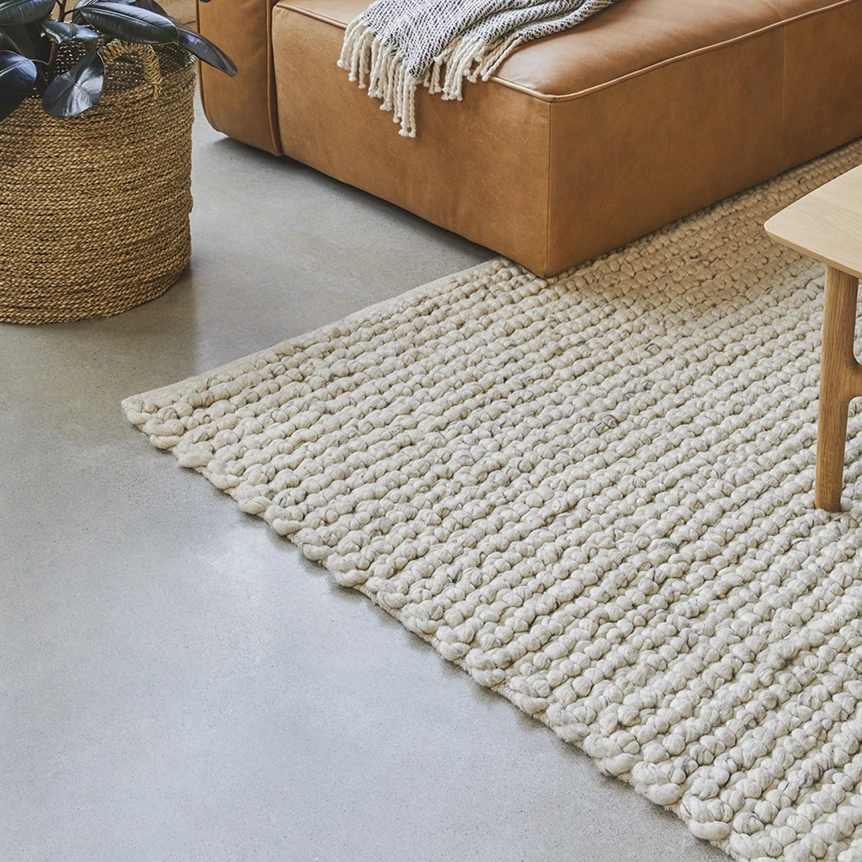
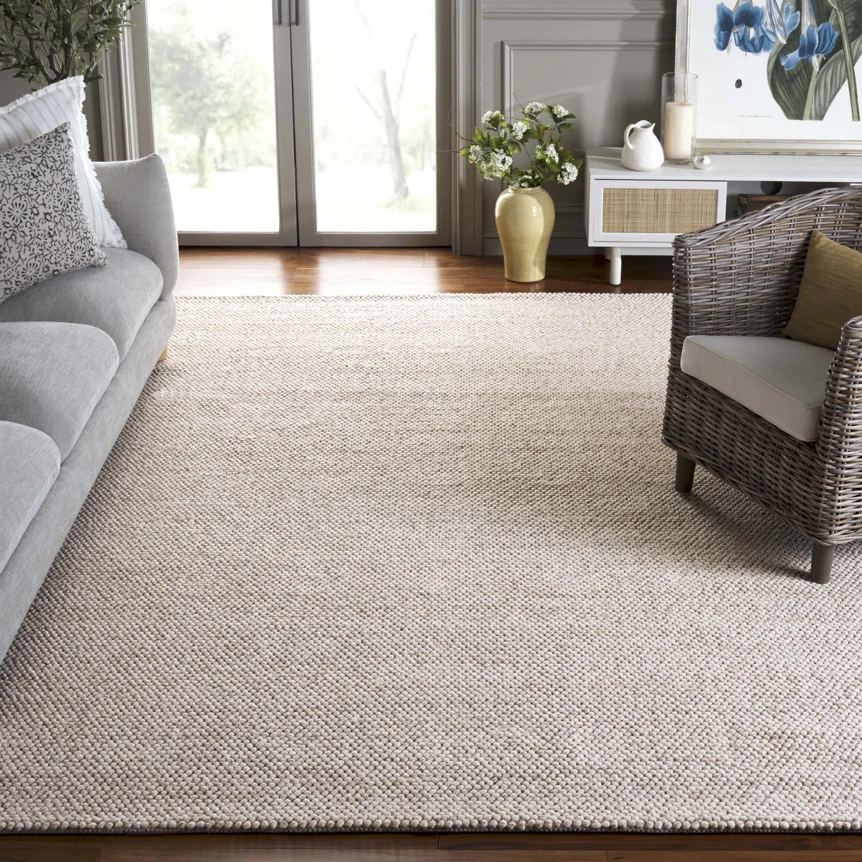
Wool is the most consistently right answer for a modern living room with the budget for it. The fiber is naturally durable and naturally stain-resistant (lanolin in the wool repels liquid), and a low-pile wool weave holds shape for ten years or more in a high-traffic room. The tradeoff is price (typically $400 to $1,500 for an 8×10) and a brief shedding period in the first month or two.
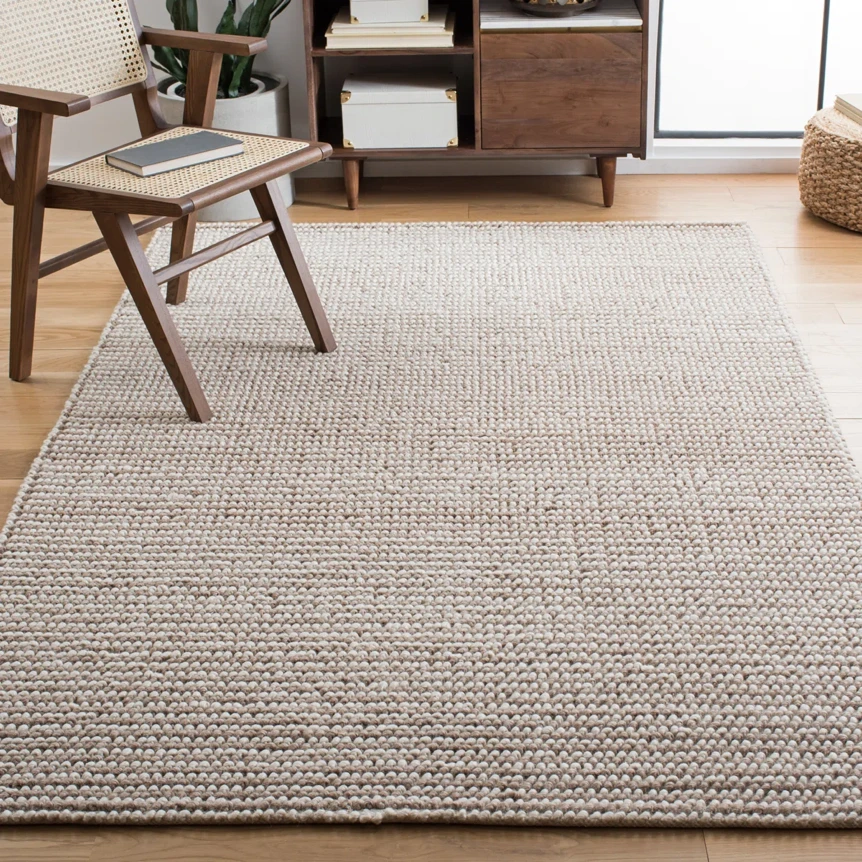
Look for a hand-tufted or hand-loomed wool with a cotton or jute backing rather than a glued synthetic backing; the latter delaminates within a few years. A warm oat, greige, or charcoal wool in a low-pile weave is the safest single pick for a modern living room with a neutral palette.
Wool Blend Rugs
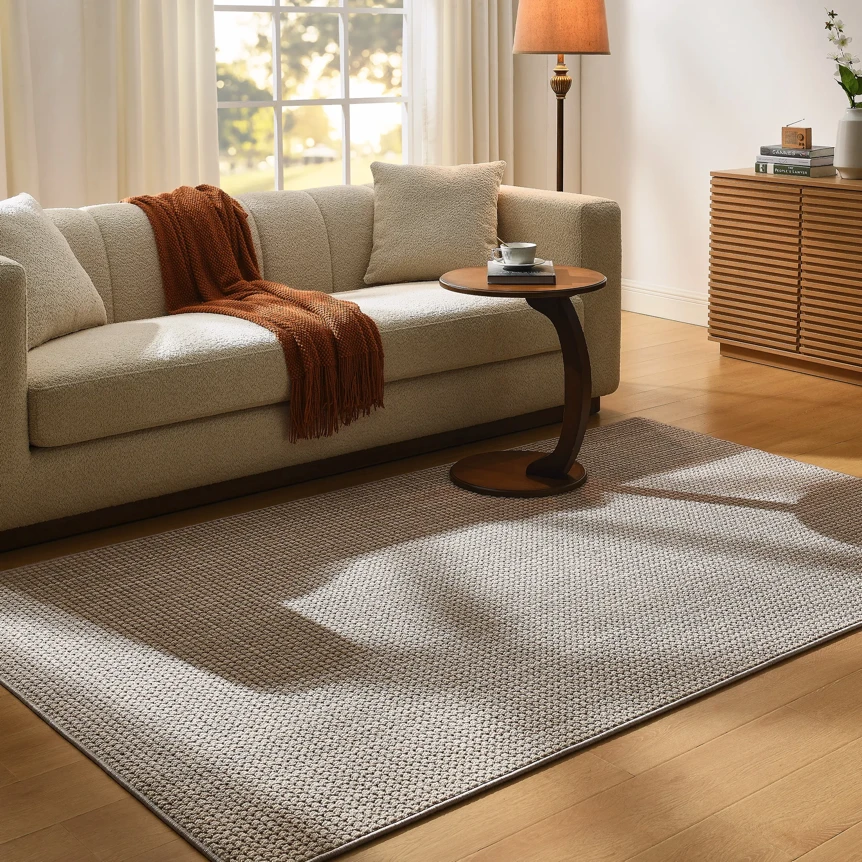
Wool blends (typically 50 to 80 percent wool, with the balance in viscose, cotton, or polyester) are the best value in the modern living-room category. Most of the durability and softness of pure wool, at roughly 60 to 75 percent of the price, with marginally easier cleaning. The honest tradeoff is that blends pill more than pure wool in the first year and lose some of the natural stain resistance lanolin provides.
The right blend pick is one with at least 50 percent wool and a viscose or cotton secondary fiber rather than polyester; viscose adds sheen and softness, polyester adds longevity but reads slightly more synthetic underfoot. A neutral wool-and-viscose blend in an 8×10 or 9×12 is the answer for most modern living rooms whose owners want the wool look without the wool budget.
Jute and Sisal Rugs
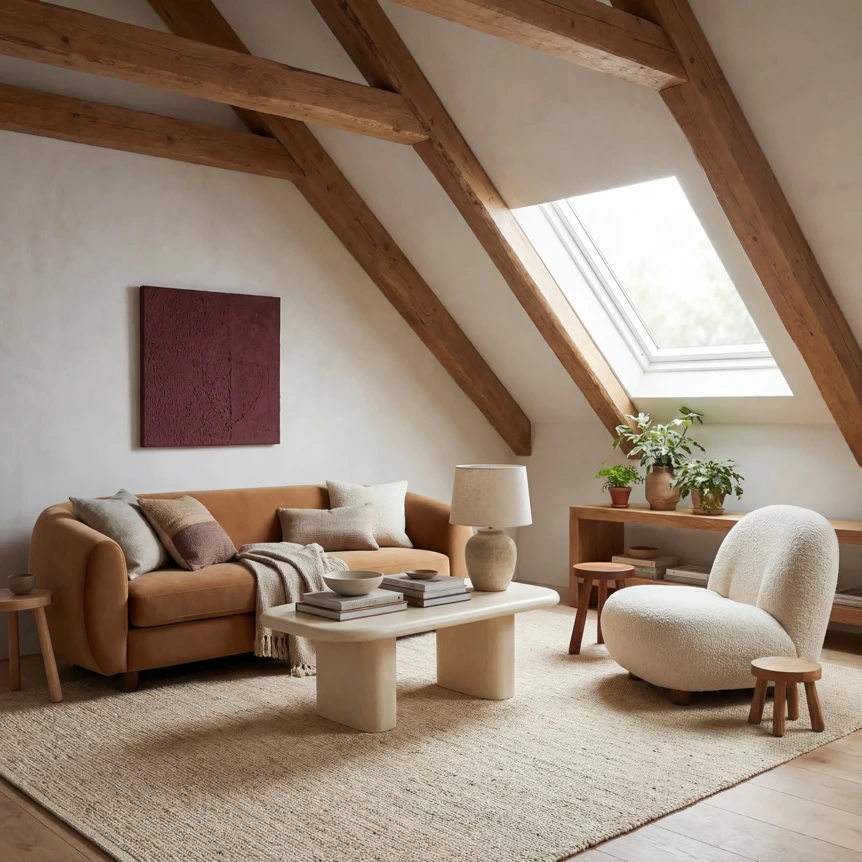
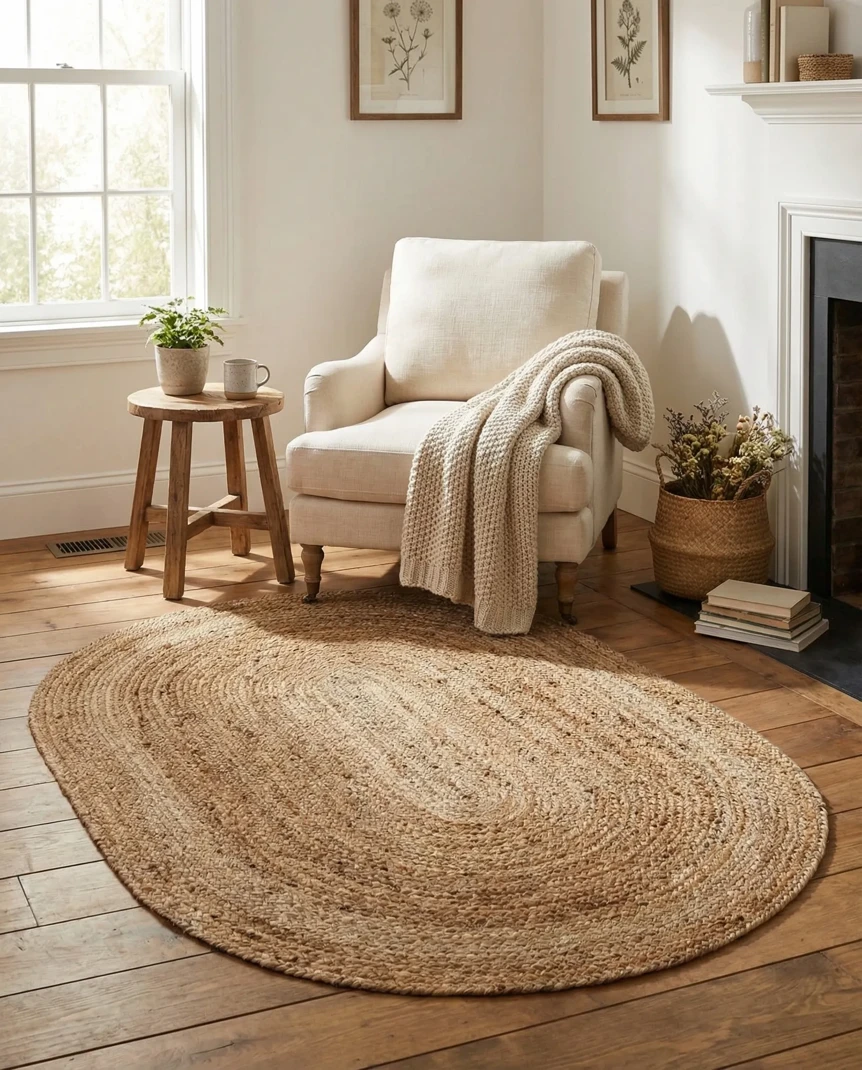
Jute and sisal are the budget-friendly natural-fiber options. They are affordable, eco-friendly, and add a warm textural note that synthetic rugs cannot replicate. The honest tradeoff is comfort: jute and sisal both feel scratchy underfoot, stain easily (any liquid spill is a permanent mark), and shed natural fibers continuously rather than tapering off the way wool does.
Jute earns its place in low-traffic rooms or as a layered jute base under a smaller wool or cotton rug, which gives the visual texture without the daily-use friction. As the primary rug in a high-traffic living room with kids or pets, it underperforms; the cost savings show up in replacement frequency rather than in long-term value.
Synthetic and Performance Rugs
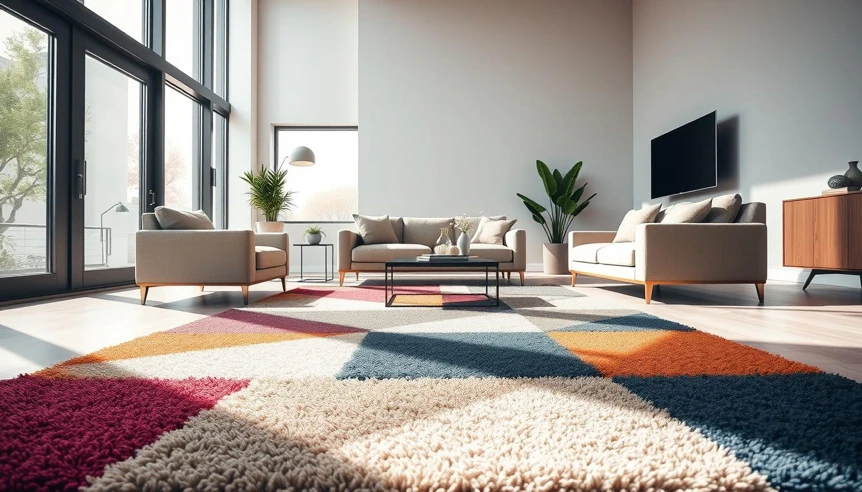
Polypropylene and other performance synthetics are the right call for households with kids, pets, or anyone who eats dinner in the living room. The fibers are inherently stain-resistant, fade-resistant, easy to clean (most can be hosed off outdoors), and durable in a way that outpaces price expectations. Modern polypropylene weaves have largely closed the hand-feel gap with wool, especially at higher pile densities.
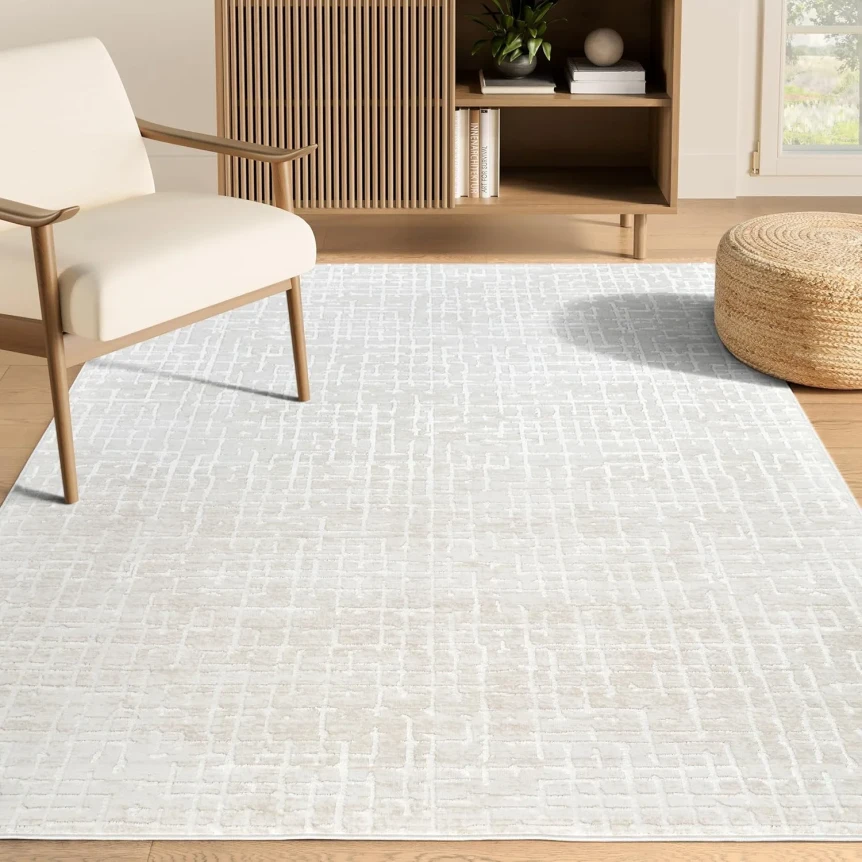
The honest tradeoff is environmental: synthetic rugs are petroleum-based and rarely recyclable, so the lifecycle cost is higher than the price suggests. Look for tightly woven low-pile constructions in neutral or low-contrast geometric patterns; loose, deeply tufted synthetics flatten and look cheap within months. A polypropylene rug in a discreet geometric pattern is the right pick for a busy household that wants a clean modern look without the maintenance burden of wool.
Modern Rug Patterns and Colors
Solid Colors
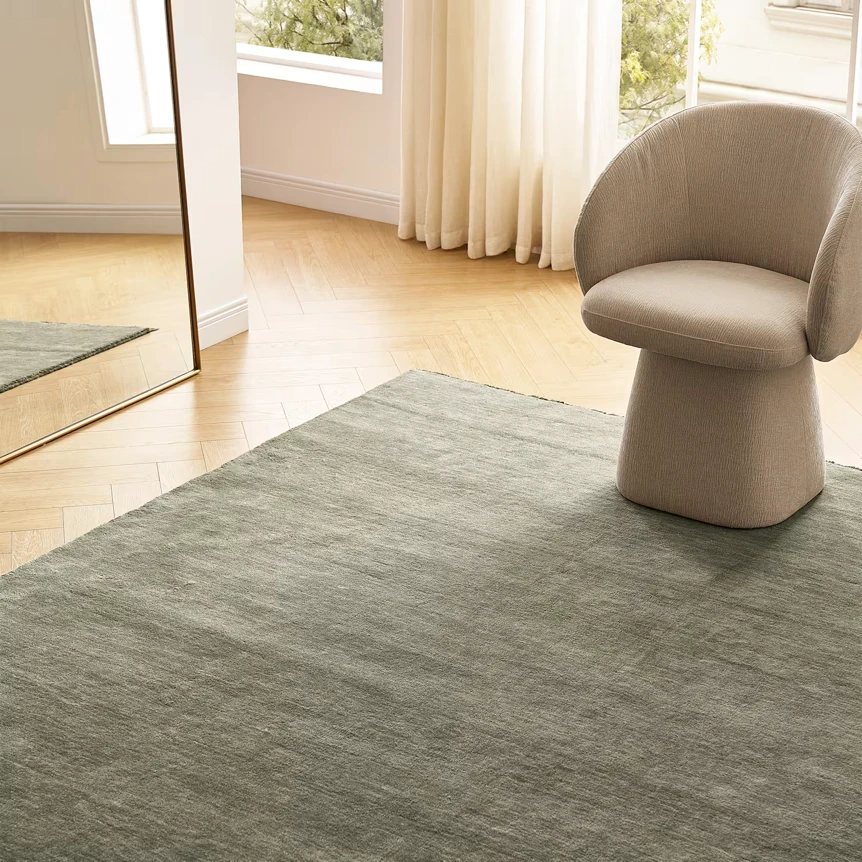
Solid-color rugs are the most consistently modern choice. They work with any furniture style, age slowly, and let the textures of the surrounding room (the sofa upholstery, the wood floor, the wall finish) carry the visual interest.
Reliable solid-color picks:
- Warm gray (the most flexible single neutral; works with both warm and cool palettes)
- Cream or ivory (lifts a room with dark furniture; needs a performance fiber if the household has kids or pets)
- Warm oat or greige (the safest pick for a warm-neutral palette; reads as both contemporary and timeless)
- Charcoal (anchors a light-walled room; hides daily marks better than any other neutral)
- Soft black (architectural and bold; the right pick when the room already has visual mass elsewhere)
Geometric Patterns
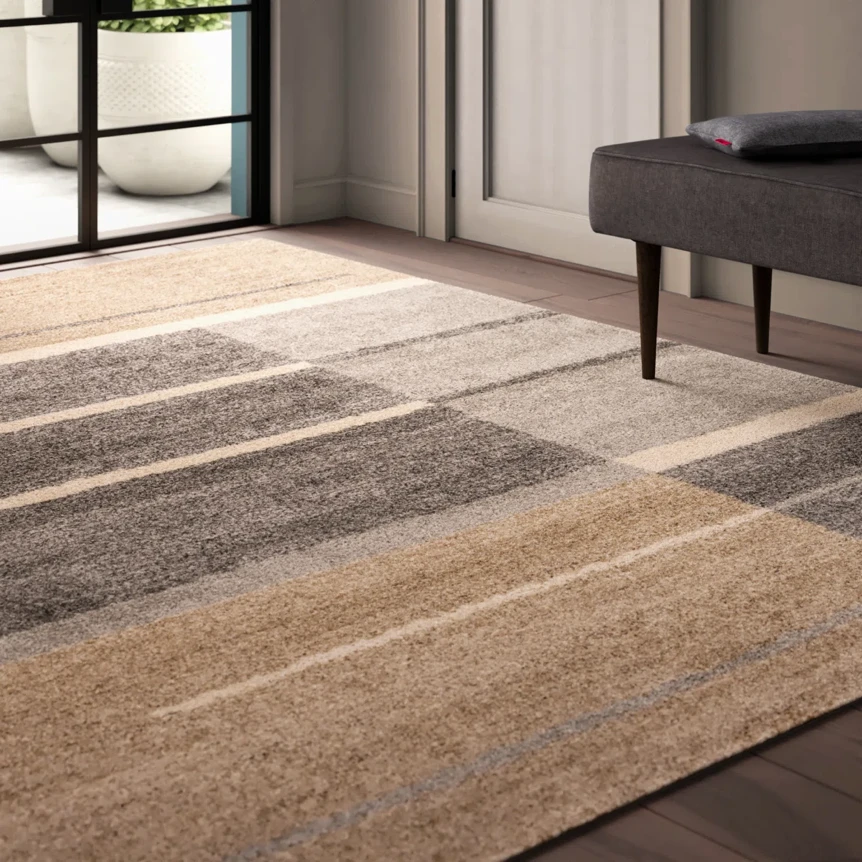
Subtle geometric patterns add visual interest without demanding attention. The pattern should read as a quiet textural variation from across the room, not as a focal point; if the rug is the first thing the eye lands on when entering, the pattern is too loud. For the same approach in another style, see warm earthy paint colors that work in modern homes.
- Linear or striped patterns in two tones of the same neutral (oat and warm gray, charcoal and soft black)
- Subtle geometric shapes (small repeating diamonds, faint chevrons, low-contrast grids)
- Tone-on-tone weaves where the pattern is built from texture rather than from contrasting colors
Patterns to Avoid in Modern Rooms
- Large, busy patterns that read as the room’s focal point
- Floral designs (read as traditional, not modern)
- Oriental, Persian, or kilim motifs (a different design vocabulary; do not mix with modern furniture without a deliberate styling reason)
- Bright, multi-color geometric patterns (a single bright color is acceptable; multiple is chaos)
Rug Placement
Under the Sofa
The cleanest placement for a modern living-room rug is centered under the sofa with at least the front legs of the sofa landing on the rug, ideally all four legs. The rug should extend at least 18 inches past each side of the sofa; 24 inches is better in any room with the floor space for it. For a more contemporary look, place the rug so the lower two-thirds of the sofa sits on it with the back of the sofa on bare floor; this works in larger rooms with longer rugs.
Coffee Table on the Rug
The coffee table should sit fully on the rug, never between the rug and the sofa. A coffee table on bare floor in front of a rug-anchored sofa reads as two unrelated decisions; on the rug, it pulls the seating arrangement into a single composed unit.
Accent Chairs
At least the front legs of accent chairs should sit on the rug. If the chairs sit entirely off the rug, the rug is too small for the seating arrangement and should be sized up.
Always Use a Rug Pad
Use a rug pad underneath any area rug. A pad prevents slipping (a real safety issue with low-pile rugs on hard floors), protects the floor finish, and adds 30 to 50 percent to the perceived softness of the rug underfoot. A felt-and-rubber pad cut to roughly 1 inch smaller than the rug on each side is the standard.
Common Mistakes Most Modern Rug Buyers Make
The mistakes below are the ones that most often turn an expected design upgrade into an expensive disappointment. They are also the most fixable, usually before the rug ships.
- Buying too small. The single most common rug mistake; an undersized rug reads as a placemat under the sofa. Go up at least one standard size from your first instinct.
- Choosing the wrong material for the household. A pure wool rug in a home with two cats and a toddler is a planned cleaning bill; a polypropylene rug in a low-traffic adult-only room leaves quality and feel on the table. Match the material to actual life conditions.
- Skipping the rug pad. Without one, low-pile rugs slip on hard floors (a safety issue) and the rug itself wears unevenly from floor contact.
- Picking a busy pattern for a modern room. Bold or detailed patterns belong to traditional or bohemian rooms. In a modern living room, the rug supports the seating arrangement rather than competing with it.
- Putting the coffee table off the rug. This is the placement error that quietly undermines every other rug decision. The coffee table sits fully on the rug; otherwise the seating zone reads fragmented.
Care and Maintenance
Vacuuming
Vacuum the rug one to two times per week. Use a low-suction setting for wool and wool blends; high-suction beater bars accelerate shedding. For jute or sisal, use a beater-bar-free attachment to avoid pulling fibers loose.
Spot Cleaning
Clean spills immediately. Blot (do not rub) with a clean cloth from the outside of the spill toward the center to prevent spreading. Plain cool water handles most fresh spills on wool; for stubborn marks, dilute mild detergent heavily. Avoid hot water on wool; it sets stains and shrinks the fiber.
Professional Cleaning and Rotation
Have wool and wool-blend rugs professionally cleaned every 12 to 18 months in a household with kids or pets, every 24 months in lower-traffic rooms. Synthetic rugs can usually be cleaned at home with water and mild soap; jute and sisal need dry-extraction methods rather than wet cleaning. Rotate the rug 180 degrees every six months to even out wear from foot traffic and sun exposure.
A Note on Price
Budget polypropylene and jute rugs in 8×10 sizes start around $150 and run to $400; this tier is the right pick for households that need a serviceable rug now. Mid-range wool blends and entry-level wool rugs cluster between $400 and $1,000 in the 8×10 size; this is the sweet spot for most modern living rooms. Premium wool rugs (hand-knotted, hand-loomed, or designer-collaboration pieces) start around $1,500 and run past $5,000 for an 8×10. Rugs are one of the few furniture categories where the marginal-quality jump between budget and mid-range is bigger than the jump between mid-range and premium; spend up the curve once, then keep the rug for a decade.
Bringing It All Together
A modern area rug is the foundation of every other styling decision in the seating zone. Choose the right size first (always go larger), the right material second (matched to actual household conditions), and the right pattern third (quieter than your first instinct).
For the broader argument about how the rug fits into a fully designed modern living room, see the complete guide to modern living room design. For the next decisions after the rug: the modern sofa that sits on top of it, the coffee table that anchors the center, the layered lighting that frames the seating zone, and the color scheme that the rug undertone has to agree with.
Frequently Asked Questions
What size rug do I need for a modern living room?
For most living rooms with an 84-inch sofa, an 8×10 rug is the right answer. The rule is at least the front legs of the sofa and accent chairs land on the rug, with at least 18 inches of rug visible past each side of the sofa. A 9×12 is the better pick for open-plan layouts or any room with a sectional; a 6×9 is the practical floor for very small rooms.
Wool, jute, or synthetic for a modern living room rug?
Wool is the most consistently right answer for households without kids or pets and a budget that can absorb $400 to $1,500 for an 8×10. Performance synthetics (polypropylene) are the better pick for households with heavy traffic, kids, or pets. Jute belongs in low-traffic rooms or as a layered base; it stains easily and feels scratchy underfoot, so it underperforms as a primary rug in a high-use living room.
Should the coffee table sit on the rug?
Yes. The coffee table should sit fully on the rug, never between the rug and the sofa. A coffee table on bare floor in front of a rug-anchored sofa reads as two unrelated decisions; on the rug, it pulls the seating arrangement into a single composed unit. If the rug is too small to hold the coffee table fully, the rug is too small for the room.
Do I really need a rug pad?
Yes. A rug pad is not optional. It prevents the rug from slipping on hard floors (a real safety issue with low-pile rugs), protects the floor finish from rug fibers, and adds 30 to 50 percent to the perceived softness underfoot. Use a felt-and-rubber pad cut to roughly 1 inch smaller than the rug on each side.