Modern Bathroom Ideas: 14 Looks With Tile, Paint and Finishes Named

By Tereza Hower | Published October 7, 2026
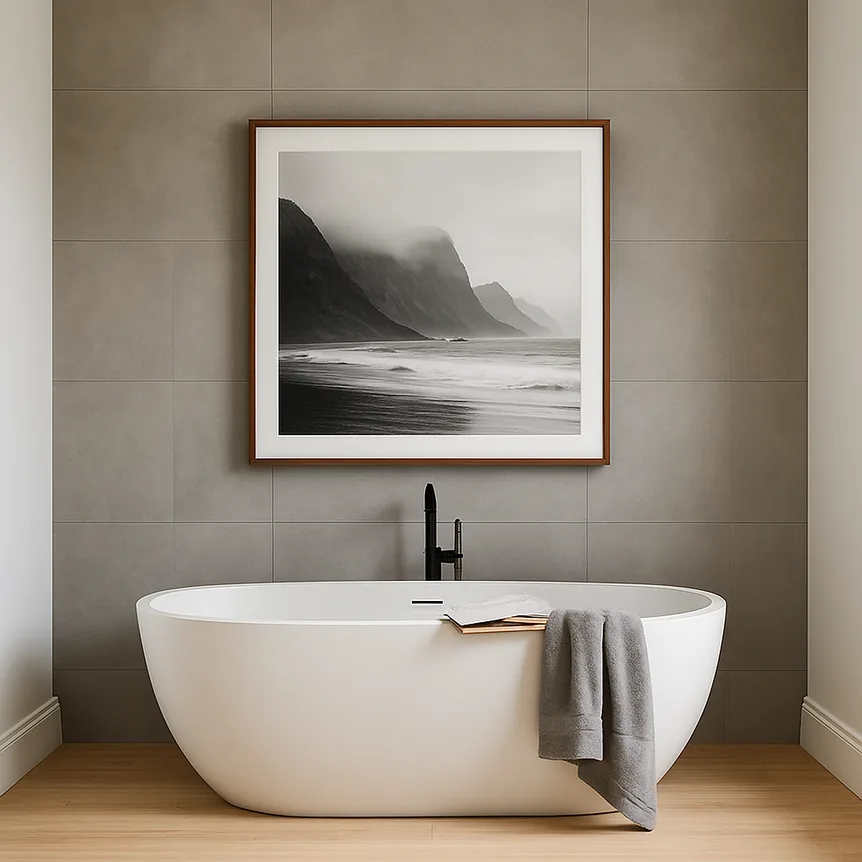
A bathroom is the one room where a design decision gets made in grout and plumbing rather than in paint and cushions, which is why it pays to see the finished room before committing. The modern bathroom ideas below are fourteen specific looks, each with the tile, the paint, and the metal finish named, so a picture can become a shopping list. None of them depends on a large room; several are built for the smallest bathroom in the house.
They are grouped the way a renovation actually runs: surfaces first, then the vanity, then light, then color, then the tricks that make a small room work. The principles behind every one of them, from layout to ventilation, are set out in our complete guide to modern bathroom design; this post is the gallery of rooms those principles produce.
Key Takeaways
- A modern bathroom reads as calm because it uses few materials, few joints, and one metal finish throughout.
- Large-format porcelain, zellige on a single wall, and grout-free shower panels are the three surfaces doing most of the work in current modern bathrooms.
- A wall-hung vanity with visible floor beneath it makes any bathroom look larger than a vanity that sits on the floor.
- Side lighting at eye level flatters faces; a single ceiling fixture over the mirror never does.
- Deep painted color belongs above the tile line, in a room with a fan sized for its floor area.
What Makes a Bathroom Look Modern?
A modern bathroom is defined by clean, uninterrupted surfaces, wall-hung or flat-front fixtures, and a short palette of materials repeated across the room. Ornament comes from the material itself, such as the veining in a stone slab or the variation in a handmade tile, rather than from molding, carving, or decorative trim.
What separates it from a generic contemporary bathroom is restraint in the count. Two surface materials, one wood, and one metal finish cover most good examples. Add a third tile or a second metal and the room starts to read as a showroom sampler rather than a designed space.
Which Modern Bathroom Ideas Start With the Walls and Floor?
Surfaces are the most expensive thing to change later, so they come first. Each of these four looks sets the character of the whole room before a single fixture is chosen. For a closer look at specific products and formats, see the roundup of modern bathroom tiles and flooring.
1. Large-format porcelain from floor to ceiling
Porcelain tiles of 24 by 48 inches or larger, run up every wall and across the floor, leave so few grout lines that the room reads as one continuous surface. A honed or matte stone-look finish in a pale limestone or soft concrete tone keeps it from feeling clinical. Ask the installer about lippage control clips: large tiles show any unevenness at the edges, and a leveling system is the difference between a flat wall and a rippled one.
2. Zellige behind the vanity, and nowhere else
Zellige is handmade glazed terracotta from Morocco, and every tile varies slightly in thickness and color. Used on one wall, it gives a plain modern room movement and depth; used everywhere, it becomes busy. A sage, ocher, or soft clay zellige behind a simple vanity, with plain porcelain on the remaining walls, is the version that ages best. Expect irregular edges and wider grout joints; that is the material, not a defect.
3. Grout-free panels in the shower
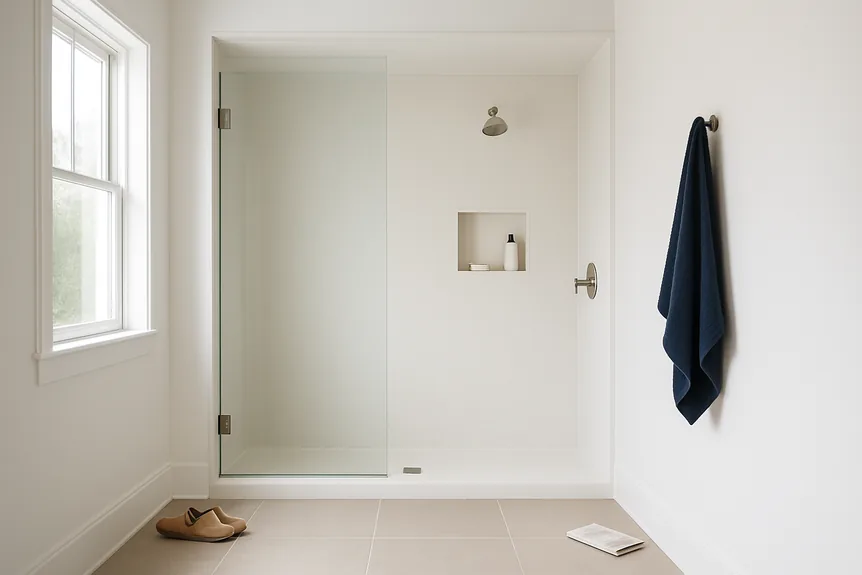
Full-height wall panels in quartz, solid surface, or cultured marble line a shower with one or two seams instead of hundreds of grout lines. They are the tub-to-shower conversion most remodelers in the US already know how to install, often in a day or two, and they turn a dated tub alcove into a walk-in shower without the mess of tile. A matte or honed finish in white, warm gray, or a soft stone pattern keeps them from looking like a hotel insert. The tradeoff is choice: there are fewer colors than in tile, and a panel cut wrong is a panel replaced.
4. Stacked vertical tile in one deep color
Narrow rectangular tiles, 2 by 8 or 3 by 12 inches, laid vertically in a straight stack rather than offset, read as crisp and architectural. In a deep forest green, dark teal, or oxblood glaze, they turn a shower wall into the room’s focal point without any pattern. Grout matched to the tile color keeps the grid quiet; contrasting grout turns it into graph paper.
Ideas Built Around the Vanity
The vanity is the piece of furniture in the room, and it sets the tone more than any fixture. The roundup of modern bathroom vanities and sinks covers specific models and sizes; these are the three looks worth building toward.
5. A floating walnut vanity with a stone top
A wall-hung vanity in walnut or white oak, with a slim quartz or honed marble top, leaves the floor visible underneath and makes the room look deeper. Mount it so the countertop sits at 34 to 36 inches, which most adults find more comfortable than the older 30 to 32 inch standard. Solid wood or a thick veneer over plywood holds up to bathroom humidity; particleboard swells at the first leak.
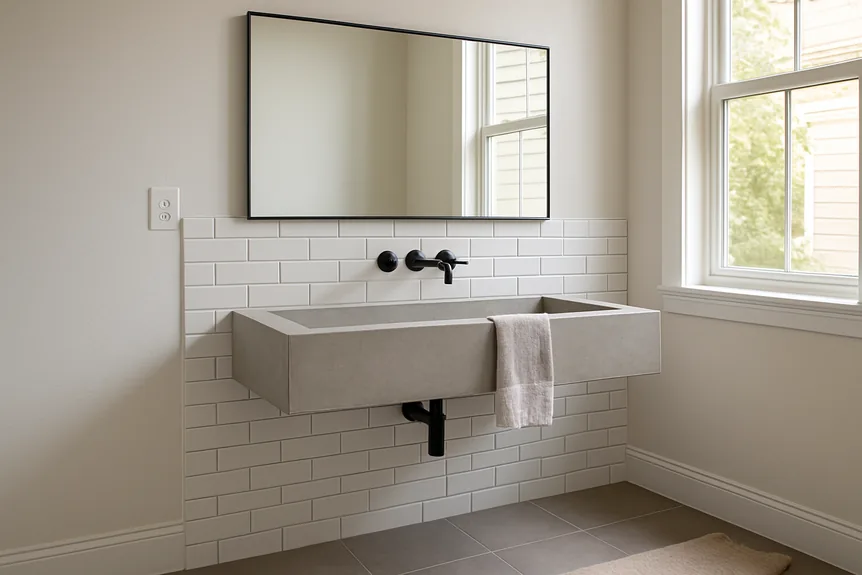
6. A wide trough sink with two faucets
Instead of two separate basins, a single long trough in concrete, solid surface, or stone with two wall-mount faucets serves two people and reads as one clean line. It suits a shared bathroom where a double vanity would crowd the wall. Wall-mount faucets also free the counter of faucet holes, so there is nowhere for water to pool.
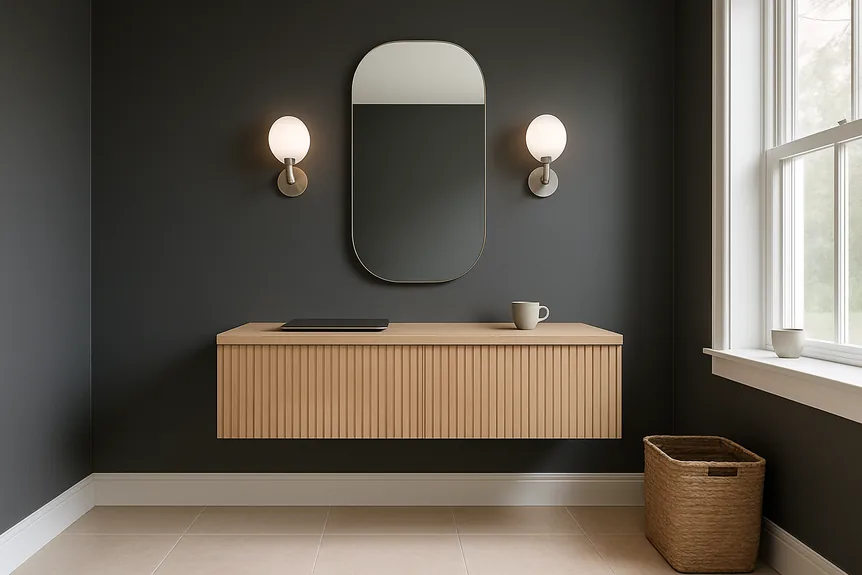
7. Fluted fronts in pale oak
Vertical fluting or reeding on the vanity doors adds texture without color or pattern, and it hides fingerprints better than flat lacquer. Paired with plain walls and a frameless mirror, it is the single detail that keeps a minimal room from feeling bare. Use it on one piece only; fluted tile plus a fluted vanity plus a fluted mirror is a theme, not a room.
How Should a Modern Bathroom Be Lit?
Lighting is the most common failure in an otherwise good bathroom. A single fixture above the mirror throws shadows under the eyes and chin, which is the opposite of what a mirror is for. The two looks below solve it, and the full approach to layering task, ambient, and accent light is in our guide to modern bathroom lighting.
8. Sconces on either side of the mirror
Two wall sconces flanking the mirror, centered at roughly eye level, about 64 to 68 inches from the floor, light the face evenly from both sides. Opal or frosted glass diffusers soften the light; bare bulbs glare. In a narrow room with no space beside the mirror, a vertical sconce mounted on the mirror itself does the same job.
9. Hidden light in the niche and under the vanity
A damp-rated LED strip tucked into the top of a shower niche or along the underside of a floating vanity gives the room a soft glow for night use and makes the vanity appear to hover. Choose a warm color temperature of 2700 to 3000 kelvin and put it on its own switch. It is a supporting layer, never the main light.
Color-Led Modern Bathroom Looks
Modern does not have to mean pale. The two looks below use color as the main idea, with tile and fixtures kept simple so the paint can lead. For palettes that suit specific light and tile combinations, see bathroom color schemes that work.
10. A deep painted room above the tile
Tile to about 48 inches or to the top of the shower, then paint everything above it, ceiling included, in one deep shade: Benjamin Moore Hale Navy, Sherwin-Williams Naval, or a dark green such as Sherwin-Williams Pewter Green. Painting the ceiling too removes the hard line where wall meets ceiling and makes a small room feel enveloping rather than cramped. Use a bathroom-rated paint with a mildew-resistant finish, and confirm the fan is sized at least 1 cubic foot per minute per square foot of floor and vented to the outside, not into the attic.
11. Tone-on-tone warm neutrals
Walls, floor, and vanity in close shades of the same warm neutral, such as a putty tile floor, Sherwin-Williams Redend Point on the walls, and a travertine vanity top, create a room that feels soft and finished without any contrast. The risk is a room that reads as flat. Prevent it with texture: honed stone, a handmade-look wall tile, and one darker accent in the metal.
What Works in a Small Modern Bathroom?
Small bathrooms benefit most from modern design, because the style’s main moves, fewer joints, raised fixtures, and fewer objects, are exactly the moves that make a room look larger. These three are the highest return in a room under 40 square feet. More layout detail is in our post on small bathroom design ideas.
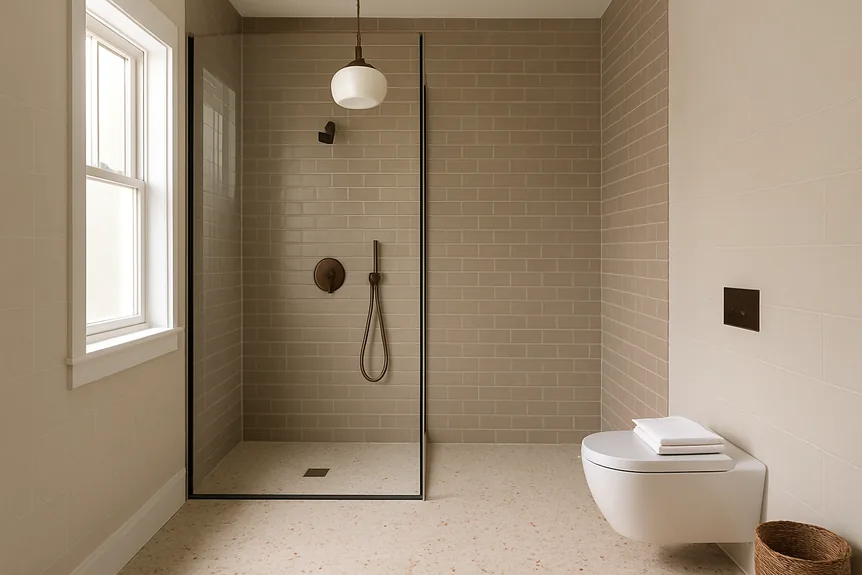
12. A curbless shower behind one fixed panel
Removing the shower curb and running the same floor tile straight into the shower makes the entire floor read as one surface. The floor needs a slope of about a quarter inch per foot toward a linear drain, which is a job for a contractor who has built one before. A single fixed glass panel, rather than a framed door, keeps the sight line open.
13. A wall-hung toilet and recessed storage
A wall-hung toilet hides the tank inside the wall and frees a few inches of depth, and the ledge above the carrier is a ready-made shelf. In most US homes it means opening the wall for an in-wall carrier, so it belongs in a full remodel; where the wall stays closed, a one-piece toilet with a skirted base gives a similar clean outline. A recessed medicine cabinet between the studs gives storage that takes no floor space at all. Keep at least 21 inches of clear space in front of the toilet, the minimum most building codes require, and 30 inches where the room allows.
14. One metal finish on every fitting
In a small room every faucet, hook, and handle is in view at once, so a single finish does more than in a large one. Brushed nickel is the easiest to live with; it hides water spots. Matte black reads graphic and clean but shows hard water marks; unlacquered brass darkens and changes over time, which some people want and others regret. Pick one and apply it to everything, including the drain cover.
The same finish should carry onto hooks, towel bars, and any open shelving, which in a small room do as much work as the cabinet. Our guide to bathroom storage solutions covers the fittings that keep counters clear.
Which Look Suits Which Bathroom?
| Look | Key material | Best for | Relative cost | Upkeep |
|---|---|---|---|---|
| Large-format porcelain | 24 by 48 inch tile | Main bathrooms, full renovations | Medium to high (labor) | Low |
| Zellige feature wall | Handmade glazed terracotta | Adding character to a plain room | Medium | Low to medium |
| Grout-free shower panels | Quartz, solid surface, or cultured marble | Tub-to-shower conversions | Medium | Low |
| Deep painted room | Bathroom-rated paint | Powder rooms, small bathrooms | Low | Low with a good fan |
| Floating wood vanity | Walnut or oak, stone top | Any size, especially small | Medium | Oil or seal the wood |
| Curbless shower | Sloped floor, linear drain | Small rooms, aging in place | High | Low |
What Most People Get Wrong in a Modern Bathroom
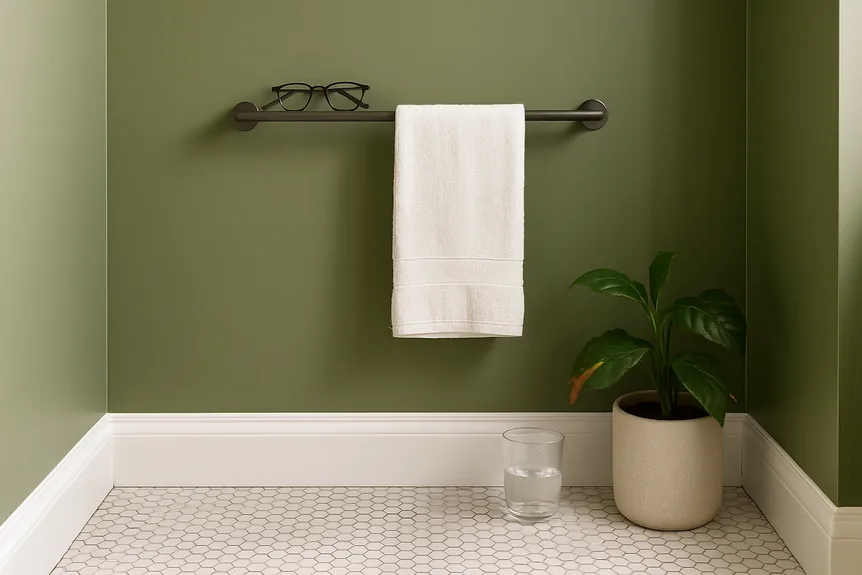
The most common mistake is choosing floor tile for its looks alone. A polished tile that is lovely in the showroom becomes slippery when wet; for a bathroom floor, look for a dynamic coefficient of friction of at least 0.42 on the tile’s spec sheet, the industry threshold for level interior floors that get wet. Small mosaics are naturally safer because the grout lines add grip.
The second is buying the vanity before measuring the plumbing. A wall-hung vanity needs blocking in the wall and a drain at the right height, and a trough sink needs its faucets placed before the wall is closed. The third is mixing finishes on purpose in a small room: two metals can work across a large bathroom, but in a powder room the eye catches every mismatch.
Finally, people underestimate ventilation. Deep paint, wood vanities, and grout all depend on the room drying quickly after a shower. An undersized or noisy fan that nobody runs undoes every other decision on this list.
Where to Start
Pick the surface first, because it is the hardest to change, and let it decide the rest: a busy zellige wall wants a plain vanity, and a plain porcelain room can carry a bold vanity or deep paint. Then choose one metal finish and hold to it. Smaller finishing pieces, from towels to mirrors, are covered in modern bathroom accessories and decor.
For the planning side, including layout clearances, storage, and how to sequence a renovation, return to the modern bathroom design guide and work through it with your chosen look in mind.
Frequently Asked Questions
What is modern bathroom design?
Modern bathroom design uses clean, uninterrupted surfaces, wall-hung or flat-front fixtures, and a short palette of materials repeated across the room. Decoration comes from the materials themselves, such as stone veining or handmade tile, rather than trim or ornament.
How do you style a modern bathroom?
Keep counters nearly clear, use one metal finish on every fitting, and limit the room to two surface materials plus one wood. Add texture through tile or stone rather than accessories, and light the mirror from both sides.
What tile is best for a modern bathroom?
Large-format porcelain gives the cleanest modern look with the fewest grout lines. Zellige suits a single feature wall, and small mosaics are the safest choice for a shower floor because the grout adds grip.
Are matte black bathroom fixtures still modern?
Matte black still reads as modern, especially against pale stone or wood, but it shows hard water marks quickly. Brushed nickel and brushed brass are easier to keep clean and suit the warmer modern bathrooms now more common.
Can a small bathroom have a dark color?
Yes. A deep color painted on the walls and ceiling above the tile blurs the room’s edges and can make a small bathroom feel more enveloping than cramped, provided the fan is sized for the room and the paint is rated for bathrooms.