Bathroom Color Schemes That Work

By Tereza Hower | Published March 17, 2026 | Updated August 14, 2026
Choosing bathroom colors is harder than choosing colors for almost any other room. So much of the bathroom is tiled that the palette is essentially permanent once applied, and the wrong call costs more to fix than in any other space in the house. The decisions are also unforgiving in a way that paint on living-room walls is not: tiles are reflective, grout has its own color, and the small footprint of most bathrooms amplifies every choice.
Most people learn this the same way. A bright cool-toned tile looks crisp in the showroom under fluorescent lighting and reads as a clean modern white. Under the warm 3000K LED bulbs already chosen for the vanity, that same cool white turns a faintly clinical gray-pink.
This guide covers the four bathroom color directions that consistently produce rooms worth living with, the principles behind why each one works, and the testing process that prevents the mistake I made the first time around.
Key Takeaways
- The four color directions that consistently work in modern bathrooms: white or off-white, earthy neutrals, deep moody tones, and tonal single-color schemes.
- Test every tile sample under the actual bulb temperature you plan to install before committing; showroom fluorescents lie about how a tile will read at home.
- Choose grout color at the same time you choose tile color; matched grout reads as one continuous surface, contrasting grout reads as a graphic grid.
- Deep tones in a bathroom need a backlit mirror and a strong vanity light; without them, cocooning slides into gloomy fast.
- The white-tone undertone matters more than the white itself; warm whites (Benjamin Moore White Dove, Farrow and Ball Wevet) hold up where cool-toned “designer” whites read gray-pink under home bulbs.
Why Bathrooms Respond to Color Differently
A few things make bathrooms behave differently from other rooms with respect to color. They are typically smaller, which means colors read with more intensity than they do in larger spaces. They often have limited natural light, which shifts how colors appear compared to how they look on a sample card. And the dominant surfaces, tiles, are reflective to varying degrees, which changes the quality of light and the way color reads throughout the day.
Colors that look balanced in a living room or kitchen can feel overwhelming in a small bathroom. Conversely, very pale colors that seem timid in a larger room can look exactly right in a bathroom where the enclosed space gives them weight and presence.
The other important factor is the relationship between the wall color, the tile color, and the grout color. In most bathrooms these are three separate color decisions that all need to work together, and the grout in particular, which is often treated as an afterthought, has a surprisingly strong effect on the overall character of the finished room.
Which Bathroom Colors Hold Up Over Time?
Four color directions reliably produce bathrooms that age well: white and off-white, earthy neutrals, deep and moody tones, and tonal single-color schemes. The table below summarizes how each one behaves, where it shines, and the most common pitfall associated with each.
| Direction | Best for | Light tolerance | Hardware that pairs | Common pitfall |
|---|---|---|---|---|
| White and off-white | Any bathroom; refresh through accessories over years | High; reflects whatever light is available | Brushed brass, warm chrome, matte black | Cool-toned whites read clinical under warm home bulbs |
| Earthy neutrals | Bathrooms with timber-effect or stone vanities | Medium to high | Matte brass, brushed bronze, warm chrome | Mismatched grout creates a busy grid that fights the warmth |
| Deep and moody | Adult bathrooms with strong vanity and overhead lighting | Low to medium; needs a backlit mirror | Brushed brass, antique brass, matte black | Paint on walls only (no tile commitment) reads half-finished |
| Tonal single-color | Bathrooms with confidence in restraint | Medium | One finish only across every fixture | Too many tonal variations read muddled rather than harmonious |
Why White and Off-White Endure
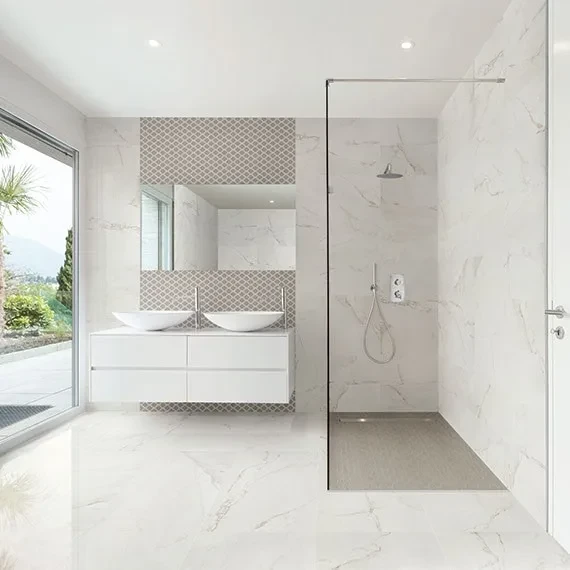
White and off-white bathrooms remain the most popular color choice, and they have earned that position. A well-executed white bathroom reflects light, feels inherently clean, works with almost any hardware finish, and provides a backdrop that is easy to refresh through accessories and towels as tastes evolve.
The key to making a white bathroom feel warm rather than clinical is in the details. The undertone of the white matters more than the white itself: a warm white with a slight yellow or pink cast reads very differently from a blue-toned white, particularly under the warm bulb temperatures most common in bathrooms (2700K to 3000K). The texture of the tiles adds depth that a flat painted wall cannot; a slightly textured matte tile in warm white has a richness that a standard gloss tile in the same color does not.
The warm whites that consistently work in bathrooms include Benjamin Moore’s White Dove, Farrow and Ball’s Wevet, and Sherwin Williams’s Alabaster. The cool-toned whites to avoid for the wall-and-tile combination include Benjamin Moore’s Decorator’s White and any pure brilliant white without a warm undertone; both read gray-pink under home LED bulbs in the 2700 to 3000 Kelvin range.
Off-white shades, including warm cream, linen, and pale stone, are often more interesting than pure white in a bathroom because they have more of an inherent character and tend to respond better to artificial light in the evenings.
How Earthy Neutrals Add Warmth Without a Strong Color Commitment
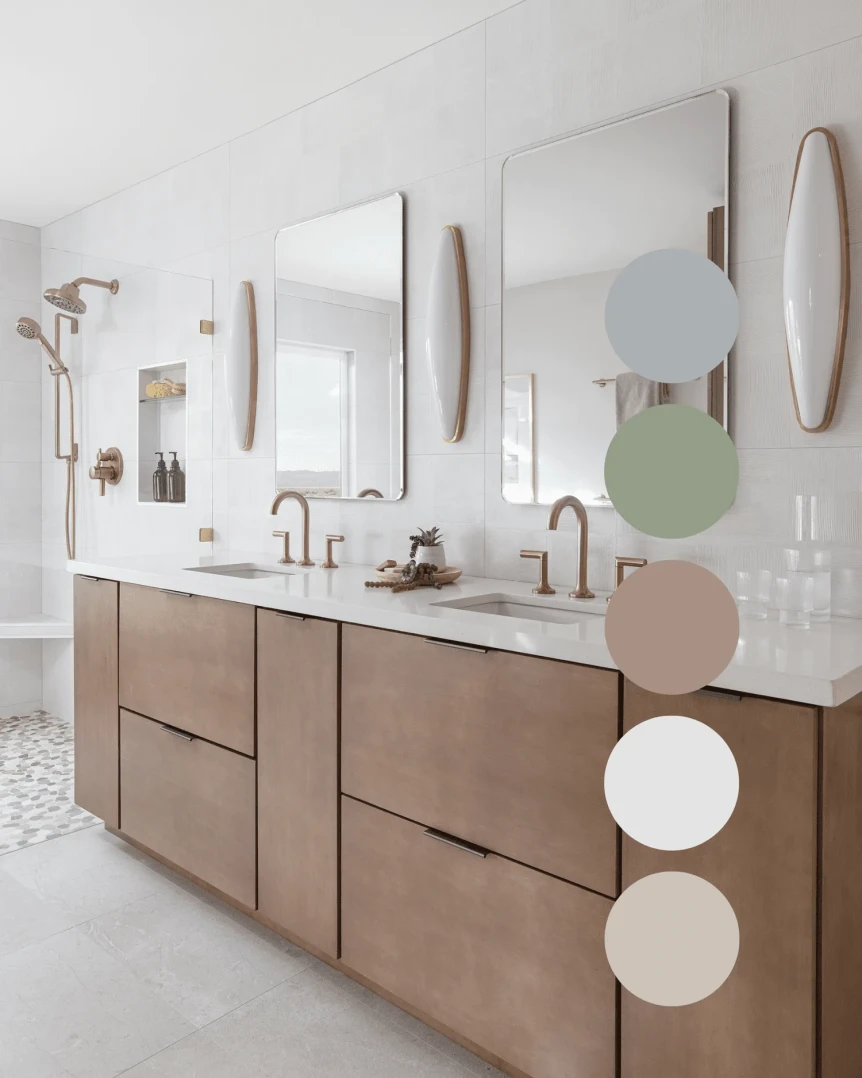
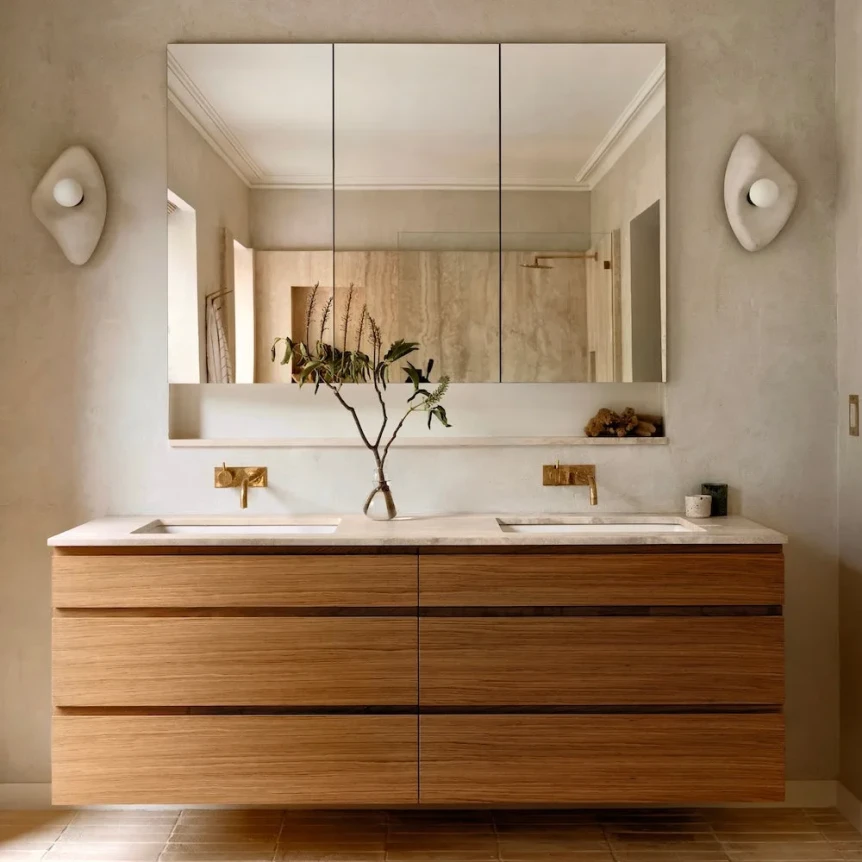
The category of bathroom colors that has seen the most growth in recent years is earthy neutrals: warm taupes, sandy beiges, pale terracotta, greige, and soft mushroom. These tones create a bathroom that feels naturally warm and grounded without the commitment of a strong color, and they age very well.
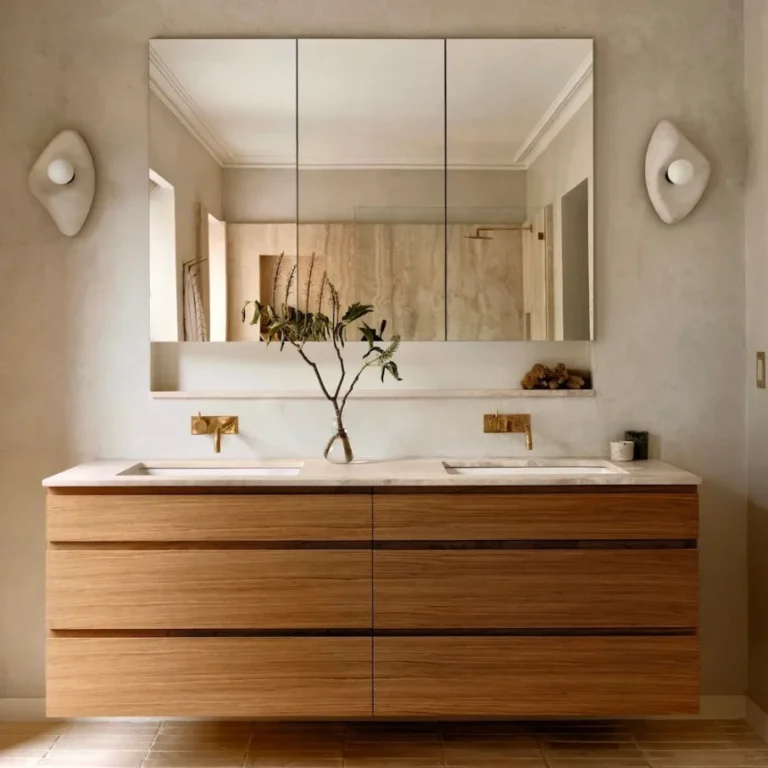
Earthy neutrals work particularly well in combination with natural materials. A sandy taupe tile alongside a timber-effect vanity, a concrete-look basin, and matte brass hardware creates a bathroom with a warm, organic quality that feels personal and sophisticated. The same sandy taupe alongside white fittings and chrome hardware would read as flat and undistinguished; the surrounding materials make as much difference as the color itself.
Specific paint and tile direction worth knowing: Farrow and Ball’s Skimming Stone, Benjamin Moore’s Edgecomb Gray, and Sherwin Williams’s Accessible Beige all sit at the warm-neutral sweet spot. Paired with a honed limestone or large-format porcelain in a complementary sand tone, they produce bathrooms that read calm without leaning beige-overload.
Grout color in earthy neutral bathrooms should complement rather than contrast. A warm sand or putty grout blends into stone-effect or beige tiles and keeps the surface looking seamless. A white or grey grout with a warm tile creates a grid pattern that draws attention to the individual tile shapes rather than allowing the surface to read as a whole.
When Deep and Moody Tones Work Best
Deep bathroom colors have moved from a niche choice to a mainstream one, and the results when done well are some of the most striking bathrooms being designed today. Deep sage green, slate blue, rich forest green, terracotta, and warm charcoal all produce bathrooms with an atmosphere that lighter rooms simply cannot match.
The paint colors most consistently used in this direction are Farrow and Ball’s Inchyra Blue (a deep slate-leaning blue), Farrow and Ball’s Studio Green (a near-black forest green), Benjamin Moore’s Wrought Iron (a deep blue-black), and Sherwin Williams’s Iron Ore (a warm charcoal). Each carries enough depth to read intentional rather than tentative.
The psychological effect of a deeply colored bathroom is the same as in a bedroom: the room feels cocooning, intimate, and calm in a way that a white or pale room does not. In a bathroom, where the primary purpose is rest and refreshment, this quality is a genuine asset.
Deep tones work best when they are carried across both walls and tiles rather than applied only to painted walls above a tiled dado. A bathroom where the tile and wall paint are the same color, or closely related tones, feels much more cohesive and intentional than one with a strong contrast between the two zones.
Lighting is especially important in a deeply colored bathroom. A dark room needs good ambient lighting and ideally a strong vanity light to ensure the space feels welcoming rather than gloomy. A backlit mirror or illuminated mirror is almost essential in a deep-toned bathroom to provide the face-level light that the darker surroundings absorb. Without that face-level light, the same room that reads cocooning at noon reads gloomy at 7pm.
The Tonal Single-Color Approach
One of the most sophisticated bathroom color strategies is choosing a single color and working through its range across different surfaces and materials. A bathroom where the floor tile is a mid-tone sage, the wall tile is a slightly lighter sage in a different format, and the painted ceiling is the palest sage in the family has a depth and harmony that a mixed palette approach rarely achieves.
This approach requires more confidence than picking a neutral backdrop and adding accent colors, but it produces remarkably beautiful results. The variation in the scheme comes from texture, format, and finish rather than color contrast, which gives the room a quality of restraint that feels genuinely considered.
The honest pitfall: more than three tonal variations of the same color usually reads muddled rather than harmonious. Pick a clear hierarchy (darkest on floor, mid-tone on walls, lightest on ceiling) and resist adding a fourth shade.
How Should You Test Bathroom Colors Before Committing?
Because so much of the bathroom is tiled, the standard advice of painting large test patches is only partly useful. Before committing to a tile color, order large-format samples of the actual tiles and look at them in the bathroom space under both natural and artificial light. Tile samples photographed in a showroom under retail lighting look significantly different from the same tile installed in a domestic bathroom with different light levels and surrounding materials.
Test the tile sample under the actual bulb temperature you intend to install, and the warm white you land on will look like the color you wanted all along. The lesson is that a tile sample under retail showroom fluorescents tells you almost nothing about how the same tile will read under 3000K LEDs in a domestic bathroom. Tape the sample to the wall, install one of your real bulbs in a temporary fixture nearby, and look at it at 7am, at noon, and at 9pm before committing.
Choose grout color at the same time as tile color. Many people choose their tiles and then pick grout almost as an afterthought, which often leads to regret. The grout color has a significant effect on how the finished surface reads: a matching grout creates continuity and makes the tiled surface feel like a single material, while a contrasting grout creates a visible grid that emphasizes the tile format and scale.
Frequently Asked Questions
What is the best color for a bathroom?
There is no single best color, but the four directions that consistently age well are white and off-white, earthy neutrals, deep moody tones, and tonal single-color schemes. The right one for you depends on the bathroom’s natural light, the household using it, and the rest of the home’s palette. For most bathrooms with limited natural light, a warm off-white or earthy neutral is the most forgiving choice.
Should bathroom walls and tiles be the same color?
For deep and moody bathrooms, yes. Carrying the color across both walls and tiles makes the room feel cohesive and intentional, where a strong contrast between painted walls and tiled walls usually reads half-committed. For lighter bathrooms, walls and tiles in closely related tones (a warm white wall above a sandy tile, for example) read more deliberate than a stark contrast.
How do I avoid choosing a bathroom color that looks dated in five years?
Stay with the warm neutrals, deep grounded tones, or restrained off-whites rather than chasing whatever bright accent color is trending. The bathroom colors that age well are the ones whose appeal is rooted in calm and natural reference rather than fashion. Trendy mint, dusty pink, or specific decade-coded colors (avocado, harvest gold) all date quickly; warm whites, earthy neutrals, and deep forest greens have remained good choices for decades.
What grout color should I choose for a modern bathroom?
Match the grout to the tile when you want the surface to read as a continuous material; contrast the grout to the tile only when you want the tile format itself to be the visual feature. For most modern bathrooms, matching reads cleaner and more sophisticated. Pick the grout color at the same time you pick the tile, not as an afterthought; the wrong grout is almost as visible as the wrong tile and twice as annoying because it was easy to get right.
Can a small bathroom handle a dark color?
Yes, with the right lighting. A small bathroom in a deep tone often reads more cocooning and intentional than a small bathroom in a stark white, which can feel cramped because there is nothing for the light to do. The non-negotiable is the lighting plan: a backlit or illuminated mirror at face height, a strong ambient overhead in the 2700 to 3000 Kelvin range, and at least one accent fixture to balance the shadows.
How many bathroom colors should be in one palette?
For most bathrooms, the palette has three colors: the tile, the wall paint, and the grout. The fixtures (basin, tub, taps) usually fall into one of those families and do not add a fourth. Tonal single-color schemes use three shades of the same color across surfaces, which still reads as one palette rather than three competing ones. Anything beyond three coordinated colors usually reads busy in a bathroom.
Where to Read Next
With your palette decided, these guides cover the rest of the bathroom: best modern bathroom tiles and flooring for the surface decisions the color sits on, best modern bathroom vanities and sinks for the anchor piece the palette has to coexist with, modern bathroom lighting for the bulb temperature and layered light plan, bathroom storage solutions for the closed-storage strategy that lets a deep tone carry without visual clutter, modern bathroom accessories and decor for the small finishing layer, and small bathroom design ideas for compact-space color decisions. For the full roadmap, the complete guide to modern bathroom design is the place to start.