Entryway Bench and Storage Solutions

By Tereza Hower | Published June 4, 2026 | Updated June 5, 2026
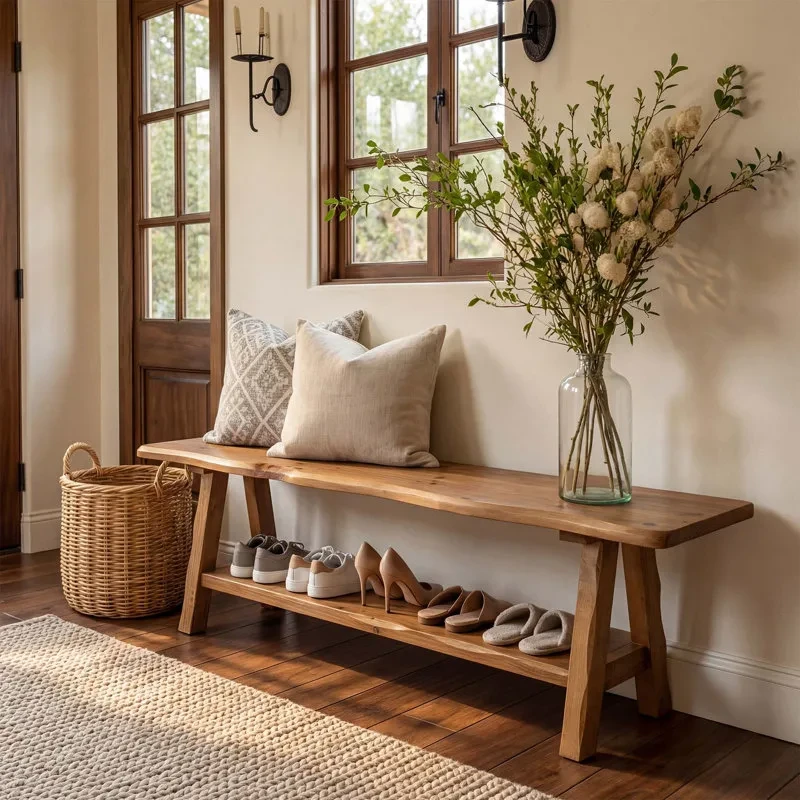
Where do you sit to put your shoes on? For most households the honest answer is the bottom stair or a hop on one foot in the hallway, which is exactly the problem an entryway bench with storage solves. The bench is the workhorse of a functional entry. It gives you a place to sit, a surface to set things down, and hidden storage underneath, all in one piece against the wall.
The trick is choosing the right kind. A bench that looks good but stores nothing, or one with a base too low to use, misses the point. The best entryway bench earns its footprint by combining seating and storage in a form that fits the way you actually move through the door.
Key Takeaways
- The best entryway bench combines seating with hidden storage in one footprint.
- Lidded benches hide the most but are slower to access daily.
- Cubby and basket benches keep shoes visible and easy to grab.
- Open base benches read lightest and suit small or narrow entries.
- Match seat height to comfort, around eighteen inches, and depth to your walkway.
The Bench as a Landing Zone
A bench works because it gathers several entry needs into one spot. You sit to handle shoes, you drop a bag on the seat, and the base below absorbs the footwear that would otherwise pile up by the door. Place a tray on one end and the bench also becomes a landing surface for keys and mail.
This consolidation is why a bench often does more for an entry than a console of the same size. A console gives you a surface but no seating and no shoe storage, while a bench delivers all three. In a household where shoes are the main clutter, the bench is the more useful piece.
The bench also defines the entry zone visually, anchoring one wall and giving the space a clear function. Even in a home where the door opens into a larger room, a bench against the nearest wall reads as the spot where arriving and leaving happen.
Which Type of Storage Bench Should You Choose?
Storage benches fall into three broad types, and the right one depends on how much you want to hide versus how quickly you need to grab things. Each makes a different trade between concealment and ease of access.
| Bench type | Storage | Best for | Trade off |
|---|---|---|---|
| Lidded seat | Hidden under the lid | Hiding clutter, seasonal items | Slower daily access |
| Cubby or basket base | Open shelves with bins | Daily shoes, busy households | Visible, needs tidy baskets |
| Open base, low shelf | Single low shelf | Small or narrow entries | Less total storage |
| Hall tree with bench | Bench plus hooks and shelf | No closet near the door | Larger footprint |
Lidded benches
A lidded bench hides everything under the seat, which keeps the entry looking clean. The trade is access, since you have to clear the seat and lift the lid to reach what is inside. This makes lidded storage ideal for seasonal gear and overflow rather than the shoes you grab every morning. Look for a soft close or stay hinge so the lid does not slam shut on a hand.
Cubby and basket benches
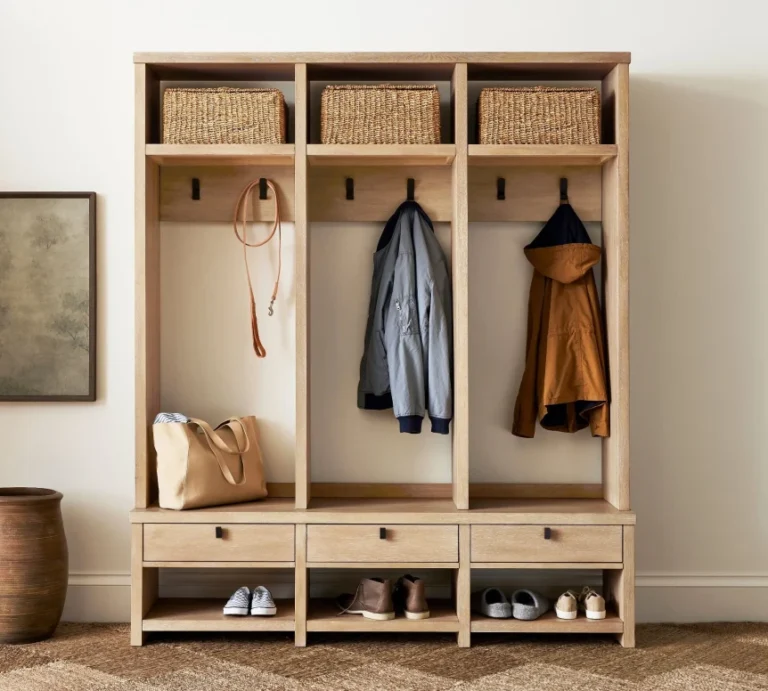
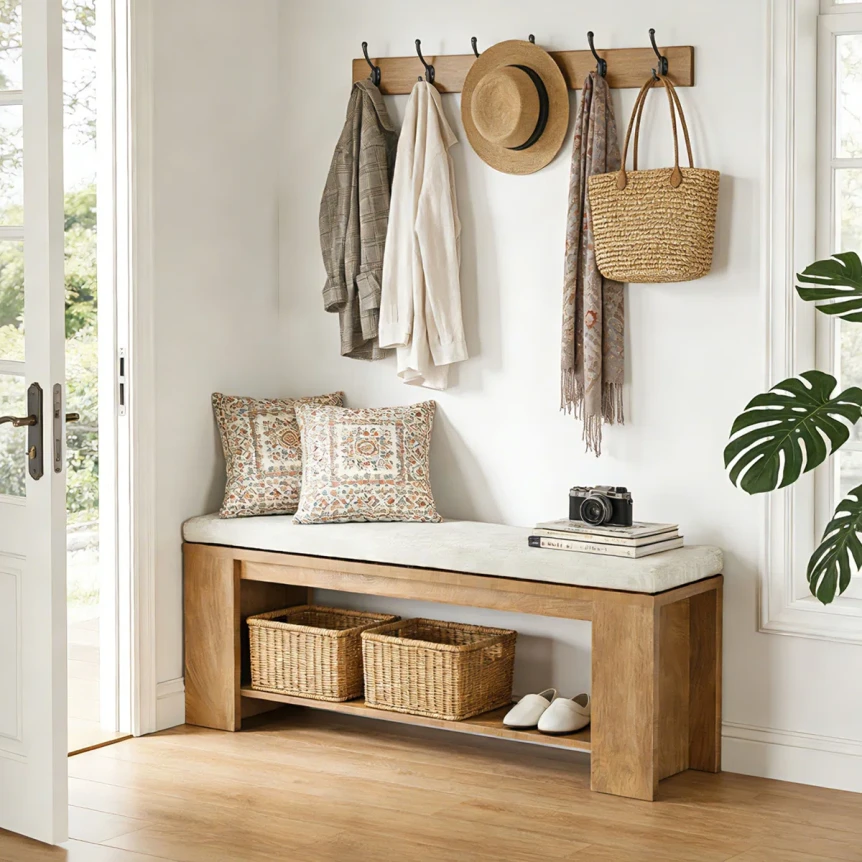
A bench with open cubbies or pull out baskets keeps daily shoes visible and easy to grab, which suits a busy household. The downside is that open storage shows its contents, so it stays tidy only if the baskets do. Matching baskets in a natural weave or felt keep the look calm even when the cubbies are full. For most families this is the most practical type.
Open base benches
An open base bench with a single low shelf reads lightest and suits a small or narrow entry where a bulky piece would crowd the path. It stores less, but the visual airiness can be worth more than the lost capacity in a tight space. This is the type that overlaps most with our small entryway ideas.
How to Size an Entryway Bench
Comfort and clearance drive the sizing. A seat height around eighteen inches suits most people for sitting to handle shoes. Depth should be enough to sit on, roughly fourteen to sixteen inches, but not so deep that it narrows the walkway below the thirty six inches of clear path an entry needs.
Length is flexible, so size it to the wall while leaving breathing room on either side rather than filling the wall corner to corner. A bench that stops short of the full wall reads as intentional and keeps the entry from feeling packed. Measure the walkway first, then the wall, as covered in the complete guide to modern entryway design.
Materials That Last
An entry bench takes daily sitting, dropped bags, and the occasional wet coat, so material matters. Solid wood and sealed engineered wood hold up well and bring warmth, with white oak and walnut among the most durable and forgiving. Powder coated metal frames survive heavy use and suit a more industrial look.
Upholstered tops add comfort but should use a performance fabric that wipes clean, since this is a high contact spot. A removable, washable cushion cover is worth seeking out if anyone in the house arrives with muddy clothes. For the broader range of storage benches that work in an entry and beyond, our roundup of modern storage benches for every room compares specific styles and builds.
If your bench will live in a high mess drop zone, the durability priorities shift toward the modern mudroom approach, where washable materials matter more than a soft seat.
How to Pair an Entryway Bench With Storage and Hooks
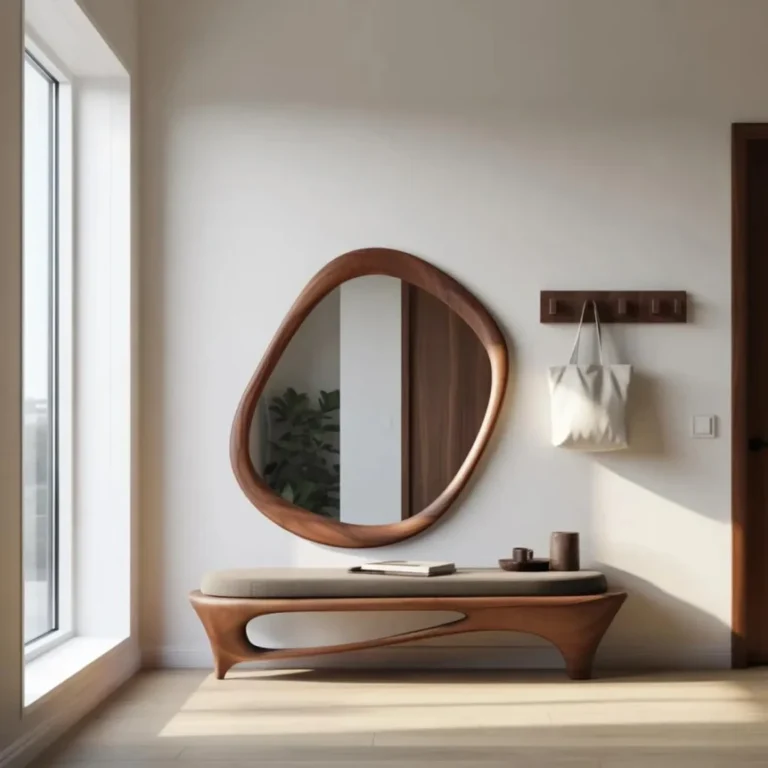
A bench rarely works alone. Pair it with wall hooks above for coats and bags, and the two together cover most of what an entry needs. Add a mirror or a small shelf above the bench and you have the full bench, hook, and mirror trio that anchors most functional entries.
Hang the hooks high enough to clear a hanging coat above the seated head height, generally around sixty four inches, with a lower row near forty four inches for children. Leave a hand’s width between the back of the bench and the hooks so coats do not drape onto the seat.
If you have no coat closet near the door, a hall tree combines the bench, hooks, and a shelf into one freestanding unit. Our hall tree buying guide covers when the all in one design makes more sense than separate pieces.
How Much Should an Entryway Bench Store?
Storage capacity is where benches quietly fail. A bench that holds four pairs of shoes in a household of five generates a pile beside it within days. Before buying, count the shoes that actually live by the door, just the daily pairs rather than the full collection, and choose a base that holds them with a little room to spare.
A rough guide is one open cubby or basket per person for daily shoes, plus a little overflow. Pull out baskets in a bench base typically hold two to three pairs each, while a lidded base swallows more but trades away the easy daily access. For boots and bulky footwear, measure the interior height, since many benches are sized for sneakers and flats rather than tall boots.
If the daily shoe count outgrows the bench, pair it with a separate shoe cabinet or a row of bins rather than forcing everything into one piece. A slim shoe cabinet beside the bench keeps the seat clear and the storage closed, and the two together handle a larger household than a single bench can. The bench stays a place to sit, and the cabinet takes the volume.
Where Should an Entryway Bench Go?
A bench works best on the first clear wall inside the door, where it is easy to sit and reach the hooks above. Centered on its wall with a clear approach, it invites people to sit and use the storage, while one crammed into a corner tends to get bypassed. Give it enough room that swapping shoes feels natural rather than cramped.
Keep the bench off the direct line of travel so it never blocks the path. Against the wall and parallel to the flow, it stays out of the way while remaining within reach. In an open plan entry, a bench can sit just to the side of the door, anchoring the arrival zone without intruding on the room beyond.
Leave clearance in front of the bench for legs and for the act of sitting, ideally a couple of feet of open floor. A bench you cannot comfortably sit at is just a shelf, so protecting that approach space is what keeps it functional.
Common Bench Mistakes
- Choosing a bench too deep for the walkway, which blocks the path.
- Picking a lidded design for daily shoes, then never lifting the lid.
- Using open baskets without committing to keeping them tidy.
- Setting the seat too low to sit on comfortably.
- Hanging hooks so close behind the bench that coats fall onto the seat.
- Filling the entire wall and leaving the entry feeling packed.
Match the bench to your real habits rather than the photo that sold you on it. A household that kicks off shoes daily wants open access, while one that craves a clean look wants a lidded seat. For how the bench fits the larger plan, return to the modern entryway design guide, and for the styled surface alternative, see our console tables for modern entryways.
Frequently Asked Questions