Entryway Lighting: First Impressions in Three Layers

By Tereza Hower | Published June 3, 2026 | Updated September 7, 2026
A single overhead light is the most common entryway mistake and the easiest one to fix. One fixture casts flat, even light that shows you the space without ever making it feel warm, which is exactly backward for the spot where you greet guests and start every departure. The best entryway lighting ideas borrow the same three layer logic used in well lit living rooms and apply it to a few square feet, so the entry feels welcoming the moment the door opens.
Three layers sounds like a lot for a small space, but each one is modest. An ambient source overhead, a task light at the surface where you find your keys, and a low accent for the evening. Together they replace the flat overhead glare with depth and warmth, and the difference is immediate.
Key Takeaways
- Layer three light sources in an entry: ambient overhead, task at the surface, and a low accent.
- A single overhead fixture flattens the space and casts no warmth.
- Use warm white bulbs around 2700 to 3000 kelvin for an inviting entry.
- Wall sconces save space when there is no surface for a lamp.
- Hang a pendant so the bottom clears head height in the walking path.
Why Three Layers Beat One Overhead Light
A single overhead light flattens a space because it comes from one direction with one intensity. Shadows fall hard, corners go dark, and the room reads as functional rather than warm. Layering light from different heights and directions fills those shadows and gives the space dimension.
The three layer method is the foundation of good lighting throughout the home, and an entry is small enough to make it easy. You are not adding a dozen fixtures, just two modest sources beyond the overhead, each doing a specific job. The result feels designed rather than merely lit.
Our complete guide to lighting every room covers the full method, and the same principle drives the approach in our living room lighting guide and home office lighting guide.
Layer One: Ambient Light Overhead
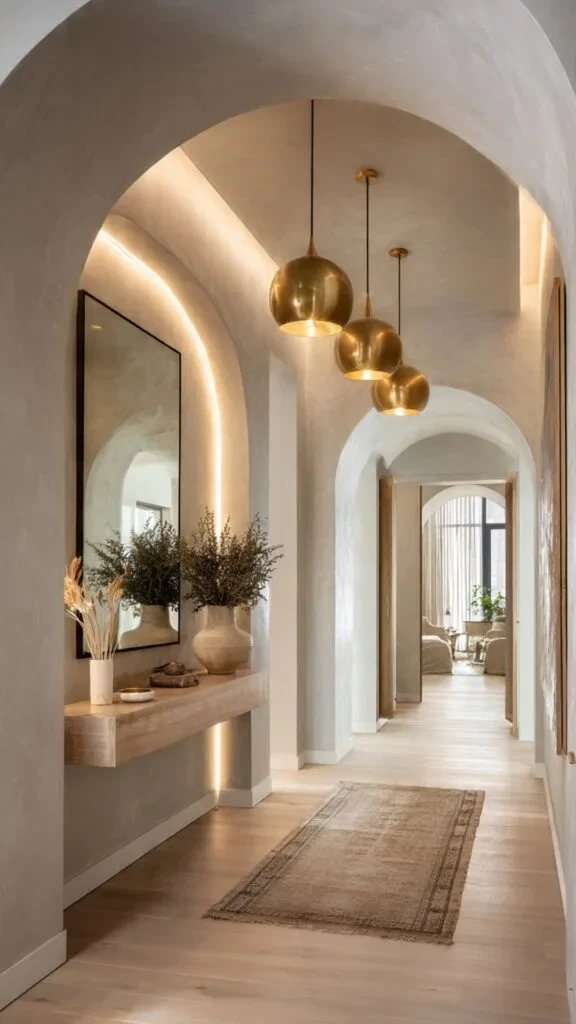
The ambient layer is the general fill that lets you see the whole space. In an entry this is usually a flush mount, a semi flush, or a pendant if the ceiling is high enough. The fixture sets the style tone, so choose one that matches the metal finish you carry through the rest of the entry.
For a standard ceiling under eight feet, a flush or semi flush mount keeps the path clear and avoids a fixture you would knock with a raised arm. If you hang a pendant, keep the bottom of the fixture above head height in the walking path, generally around seven feet from the floor in a passage. In an entry with a tall ceiling or a stairwell, a longer pendant or a small chandelier can fill the vertical volume and become a focal point as you walk in.
Layer Two: Task Light at the Surface
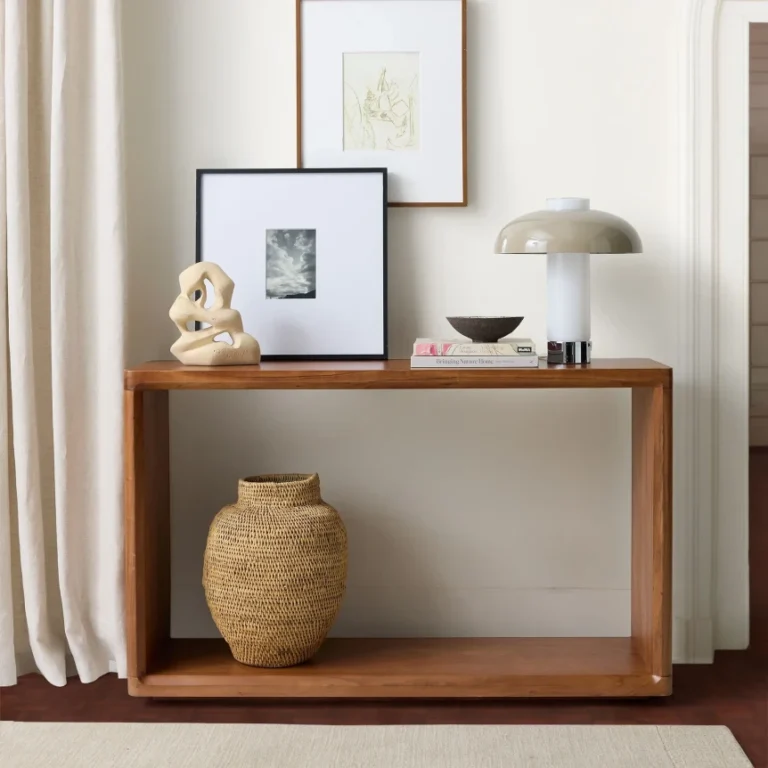
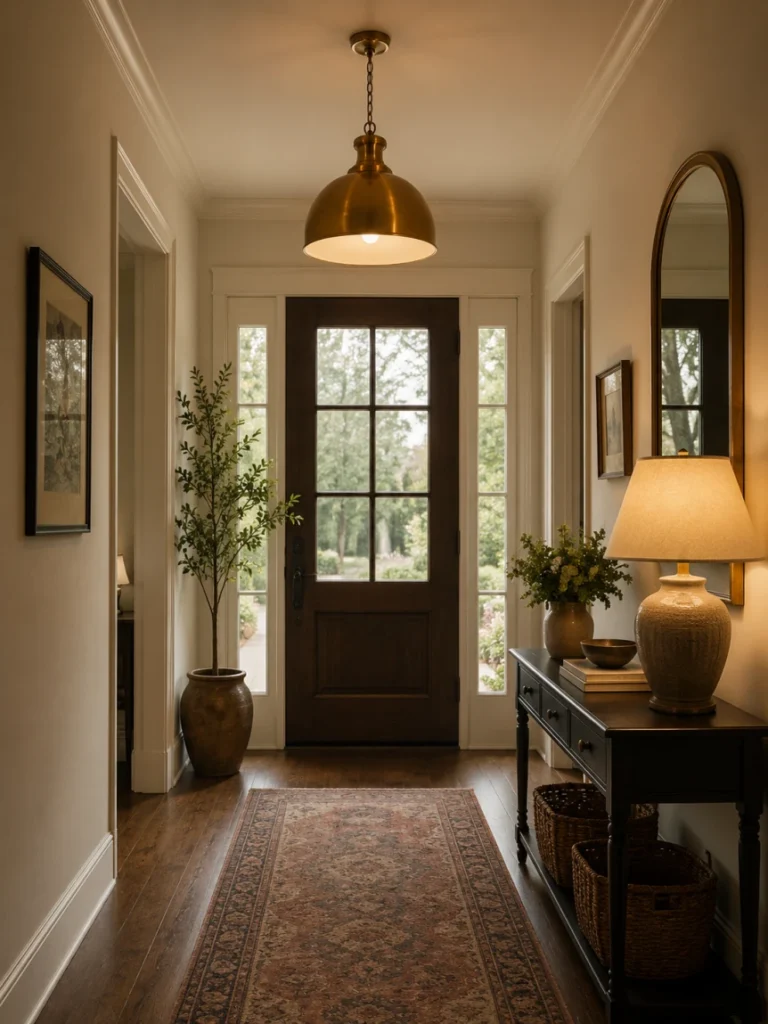
The task layer is the light you actually use, the one that helps you find keys, read a label, or check a coat. A small lamp on the console is the simplest option and adds the warm pool of light that makes an entry feel lived in. A pair of wall sconces flanking a mirror does the same job and frees up the surface.
Sconces are the space saving answer when there is no room for a lamp, since they add a light layer without using any surface. Mount them at roughly eye level, around sixty to sixty six inches, beside the mirror so they light a face rather than the top of the head. This is the layer most entries are missing, and adding it does the most to warm up the space.
If your entry has a console, the lamp does double duty as styling and as task light. The choice of surface piece feeds directly into our guide to console tables for modern entryways.
Layer Three: A Low Accent for Evening
The accent layer is the small touch that keeps an entry from going dark or harsh at night. It can be as simple as a low wattage lamp left on a timer, a small puck light under a bench, or a picture light over a piece of art. The point is a soft glow that welcomes you home in the evening without the full overhead.
This layer is also the one that makes an entry feel hospitable to guests arriving after dark. A warm low light visible through the door reads as welcoming in a way a bright overhead never does. It is the least functional layer and the one that most shapes the mood.
A smart plug or a simple timer makes this layer automatic, so the entry is never fully dark when you walk in. A dimmer on the overhead fixture serves a similar purpose, letting you drop the ambient layer to a soft evening level.
What Bulb Temperature Works Best in an Entry?
Stick to warm white bulbs in the range of 2700 to 3000 kelvin for an entry. This warm tone flatters skin, makes wood and textiles look rich, and reads as inviting. Cooler bulbs above 4000 kelvin push the space toward a clinical, commercial feel that works against the welcome you want at the door.
Pay attention to the color rendering index as well, and choose bulbs rated 90 or higher so colors read true rather than washed out. Keep the temperature consistent across all three layers so the light reads as one warm wash rather than a mix of tones. Mismatched bulb temperatures are a quiet way to make a carefully designed entry feel off without an obvious cause.
Which Fixtures Suit Your Entryway Lighting Ideas?
| Fixture | Layer | Best for | Note |
|---|---|---|---|
| Flush or semi flush | Ambient | Standard ceiling heights | Keeps the path clear |
| Pendant or chandelier | Ambient | Tall ceilings, stairwells | Mind head clearance |
| Table lamp | Task | Entries with a console | Adds a warm pool of light |
| Wall sconces | Task | No surface for a lamp | Mount at eye level by a mirror |
| Picture or puck light | Accent | Evening warmth | Low and soft, often on a timer |
Match the fixture to the layer it serves and to the space you have. A console entry can use a lamp for task light, while a narrow hallway entry leans on sconces. In a tight space, the sconce approach overlaps with our small entryway ideas, where saving surface and floor is the priority.
How Do You Use a Mirror to Boost Entry Light?
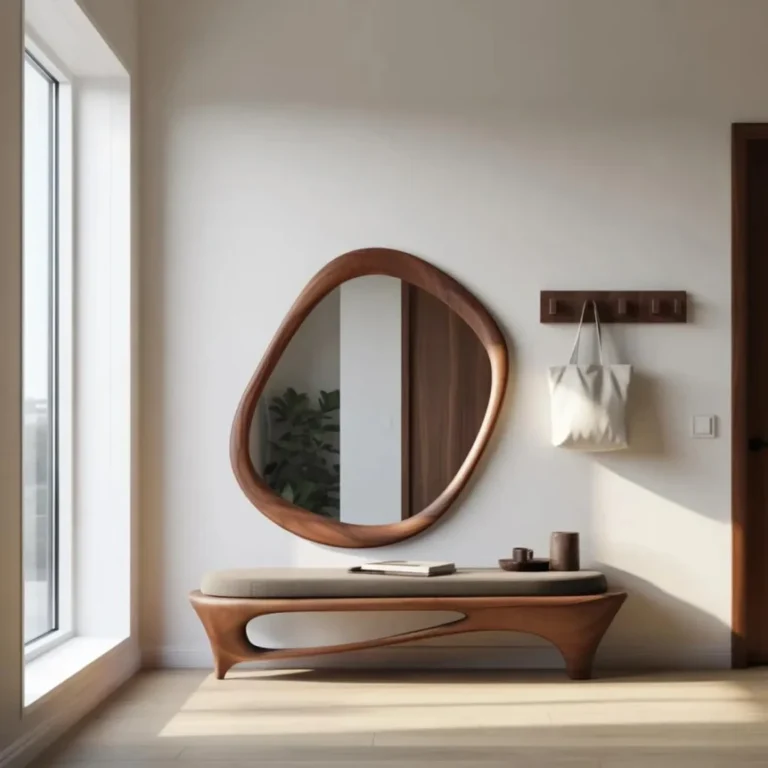
A mirror is a lighting tool as much as a decorative one. Placed opposite or beside a light source, it bounces the existing light deeper into the entry and doubles the apparent brightness without adding a fixture. In an entry with a single window or a lamp, hanging a mirror to catch that light is the cheapest way to brighten the space.
Position matters more than size here. A mirror facing a dark wall reflects only the dark wall, while one angled toward a window or a lamp pulls brightness into the room. Pair the mirror with the task layer and the two reinforce each other, the light source feeding the reflection.
Lighting an Entry Without Overhead Wiring
Not every entry has a ceiling box, and renters rarely get to add one. The three layer approach still works without hard wiring. A plug in pendant or a plug in sconce mounts to the wall and runs a cord to the nearest outlet, hidden with a cord cover painted to match the wall. A floor lamp tucked beside a console adds ambient and task light in one.
Battery and rechargeable fixtures have closed the gap too. A rechargeable table lamp or a stick on puck light gives you a task or accent layer with no wiring at all, useful in a rental or an entry with no convenient outlet. Smart bulbs in any of these let you set a warm evening level on a schedule, so a lack of ceiling wiring is no reason to settle for one flat light.
Should Entryway Lighting Be on a Sensor?
For an entry you walk into with full hands, a motion sensor or a smart switch earns its place. A sensor turns the light on as you step through the door, so you are never fumbling for a switch with an armful of bags. It also handles the evening accent automatically, keeping the entry from ever being fully dark.
A smart switch or smart bulb adds a schedule, dropping the overhead to a soft level after dark and bringing it up in the morning. For a rental where rewiring is off the table, a smart bulb in the existing fixture and a plug in lamp on a timer cover the same ground without touching the wiring.
Common Entryway Lighting Mistakes
- Relying on a single overhead fixture and nothing else.
- Choosing cool white bulbs that make the entry feel commercial.
- Hanging a pendant too low in the walking path.
- Mixing bulb temperatures across the layers.
- Using a low color rendering bulb that washes out wood and textiles.
- Forgetting an evening accent, so the entry goes dark or harsh at night.
Lighting is the highest leverage change you can make in an entry, often more than the furniture. For how lighting fits into the full picture of layout, storage, and materials, start with our complete guide to modern entryway design. If your entry doubles as a working drop zone, our modern mudroom design guide covers lighting weighted toward function.
Frequently Asked Questions