Living Room Ideas: Sofa, Rug, Paint and Light Picks That Work

By Tereza Hower | Published September 21, 2026
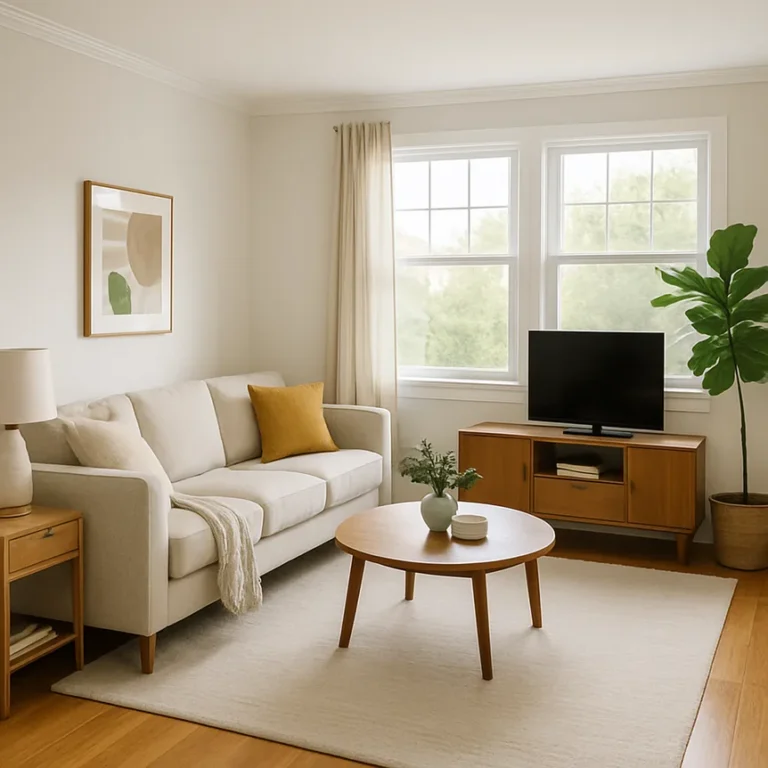
Most living rooms are furnished in the wrong order. The sofa arrives first because it is the biggest purchase, the rug comes months later in whatever size was on sale, and the paint is picked last to match both. The living room ideas below keep that sequence but fix the sizes, the materials, and the colors, so the pieces stop working against each other.
This is the piece by piece version: what to buy, which materials hold up, which paint colors to name at the counter, and what to do in a room with no ceiling light. The site’s buying guides are linked where a piece needs more than a paragraph, and the complete guide to modern living room design covers the principles behind each choice.
Key Takeaways
- Buy in this order: sofa, rug, lighting, paint, then tables and art, because each one sets the size of the next.
- An 8 by 10 foot wool rug with the sofa’s front legs on it fixes more living rooms than any other single purchase.
- Benjamin Moore White Dove is the one paint color to name when a living room needs a single safe answer.
- A room with no ceiling light needs three plug in sources at three heights, all on warm 2700K bulbs.
- Skip the matched living room set; a sofa plus one chair in a different material looks more expensive for less money.
How Do You Start Decorating a Living Room?
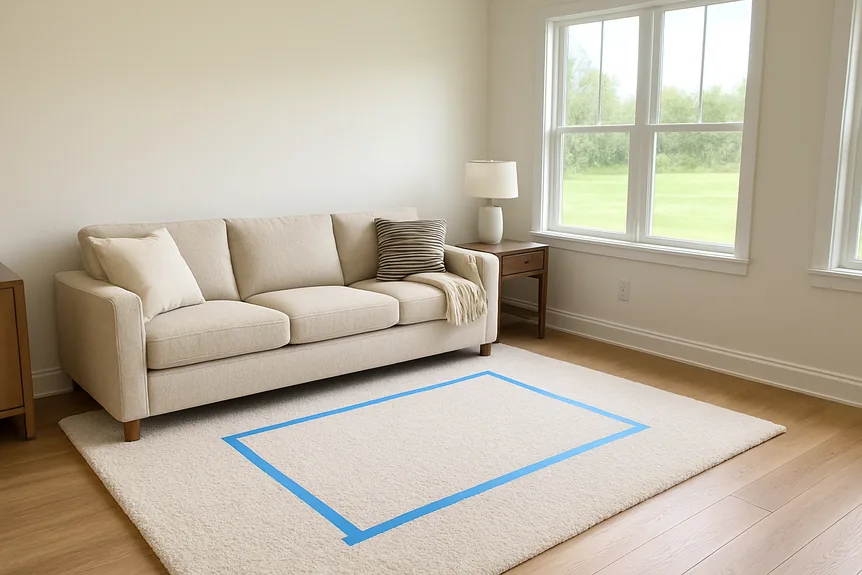
Decorating a living room means fixing four decisions in order: the sofa and where it sits, the rug that anchors it, the light sources that replace or soften the ceiling fixture, and the wall color that ties the three together. Everything else, from tables to art, is sized against those four. Buying in that order avoids the most expensive mistake in the room, a rug that is too small for a sofa already in place.
Before anything is ordered, mark the sofa footprint on the floor with painter’s tape and walk around it for a day. Leave 30 to 36 inches for any path through the room, 14 to 18 inches between sofa and coffee table, and at least 24 inches between the sofa and a facing chair. A 90 inch sofa looks fine on a screen and blocks a doorway in a 12 by 14 foot room.
The tape also settles the layout early. In most rooms the sofa faces the longest uninterrupted wall, not the television, and the television goes where the sofa can see it. For the softer, layered version of the same room, the guide on how to style a cozy living room works through the same room from the textiles inward.
Living Room Ideas Piece by Piece
The pieces below are listed in buying order, with the sizes and materials that separate a piece worth owning from one that only photographs well. Prices are context, not recommendations.
The Sofa: Frame and Depth Before Fabric
A three seat sofa runs 84 to 90 inches long, and the seat depth is the number that matters more than either. A 21 to 22 inch seat suits people who sit upright and read; a 24 to 26 inch seat suits people who put their feet up and watch. Under the cushions, look for a kiln dried hardwood frame with sinuous or eight way hand tied springs; “engineered wood” is particleboard with a better name.
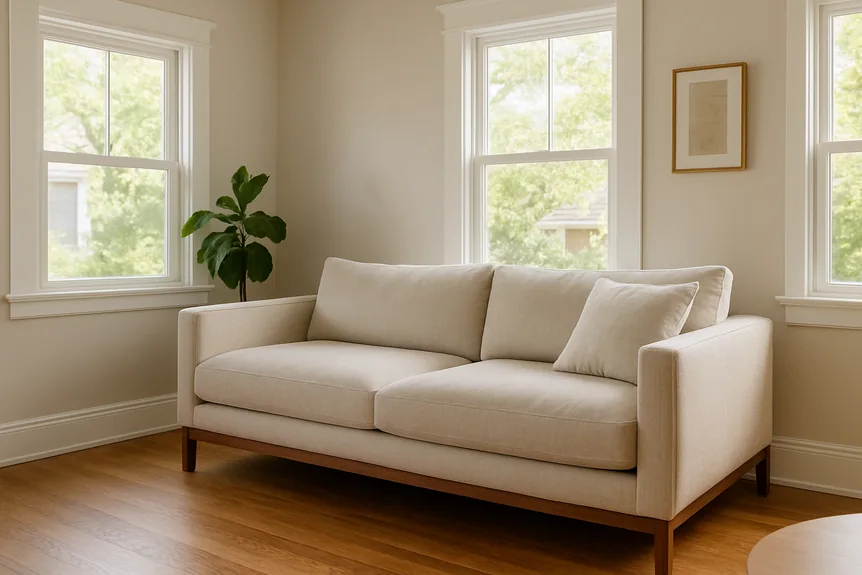
Sit on it before buying it. This is the part most people skip when shopping online, and the part I always made customers do in person. Expect $1,200 to $2,500 for a frame built to last, and read the sofa buying guide for the cushion fills and fabric grades before spending more.
Coffee and Side Tables: Sized to the Sofa
A coffee table should be about two thirds the length of the sofa and within two inches of the seat height, which usually means 16 to 18 inches tall. The material does more than the shape: a solid white oak top, a slab of honed travertine, or a blackened steel base under glass each set a different tone at the same price. Side tables sit level with the sofa arm, 22 to 26 inches tall, one on each end.
Storage That Does Not Look Like Storage
A low credenza, 60 to 72 inches wide and 28 to 32 inches tall, does the work of three baskets and a bookcase without the visual noise. Solid walnut or white oak with closed doors is the version worth paying for; a veneered version in the same species costs about half and shows wear at the door edges within a few years. Under the television or behind a floated sofa, it also gives lamps and art a surface.
| Piece | What to look for | Material or color | Price band |
|---|---|---|---|
| Sofa | 84 to 90 inches, 22 to 24 inch seat depth, kiln dried hardwood frame | Flax linen, wool blend, or performance velvet over walnut or oak legs | $1,200 to $2,500 |
| Rug | 8 by 10 feet minimum, front legs of every seat on it | Wool, hand tufted or hand knotted, in oatmeal, sand, or charcoal | $600 to $1,500 |
| Coffee table | Two thirds the sofa length, 16 to 18 inches tall | Solid white oak, honed travertine, or blackened steel and glass | $400 to $1,200 |
| Floor lamp | Arc or column, shade at 58 to 64 inches, 2700K bulb | Brass or blackened steel with a linen shade | $150 to $500 |
| Wall paint | Warm white, greige, or green gray with a visible undertone | White Dove OC-17, Agreeable Gray SW 7029, Evergreen Fog SW 9130 | $60 to $90 a gallon |
| Credenza | 60 to 72 inches wide, closed doors, 28 to 32 inches tall | Solid walnut or white oak | $900 to $2,400 |
Which Living Room Colors Work Best?
The best living room colors are soft neutrals with a visible undertone: a warm white, a greige, a green gray, or a deep blue held to a single wall of built ins. Pure bright white and a saturated accent wall are the two choices that date a room fastest. The undertone matters because a living room is lit differently at noon and at night, and a color without one reads flat in one and dirty in the other.
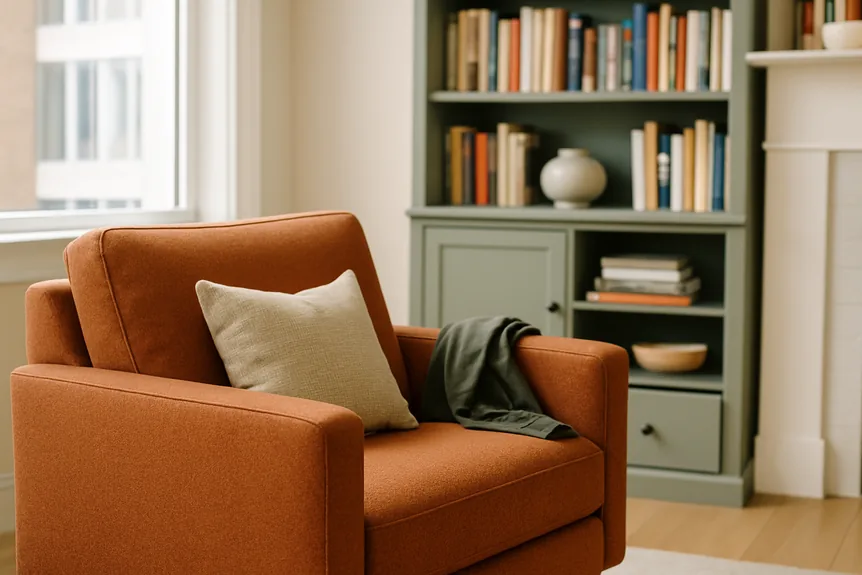
For whites, Benjamin Moore White Dove OC-17 is the default white I recommend when someone needs a single answer; it has a faint gray yellow undertone that keeps it from going cold or creamy. Swiss Coffee OC-45 is the warmer choice for a north facing room, and Chantilly Lace OC-65 is the crisp one that only works with strong south light and plenty of wood in the room.
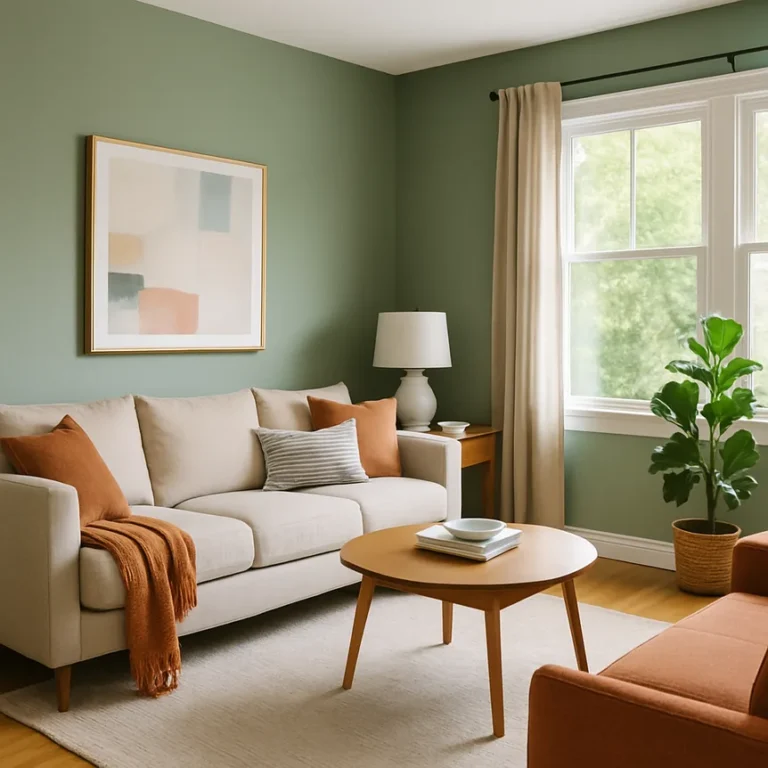
Past white, the reliable living room paint colors are Sherwin Williams Agreeable Gray SW 7029 for a greige that does not go purple, Farrow and Ball Pigeon for a gray green that flatters oak and brass, and Sherwin Williams Evergreen Fog SW 9130 for a deeper green that still reads as a neutral. Benjamin Moore Hale Navy HC-154 belongs on a bookcase wall or the inside of built ins, never on all four walls of a room under 200 square feet. The modern color schemes for living rooms guide pairs each of these with accent colors and a 60-30-10 split.
Sample every candidate on a 2 by 2 foot board, two coats, and move it around the room over a full day. A chip that looks right in the store reads a full shade darker on a whole wall, and a warm color at noon can go green at dusk under LED bulbs.
Best Living Room Rugs: Material, Size and Placement
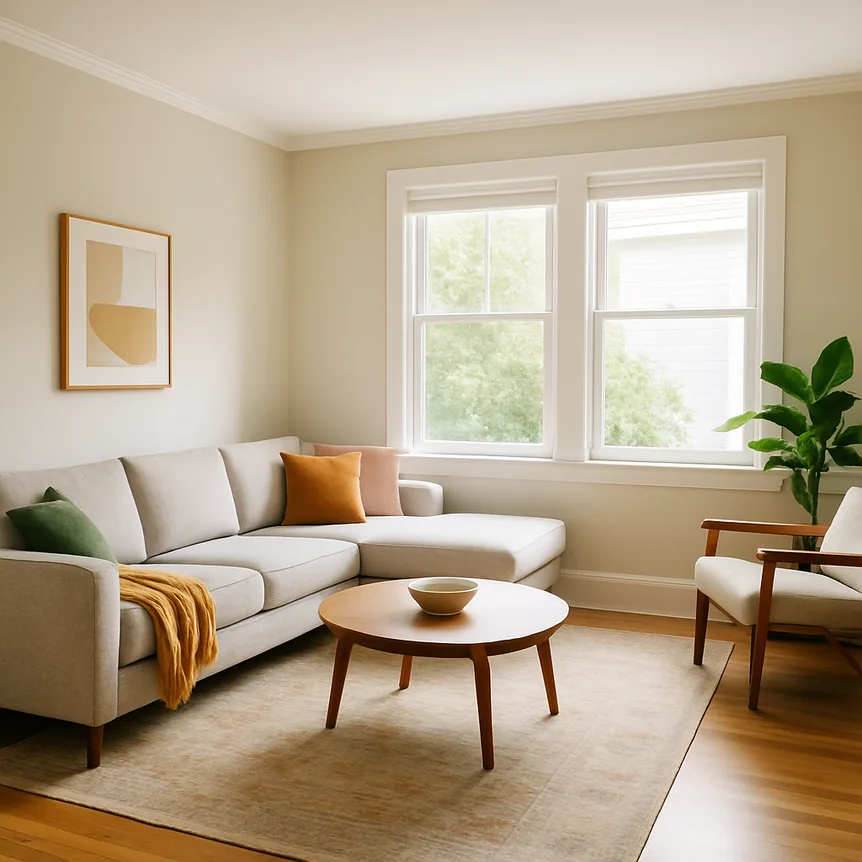
The best living room rugs are wool, sized so the front legs of every seat sit on them, with 12 to 18 inches of bare floor showing at the walls. For a standard three seat sofa that means 8 by 10 feet as the minimum and 9 by 12 feet for a sectional or a room over 250 square feet. A 5 by 8 foot rug floating in front of the sofa is the single most common reason a living room looks smaller than it is.
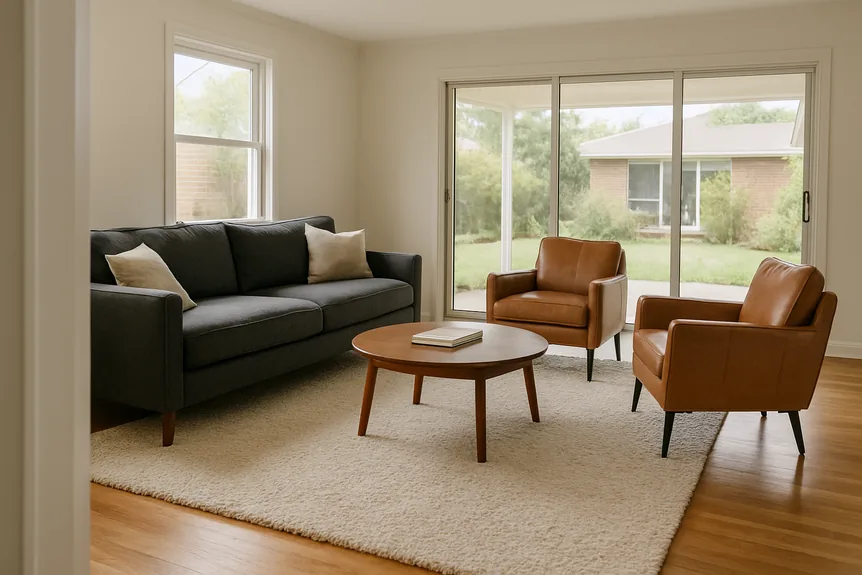
Wool holds up because the fiber springs back under furniture legs and hides soil in its texture; expect $600 to $1,500 for a hand tufted 8 by 10 and two to three times that for hand knotted. Jute and sisal bring texture at half the price but shed and stain, so they work best layered under a smaller wool rug. Polypropylene is the one to avoid: it photographs well, then flattens and takes on a sheen along the walking path within a year.
An oatmeal, sand, or charcoal ground with a low contrast pattern hides the most and dates the least; a strong graphic pattern is a commitment the sofa and art then have to work around. The roundup of modern area rugs covers weave types, pile height, and which patterns survive a change of sofa.
What If the Living Room Has No Ceiling Light?
A living room with no ceiling light is lit from three plug in sources at three different heights: a floor lamp beside or behind the sofa, a table lamp on each side table, and one wall mounted source such as a plug in sconce or a picture light. Three sources at 2700K, each on a dimmer plug, make a room that looks better at night than most rooms with a single overhead fixture. Many older apartments have no ceiling box at all, and the fix is layered lamps, not an electrician.
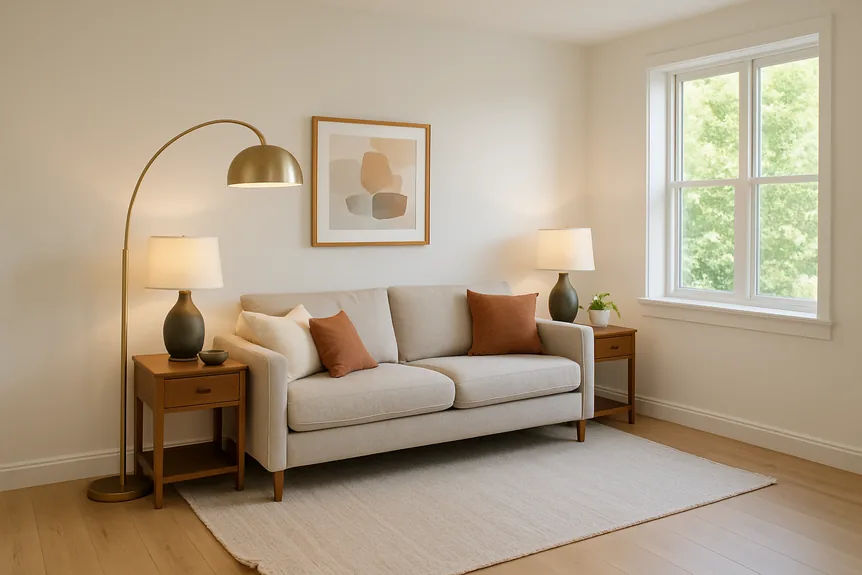
The floor lamp does the most work. An arc lamp reaching over the sofa from behind lights the seating like a pendant would, and a column lamp with its shade at 58 to 64 inches lights a reading corner. Table lamps should be 24 to 30 inches tall so the shade sits at seated eye level, and every bulb in the room should match; mixing 2700K and 4000K is the most common reason a well furnished room feels off at night.
Plug in sconces with a cord cover painted to match the wall, hung at 60 to 66 inches, add the third height. Skip the single bright torchiere; it lights the ceiling and leaves the faces in shadow. The modern lighting guide for living rooms covers bulb lumens, dimmers, and where a ceiling fixture is worth adding when one can be wired.
Small Living Room Ideas and Large Room Ideas
Under 180 Square Feet
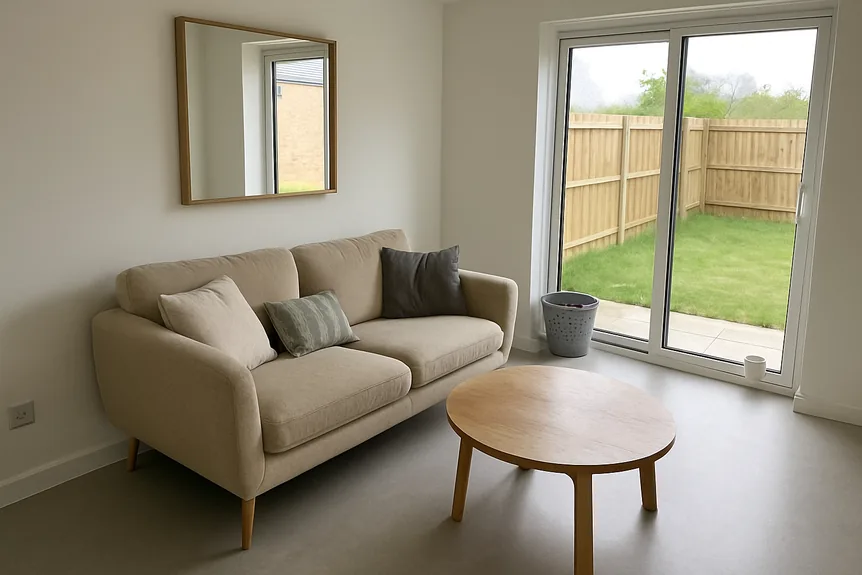
Drop the sofa to 72 to 78 inches and choose one with exposed legs and a low back, so floor and wall show behind it. Use one rug that reaches within a foot of every wall, and swap the rectangular coffee table for a round one 30 to 36 inches across. A single mirror, 30 to 40 inches wide, hung opposite the window does more for a small room than any lamp.
Over 300 Square Feet
Float the sofa off the wall with a console behind it and give the room two seating groups: the main one around the coffee table and a second of two chairs and a small table by the window. Each group gets its own rug, with 36 inches of bare floor between them. A large room with everything pushed to the walls reads as a waiting room no matter how good the pieces are.
Walls and Art, Including the Quote Print
One large piece above the sofa, about two thirds of the sofa’s width with its bottom edge 6 to 8 inches above the back, finishes the wall in a way a cluster of small frames rarely does. If a grid is the plan, use six or nine identical frames 2 to 3 inches apart, centered at 57 to 60 inches from the floor. A round mirror, 36 inches or more, is the reliable alternative when nothing in the art budget is large enough.
Living room quotes, the typography prints that read “gather” or “home sweet home,” are the one wall idea to skip. They fill the wall without adding anything a visitor has not seen in a hundred other rooms, and they date faster than any paint color. Text worth framing is a letter, a menu, or a page from a book that means something to the people who live there.
What Most People Get Wrong About Living Rooms
The matched living room set is the first thing to skip. A sofa, loveseat, and chair in the same fabric cost more together than a good sofa plus one chair in leather or a contrasting fabric, and the matched version looks like a showroom floor. A search for the best living room sets almost always ends better with a sofa bought alone and a chair bought a month later, once the sofa’s scale is known.
The second mistake is the rug bought to fit the budget rather than the room. The third is pushing every piece against a wall in a room large enough to float the sofa; a sofa 12 inches off the wall with a lamp behind it gives the room depth that no art can. The fourth is one overhead fixture on full brightness and nothing else, which flattens every surface and every face.
The last is the accent wall, which draws the eye to a wall rather than to the room and then dictates every cushion and rug that follows. If a room wants color, put it on the built ins, in a rug, or in one upholstered chair, where it can be changed without a repainting weekend.
Where to Go Next
Start with the tape on the floor, then the sofa, then the rug that fits it, and the rest of the room falls into place with fewer regrets. For the principles behind each choice, and how they shift across Japandi, Scandinavian, mid century, and industrial rooms, the guide to modern living room design is the longer read.
Frequently Asked Questions
Is living room one word or two?
Two words. Living room is written as two words in every major dictionary and style guide; the single word version appears online but is not standard. The same applies to dining room and family room.
Which direction should a living room face?
South facing rooms get the strongest, warmest light and can carry crisp whites and cooler grays. North facing rooms get even, cooler light and need warmer paint such as Swiss Coffee or a greige. You rarely get to choose the orientation, so choose the paint for it: warm colors for north, cooler ones for south.
What is the best living room paint color if you only pick one?
Benjamin Moore White Dove OC-17. It is a warm white with a faint gray yellow undertone that reads clean in south light and soft in north light, and it works with oak, walnut, brass, and black metal without a color clash.
How big should a living room rug be?
Large enough that the front legs of the sofa and every chair sit on it, with 12 to 18 inches of bare floor at the walls. For a standard three seat sofa that is 8 by 10 feet as a minimum; sectionals and rooms over 250 square feet need 9 by 12.
Do quote prints work as living room wall decor?
Rarely. Typography prints fill a wall without adding anything personal, and they date quickly. One large piece of art or a mirror above the sofa, about two thirds of the sofa width, finishes the wall better. If text matters, frame a real letter or a page from a book instead.