Modern Mudroom Design and Storage

By Tereza Hower | Published June 5, 2026 | Updated October 12, 2026
Half past five on a wet weeknight, and the back door opens on two backpacks, a soaked dog leash, a bag of groceries, and three pairs of boots that have already tracked mud six feet into the kitchen. That moment is the whole brief for modern mudroom design. The room exists to catch that wave at the door, and every choice in it, from the floor tile to the height of the hooks, should be judged on how well it does that.
That priority is what separates a mudroom from an entryway. A front entry is about first impressions and a clean transition; a mudroom is about containment, and when the containment works the space looks composed as a side effect. This guide covers the layout that holds up, what it costs at three budget levels, the materials worth paying for, and how to tell a bench that will last from one that will sag by its second winter.
Key Takeaways
- A mudroom is judged on containment and durability, not presentation.
- The reliable layout stacks a bench, a hook or locker row, and a high shelf against one wall.
- Expect roughly $300 to $900 for a freestanding setup and $3,000 to $8,000 for built in lockers on an 8 foot wall.
- Matte porcelain tile, sealed concrete, or a thick wear layer vinyl are the floors that survive; untreated wood and carpet are not.
- A 36 inch wide nook or a converted reach in closet can run the same system as a dedicated room.
What Is the Difference Between a Mudroom and an Entryway?
A mudroom is a working arrival space, usually at the garage or back door, built to absorb wet gear, dirt, and the daily churn of bags and shoes. An entryway is the front facing version, styled for guests and built around a clean transition into the home. One is designed for containment, the other for presentation.
The dividing line is the door the household actually uses. In most homes that is the garage or back door, not the front, so the working space sees far more traffic than the styled one. Design the busy door as a mudroom and reserve the front entry for arrivals, and both spaces do their jobs.
Plenty of homes have one space that plays both roles. When that is the case, go with mudroom durability first and add a few entry touches, since function should win at the door you use every day. The framework for the styled side lives in our complete guide to modern entryway design.
What Layout Works for Modern Mudroom Design?
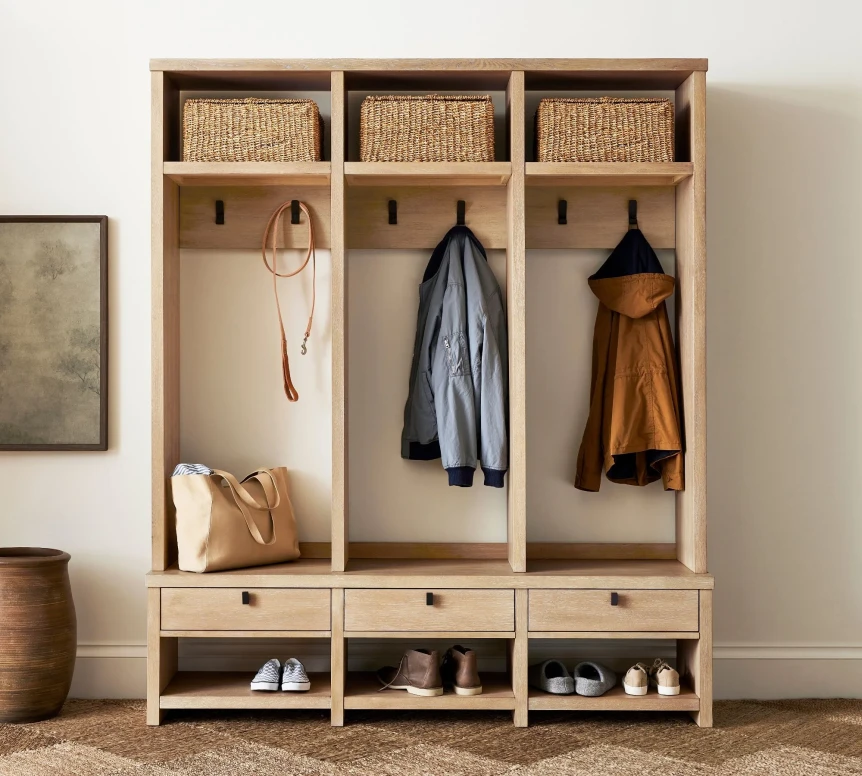
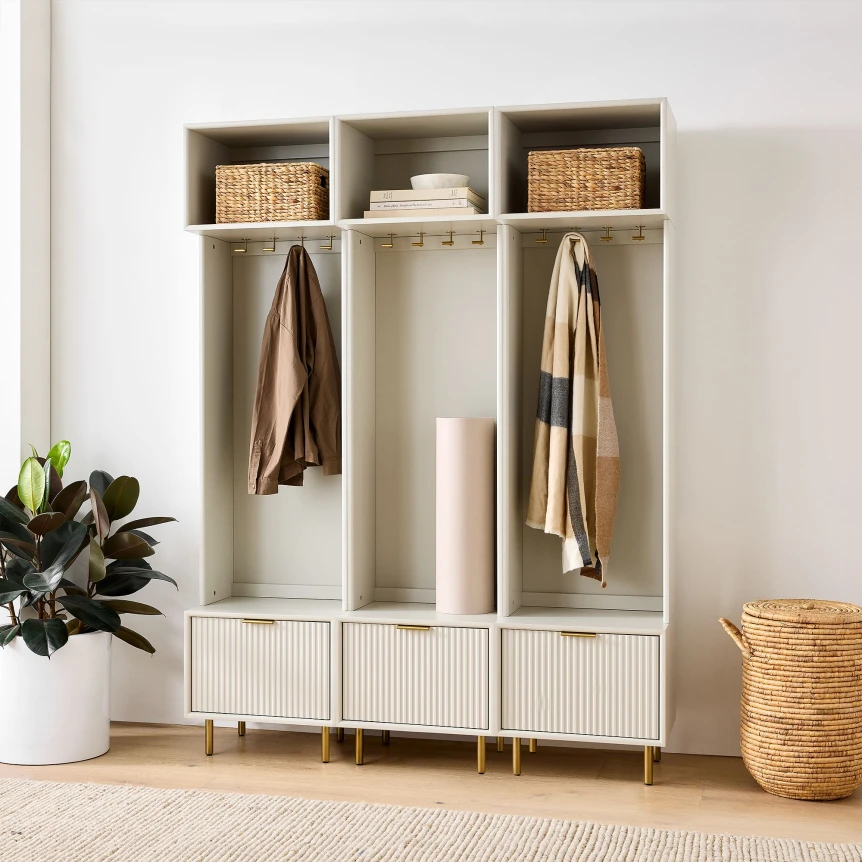
The layout that holds up stacks three zones vertically against a single wall. A bench at the bottom for sitting and shoe storage, hooks or lockers in the middle for coats and bags, and a shelf or closed cabinet on top for seasonal overflow.
A mudroom locker is a tall, open fronted cubby, typically 15 to 18 inches wide and 72 to 84 inches tall, assigned to one person and fitted with a hook rail, a bench section, and a shelf above. The open front is deliberate: doors get left ajar in a busy household, and an open cubby with a basket reads tidier than a door that never closes.
Built in lockers give each person a defined cubby, which is the cleanest solution for a busy household because everyone knows where their gear lives. Allow 15 to 18 inches of width per person; anything narrower than 14 inches will not take a winter coat on a hanger. If built ins are out of budget, a freestanding bench with a hook rail above and baskets below reproduces the same logic for a fraction of the cost.
Set the bench seat at 18 inches high and 16 to 20 inches deep, which is the depth that fits a boot underneath without a toe catching the front rail. Mount the lower hook row at 44 to 48 inches so children can reach it, and the adult row at 60 to 66 inches. The upper shelf belongs above 70 inches, out of the daily flow, where bulky seasonal items wait until they are needed.
| Layout | Best for | Storage style | Typical cost |
|---|---|---|---|
| Built in lockers | Larger families, dedicated rooms | Closed or open cubby per person | $3,000 to $8,000 for an 8 foot wall |
| Semi custom modular units | Mid size spaces, a wall of 5 to 8 feet | Matched bench, hook panel, upper cabinets | $1,200 to $3,000 |
| Bench plus hook rail | Most homes, any wall over 4 feet | Open hooks, under bench bins | $300 to $900 |
| Wall system in a nook | Closet sized or hallway spaces | Vertical hooks and shelves | $150 to $500 |
| Freestanding hall tree | Renters, no build options | All in one unit | $200 to $600 |
How Much Does a Mudroom Cost?
The price bands in the table are wide because the same layout can be built three ways. Custom built in lockers in painted maple or poplar run $3,000 to $8,000 for an 8 foot wall, and the high end of that range buys drawers under the bench and doors on the upper cabinets. Semi custom modular units, sold as matched bench, hook panel, and upper cabinet pieces, land between $1,200 and $3,000 and install in a day.
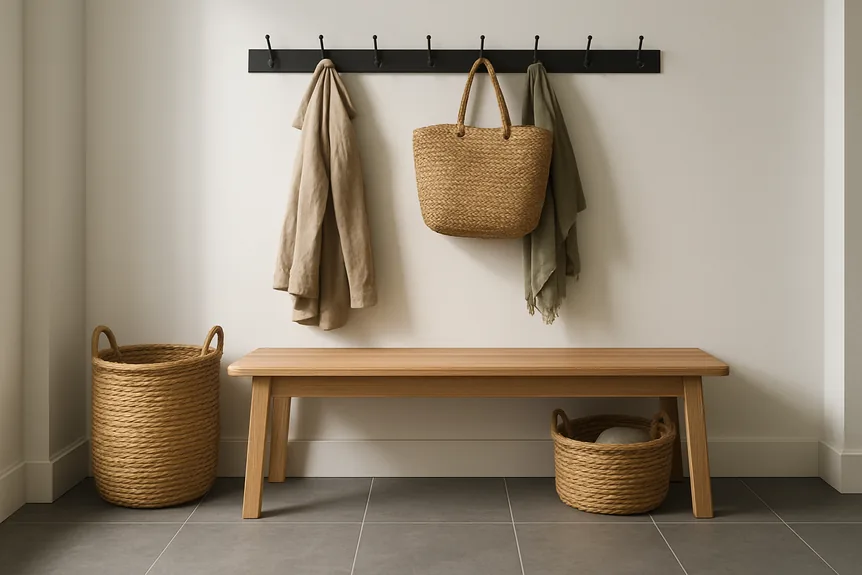
The freestanding tier is where most households should start. A solid wood bench at $250 to $500, a hook rail at $40 to $120, and three or four baskets cover the essentials for under $900 and can move to the next house. Spend the rest on flooring and a wall treatment, which do more for the room’s longevity than a custom cabinet face.
Live with the freestanding version for a season before committing to built ins. It tells you which hooks get used, whether the bench sits where the door swing allows, and how many cubbies the household really fills. Skip the trial and the risk is a locker wall built for the imagined family is the most expensive mudroom mistake to undo.
Which Materials Hold Up in a Mudroom?
A mudroom lives or dies on its floor. Porcelain tile with a matte or textured surface is the safest choice: look for a PEI rating of 4 or 5 and a 12 by 24 inch format, which means fewer grout lines to scrub. Sealed concrete works in a room off the garage, and luxury vinyl plank with a 20 mil wear layer or thicker is the right answer where tile is too cold or too costly.
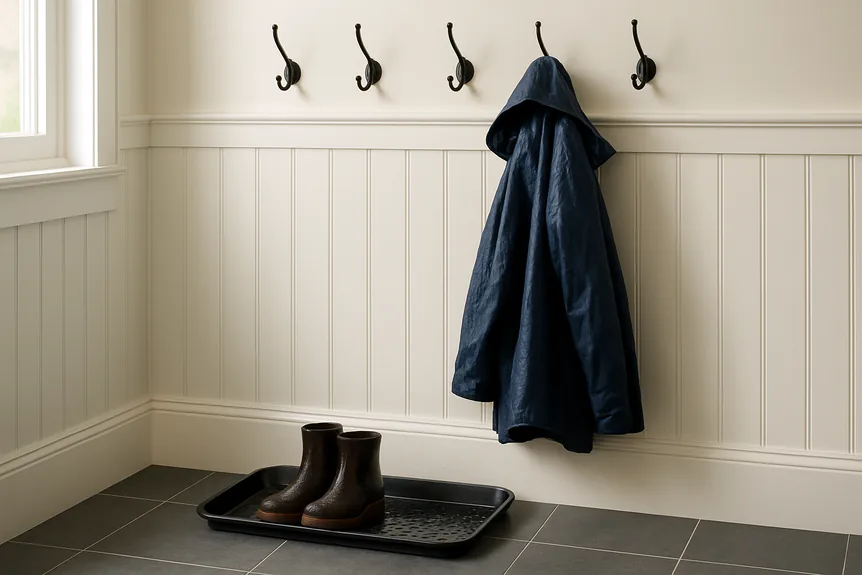
Avoid anything that stains or warps when wet, which rules out untreated wood, laminate flooring, and carpet of any kind. A matte tile also hides grit better than a polished one and is far less slippery underfoot. Put a boot tray or a recessed mat at the door so the water lands in one place instead of everywhere.
The wall behind the hooks takes wet coats every day, so protect it. A beadboard or tile wainscot to 48 inches wipes clean, and above it a satin or semi gloss paint holds up to scrubbing where a flat finish would mark. A warm white such as Benjamin Moore Chantilly Lace OC-65 or Sherwin-Williams Alabaster SW 7008 keeps the room bright without showing every scuff the way a cool white does.
For the bench and storage, sealed hardwood, powder coated steel, and a wipeable laminate face all survive daily use. Hooks should be steel or cast iron screwed into studs rather than drywall anchors, since a wet parka on a hanger can weigh 6 pounds and a loaded school bag twice that. Choose baskets that can be hosed out, and line the shoe cubbies with a removable waterproof tray so the whole system can be cleared at the end of a muddy season.
How to Tell a Quality Mudroom Bench from a Cheap One
Start with what the bench will actually do. In a mudroom the answer is blunt: it will hold two adults pulling on boots, take wet gear underneath, and get kicked every day. A bench that only has to look good in a photo will not survive that, and the difference is visible before you buy.
Check the seat first. A solid wood or 3/4 inch plywood seat will span 48 inches without a center support; a 5/8 inch particleboard seat sags within a year under the same load. Weight is the fastest tell on a showroom floor: a well built 48 inch bench weighs 40 pounds or more, and a hollow one lifts with one hand.
Then look at the joinery and the finish. Screws driven into solid rails and a back panel that is fastened rather than stapled mean the frame will not rack when someone sits on the edge. A conversion varnish or catalyzed lacquer finish shrugs off water; a thin spray finish over paper veneer bubbles at the first wet boot. The same tests apply to the picks in our entryway bench and storage guide, and our roundup of modern storage benches flags which ones pass.
Storage That Earns Its Place
Mudroom storage works when it matches how items actually move through the space. Coats and bags go on hooks because hooks take no effort. Shoes go in open cubbies or under the bench so they are off the floor but easy to grab, and seasonal gear goes up high where it is out of the daily flow.
- Hooks at two heights, 44 to 48 inches and 60 to 66 inches, so adults and children each have a row.
- A bench with cubbies or pull out baskets, one per person, so shoes stay contained.
- A closed upper cabinet for off season gloves, hats, and bulk items.
- A shallow tray or bin for keys, leashes, and the small items that go missing.
- A drop zone with an outlet nearby for phones, headphones, and school devices.
If the mudroom opens into a kitchen or dining zone, a low closed cabinet can bridge the two with extra storage and a clean face. Our sideboard buying guide covers how to choose a low piece that holds up in a high traffic spot. Skip open shelving at eye level; it is the single choice most likely to make the room read as chaos, because a shelf of mismatched bags never looks ordered.
Can a Small Space Work as a Mudroom?
A full mudroom is a luxury of square footage that many homes do not have, and the logic scales down further than most people expect. The vertical stack of bench, hooks, and shelf works in as little as 36 inches of width, the footprint of a single wall beside the back door.
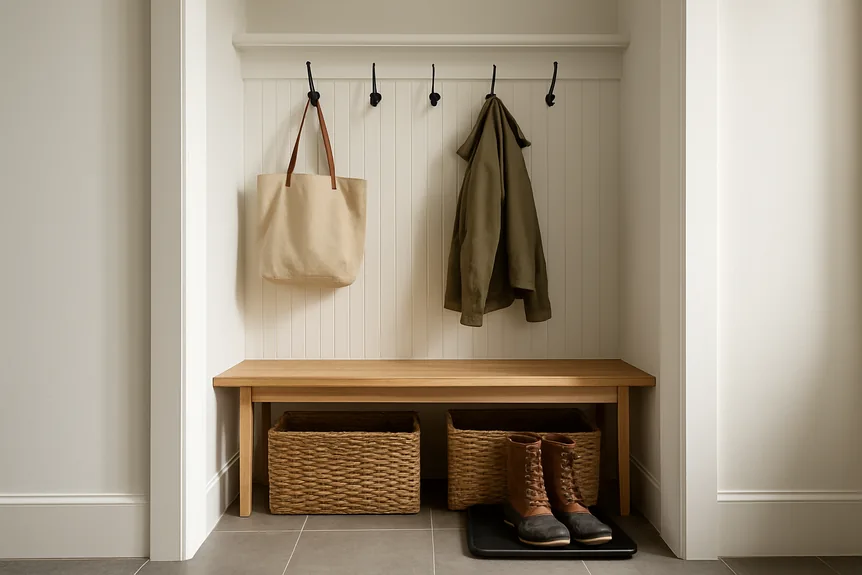
In a tight nook, a bench 36 to 42 inches wide with a hook rail above and two baskets below covers the essentials. A reach in closet near the door converts into a mini mudroom by removing the door, adding a bench at 18 inches, and lining the back wall with beadboard and hooks; budget about $400 to $700 in materials. Renters who cannot build should go with a freestanding hall tree, and our hall tree buying guide sorts the ones with a real bench from the ones that are a coat rack with a shelf.
The principles overlap with our small entryway ideas, since both come down to going vertical and protecting the floor. The difference is that the mudroom version chooses washable materials over styling every time.
How Should You Light a Mudroom?
A mudroom needs more practical light than a styled entry, because you are sorting gear, checking shoes, and finding a lost glove rather than making a first impression. Choose a bright overhead fixture in the 3000K to 3500K range, which reads clean and functional without the blue cast of a garage bulb. Two 4 inch recessed cans or a single flush mount rated around 1,500 lumens is enough for a 6 by 8 foot room.
Add a task light over the bench or an LED strip inside a deep locker so the back corners are not lost in shadow. The layered approach from our entryway lighting ideas applies here, weighted toward function over mood. Put the main fixture on a motion sensor, since this is a room you walk into with both hands full.
Where Should a Mudroom Go in the Floor Plan?
The best mudroom sits between the door the household uses most and the kitchen, since that is the path groceries, bags, and people travel every day. A spot just inside the garage or back door catches the mess before it reaches the living areas. A route past the laundry room is a bonus.
Plan for the door swing and the traffic flow. A 36 inch door needs its full arc clear of the bench, and two people should be able to pass in the remaining aisle, which means leaving at least 36 inches between the bench front and the opposite wall. A mudroom where the door hits the bench becomes a daily bottleneck within a week.
Common Mudroom Mistakes
- Choosing flooring that stains or warps when it gets wet, which it will.
- Relying on open shelves at eye level, so the space always looks chaotic.
- Hanging every hook at adult height, so children drop coats on the bench instead.
- Skipping the boot tray, so mud and water spread across the floor.
- Leaving the wall unprotected behind wet coats and hooks.
- Building lockers for the imagined household instead of the real one.
The mudroom rewards planning for the messiest realistic day, not the tidy ideal. Build for wet boots and overflowing bags and the space will handle an ordinary day without effort. Leave one empty hook and one open cubby per person; that slack is the difference between a system that holds through a rainy week and one that spills onto the floor by the first storm.
For the styled, front facing counterpart to all of this, our modern entryway design guide covers the console, the mirror, and the arrival moment the mudroom is there to protect.
Frequently Asked Questions
How wide should a mudroom locker be?
Allow 15 to 18 inches per person. A 14 inch cubby is the minimum that takes a winter coat on a hanger, and 18 inches leaves room for a bag beside it. A wall of four lockers therefore needs 60 to 72 inches, plus a few inches for end panels.
What is the best flooring for a modern mudroom?
Matte porcelain tile with a PEI rating of 4 or 5 is the most durable choice, followed by sealed concrete and luxury vinyl plank with a 20 mil or thicker wear layer. Avoid untreated wood, laminate flooring, and carpet, all of which stain or warp when wet.
How much does a built in mudroom cost?
Custom built in lockers typically run $3,000 to $8,000 for an 8 foot wall, depending on drawers, doors, and paint. Semi custom modular units cost $1,200 to $3,000, and a freestanding bench, hook rail, and baskets can be done for under $900.
Can you add a mudroom to a house that does not have one?
Yes. A 36 inch wide wall beside the back door, a reach in closet with the door removed, or the end of a hallway can hold a bench, hooks, and a shelf. Converting a closet costs roughly $400 to $700 in materials.
Should a mudroom have a door to the rest of the house?
A door or a half wall helps contain dirt and noise, but it is optional. What matters more is a threshold that separates the wet floor from the dry one: a change in flooring material and a recessed mat do most of the containment work.